Iran's Uranium Has Been Off the IAEA's Chart for 17 Months. The NPT Exit Debate Misses That
TL;DR
- At the IAEA Board of Governors meeting that opened in Vienna on November 18, Director General Rafael Grossi said the agency has received no information from Iran on its declared nuclear material and facilities apart from the Bushehr power plant, and cannot verify that declared material has not been diverted.
- The figure every government still quotes, 440.9 kilograms of uranium enriched up to 60 percent, is an estimate for June 13, 2025, the first full day of Israeli strikes. The agency has not been able to verify it since. Inspectors are also unable to say where Iran's declared fourth enrichment plant, at Isfahan, actually is.
- Tehran's debate about leaving the Non-Proliferation Treaty gets the headlines. The question nobody is asking is what an exit would change, when the treaty's working part, inspection, has been absent from the bombed sites since June 2025 and limited to a single declared site since February.
Rafael Grossi has given versions of this speech before, but on Wednesday, November 18, the words carried a different weight. Opening the quarterly meeting of the International Atomic Energy Agency's Board of Governors in Vienna, the Director General told the 35 member states that, apart from the Bushehr nuclear power plant, his agency had received no information from Iran about the status of its declared nuclear material and facilities, and had been denied access to verify them. According to accounts of the statement carried by Anadolu Agency and IranWire, he said the agency had lost continuity of knowledge over Iran's previously declared inventories of uranium enriched up to 60 percent after the military attacks of June 2025.
The report behind that speech, circulated to member states on Friday, November 13, went further. It said the agency "is not able to conclude that there has been no diversion of declared nuclear material from peaceful nuclear activities in Iran." For an organisation whose entire output is a conclusion of exactly that kind, it is close to the strongest sentence it can write. On Iran's Isfahan Fuel Enrichment Plant, a site Tehran declared in June 2025 and inspectors have never entered, the report said, according to Reuters, that "the Agency does not know IFEP's exact location, status for safeguards purposes or whether it contains nuclear material."
A day later, France read a joint statement on behalf of Germany, the United Kingdom and the United States. It noted that since February 2026 the only in-field verification activity in Iran has been at Bushehr, and that "for a year and a half, the Agency has lost continuity of knowledge regarding Iran's previously verified stockpile of high-enriched uranium." Russia's envoy read a rival statement for Russia, China and Iran, saying full inspections depend on an end to military strikes and guarantees that they will not be repeated.
Most coverage of this week will slot it into a familiar frame: the West presses Iran, Iran threatens to walk out of the Non-Proliferation Treaty, and the world waits to see whether Tehran crosses that line. That frame assumes the line still does what people think it does. This piece argues that the more consequential event already happened, quietly and in stages, and that it explains more about where the Iran file goes next than any parliamentary vote in Tehran will. The treaty's legal shell is intact. Its eyes are not.
The last fix: how one number froze in June 2025
Start with the number, because almost everything else rests on it. In September 2025 the IAEA reported that Iran's stockpile of uranium enriched up to 60 percent stood at an estimated 440.9 kilograms as of June 13, 2025, the first full day of Israel's strikes on Iran's nuclear programme. That was 32.3 kilograms more than the agency's previous report in May, according to the Associated Press and Euronews, which both covered the report.
The fine print matters more than the headline figure. The agency said the number was "based on the information provided by Iran, agency verification activities between 17 May 2025 and 12 June 2025, and estimates based on the past operation of the relevant facilities." In other words, even on the day it was fixed, 440.9 kilograms was partly a measurement and partly a projection. Since June 13, 2025, the agency said, it had "not been able to conduct the in-field activities required to collect and verify Iran's declarations."
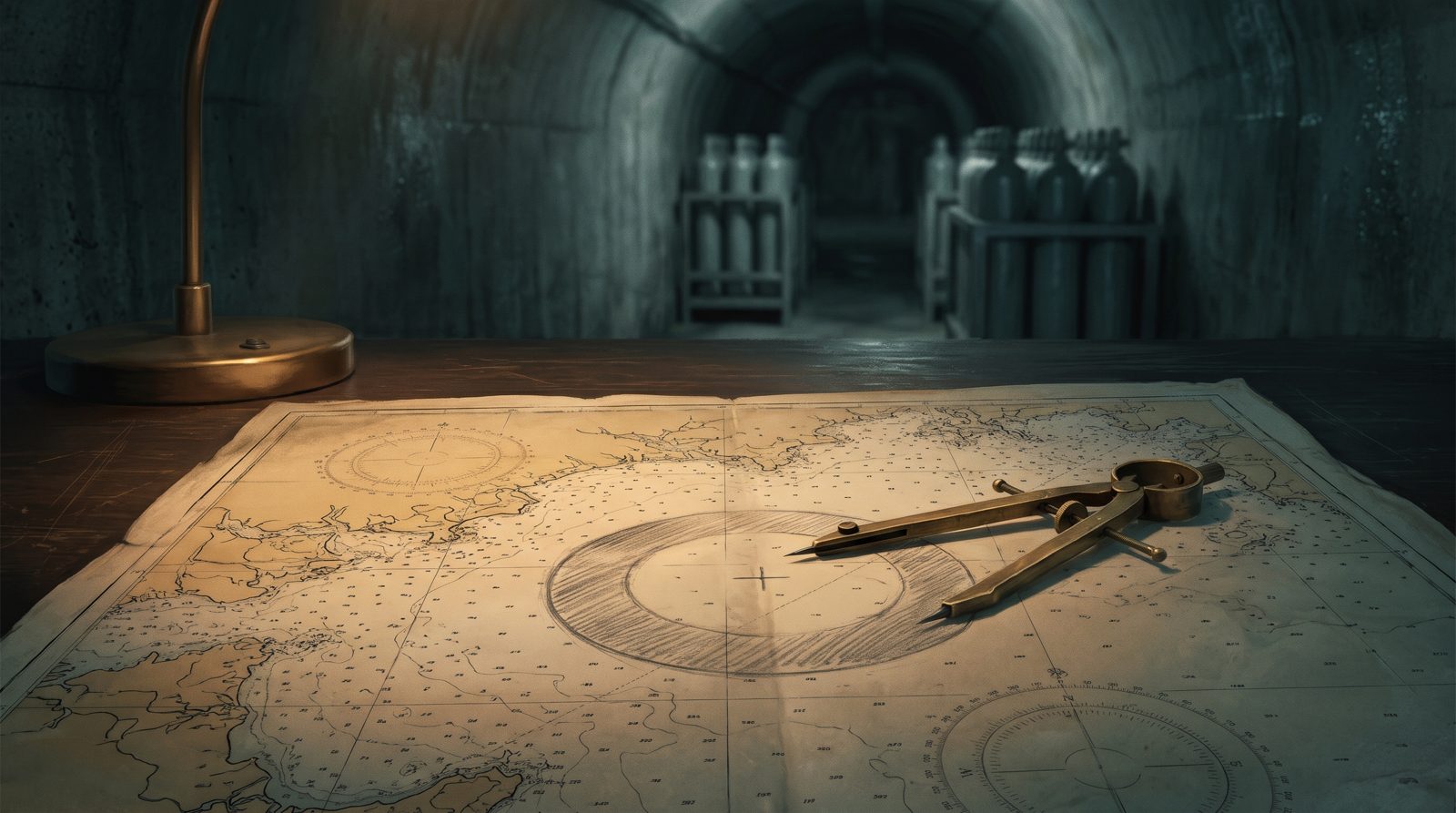
Navigators have a name for what happens next. Before satellite positioning, a ship's officer would take a "fix", a confirmed position from stars or landmarks, and then estimate the ship's location from its speed, heading and elapsed time. That method is called dead reckoning. It works well for a few hours. Over days, small errors in speed or heading compound, and the circle of possible positions on the chart grows wider with every watch. A good navigator draws that circle honestly and does not mistake the pencil mark for the ship.
The 440.9-kilogram figure is a pencil mark from June 2025. Every statement since that cites it, from Washington, Jerusalem, Brussels or Tehran, is dead reckoning from a 17-month-old fix. Reuters now routinely adds a sentence to its stories saying how much of the material "has survived is unclear." Most political rhetoric does not.
The size of the gap becomes clearer against the agency's own routine. Highly enriched uranium is the material safeguards are designed to watch most closely. According to the AP's reporting on the IAEA's guidelines, material of this kind should normally be verified every month. By that yardstick, inspectors have missed roughly 17 monthly checks on Iran's most sensitive inventory. The circle on the chart is not a few miles wide anymore.
Seventeen months, in the order they happened
The blindness did not arrive in a single moment. It accumulated, and the sequence matters because each side tells it differently.
In June 2025, Iran declared a new enrichment plant at Isfahan on June 12. Inspectors planned to visit on June 13, according to Reuters and Grossi's later account to the Security Council. Israel's strikes began that day, the United States joined during the 12-day conflict, and the visit never happened. Inspectors withdrew for their safety, and Iran then suspended cooperation with the agency.
On September 9, 2025, Grossi and Iranian Foreign Minister Abbas Araghchi signed what became known as the Cairo Agreement, under the auspices of Egyptian President Abdel Fattah el-Sisi, meant to set terms for restoring inspections at attacked sites. Grossi was still citing it as a template in October 2026, which suggests how little of it was implemented. Later in 2025, the United Nations sanctions suspended under the 2015 nuclear deal were reimposed after Washington and Tehran failed to agree on restoring the accord, as the Arms Control Association has recounted. Iran, Russia and China have consistently called that snapback legally invalid.
In a letter dated February 2, 2026, cited in an IAEA report seen by the AP, Iran told the agency that normal safeguards were "legally untenable and materially impracticable" because of threats and "acts of aggression." The same AP report described commercial satellite imagery showing "regular vehicular activity" around the entrance to a tunnel complex at Isfahan used to store enriched material. The agency requested access that month. Iran did not grant it.
On February 28, 2026, the current war began with US and Israeli strikes on Iran, according to Reuters and AFP. Supreme Leader Ali Khamenei was killed in the first weeks of the war, The National reported in March, and his son Mojtaba Khamenei succeeded him. In May, two senior Iranian sources told Reuters that the new Supreme Leader had issued a directive that the country's near-weapons-grade uranium should not be sent abroad.
In June 2026, the Board passed a resolution submitted by the US, Britain, France and Germany demanding that Iran account for its enriched uranium and the status of bombed sites. The vote, reported by JNS and the Tehran Times, was 21 in favour, three against (Russia, China and Niger) and 10 abstentions. On September 9, 2026, the Board went further and voted 23 to 3, with eight abstentions, to report Iran to the UN Security Council for non-compliance, the first such referral in 20 years, according to the Arms Control Association, AFP and Arab News.
On October 27, Grossi briefed the Security Council for the first time since that referral. He told the 15 members that "as of today, the IAEA has not been able to verify that there has been no diversion of nuclear material," and that legal obligations "cannot be unilaterally suspended under any circumstances." Then came the November 13 report and this week's Board session.
The turn: the part of the treaty that matters is already switched off
Here is the frame most coverage takes for granted. The Non-Proliferation Treaty is a wall, Iran is standing behind it, and the drama is whether Tehran climbs over. On November 12, Iran's Assembly of Experts, the clerical body that chooses the Supreme Leader, issued a statement saying that "examining the issue of withdrawal from the NPT, reviewing the country's defense doctrine and establishing the necessary deterrence have become an inevitable necessity and a public and national demand," in the Tasnim news agency's English translation. TASS carried a near-identical text. On November 9, lawmaker Mojtaba Zolnouri said nine bills on withdrawal were on parliament's agenda, TASS reported. At the end of October, a member of parliament's national security committee told Al Jazeera that about ten such proposals had been registered.
Now look at what the treaty actually delivers in practice. For a non-nuclear-weapon state, the NPT's working machinery is the safeguards agreement: declarations of material, inspectors who check them, seals and cameras, and an annual conclusion that nothing has been diverted. The treaty's promise to the rest of the world is not Iran's signature. It is that signature plus verification.
Measured that way, the debate in Tehran is about the shell. The contents are already gone. Since February 2026, according to the four Western governments' joint statement, inspection has happened at one declared site out of many. The agency cannot locate a declared enrichment plant. It cannot say how much highly enriched uranium exists, where it is, or in what form. That is close to the practical condition the world would be in if Iran left the treaty tomorrow.
Formal withdrawal would still matter. Article X of the treaty requires three months' notice to all parties and the Security Council, with a statement of the "extraordinary events" a state believes have jeopardised its supreme interests. It would end Iran's legal obligations, remove the basis for the Board's non-compliance findings and almost certainly raise the risk of renewed military action. Iran's leaders have also told the world, repeatedly, that the programme is peaceful and that they want verification inside an agreement, as President Masoud Pezeshkian told Fox News in September. But the step that would alarm intelligence agencies most, losing sight of the material, is not a future risk. It is the present tense.
The NPT exit, in short, is a fight about the label on a box that nobody has been allowed to open.
A pocket glossary for reading IAEA reports on Iran
- Continuity of knowledge: the unbroken chain of measurements, seals and surveillance that lets inspectors say a quantity of material is where it was declared. Once broken, it cannot be restored by inspection alone. It needs a fresh baseline, which usually means re-measuring everything and reconciling it with the operator's records.
- Diversion conclusion: the agency's statement that declared material has stayed in peaceful use. "Not able to conclude that there has been no diversion" is not an accusation of diversion. It means the agency cannot vouch either way.
- Significant quantity: the IAEA's benchmark for the approximate amount of material from which a nuclear explosive device cannot be ruled out. For highly enriched uranium it is 25 kilograms of uranium-235.
- Timeliness: how often material must be checked to detect a diversion in time. For unirradiated highly enriched uranium, the target is one month.
- Modified Code 3.1: a safeguards provision requiring early notice of plans for new nuclear facilities. The joint statement says Iran still does not implement it.
- Article X: the treaty's withdrawal clause. Only North Korea has invoked it, announcing its withdrawal in January 2003.
What Vienna heard this week
Read side by side, the statements delivered in Vienna show how far apart the parties are on the cause of the blindness, and how close they are on its existence.
Grossi's position, as reported by Anadolu, was a call for "gradual, technical, incremental steps" that "could pave the way to normal safeguards implementation in Iran while contributing to a confidence-building atmosphere conducive to a wider agreement." He also said "a return to diplomacy and negotiations aimed at finding a solution to issues related to Iran's nuclear program is imperative." The emphasis on incremental steps is telling. The agency is no longer asking for full inspections as a first move. It is asking for a way back in.
The joint statement from France, Germany, the UK and the US took a harder line on responsibility. It called Iran's approach a "stonewalling strategy," said Iran "should not expect praise" for inspections at Bushehr while refusing them everywhere else, and shared Grossi's "increasing concern" about the Isfahan plant. It also recalled that Security Council resolutions require Iran to suspend enrichment, reprocessing and heavy water projects, a demand Tehran rejects as legally void since the snapback dispute.
The Russia, China and Iran statement, as described by IranWire, argued that "insisting on the normal implementation of safeguards obligations without accounting for the obstacles created by military strikes and threats does not facilitate the full resumption of the agency's activities." Iran's own mission had previewed that line on November 14 in a post quoted by Tasnim: "Normal safeguards implementation cannot and will not resume under abnormal circumstances." It also accused the Board of adopting its resolutions "by abuse of process."
Strip out the adjectives and the three positions describe the same fact. The agency is blind. The West says Iran chose that. Iran says the strikes caused it and that normal inspections cannot resume while the threat of further attacks remains. None of the three statements claims that anyone currently knows the size or location of the stockpile.
The fog that cuts every way
It is tempting to treat lost verification as Iran's problem, a penalty it pays in diplomatic isolation. The dead-reckoning picture suggests something less comfortable: everyone on the chart is now navigating by estimate, and each actor's estimate is shaped by what it fears.
For Israel, the uncertainty is an argument for action. Prime Minister Benjamin Netanyahu has said he will not consider the war over until enriched uranium is removed from Iran, Reuters reported in May. As we reported in our analysis of who holds the keys to an Israeli strike during the transition, the debate inside Israel's caretaker government is now about urgency and authority, not about whether the material matters. When the material's location is unknown, the case for striking rests on intelligence that the public cannot check and the IAEA cannot confirm.
For Washington, the fog sits awkwardly next to its own claims. President Donald Trump said in 2025 that the US strikes had obliterated Iran's programme, and said on November 12, according to CBS News, "We don't need a deal with Iran." Yet the joint statement the US co-signed this week quotes the agency's warning that the lack of access to the stockpile is "a matter of serious proliferation concern." Both positions can be held at once only if one assumes the material is buried and inaccessible. That may be true. It is still an assumption, and the agency says it cannot test it.
For Iran, the fog has become an asset with a shelf life. Ambiguity about the stockpile is a deterrent and a bargaining chip, and Iranian officials have treated it that way. Mohsen Rezaei, the secretary of the Supreme National Security Council, told Lebanon's Al Mayadeen on November 11 that Iran would not allow "even a single particle" of enriched material to leave the country, according to Reuters, and said Iran needs it for nuclear-powered ships and submarines. Tasnim reported the same interview. Before the war, two Iranian sources told Reuters in May, Tehran had signalled willingness to ship out half of its 60 percent stockpile. That position hardened as the threats escalated.
But ambiguity cuts against its holder too. A stockpile nobody can verify is also a stockpile nobody can certify as safe from a future strike, and it leaves Iran's neighbours with only worst-case planning. Gulf states that have spent the year absorbing Iranian missiles and drones have begun buying insurance in the form of new defence pacts, a shift we examined in our look at the fine print of the Gulf's new alliances. A Gulf planner looking at an unverifiable stockpile does not reason from Iran's stated intentions. They reason from the edge of the circle on the chart.
Where the nuclear file sits in the Hormuz bargain
The Vienna meeting is not happening in a vacuum. It sits beside a negotiation, mediated mostly through Qatar, about the Strait of Hormuz and the US naval blockade of Iranian ports, which Washington has maintained since July. The sequencing of that negotiation tells you how each side ranks the nuclear question.
According to a senior Iranian official who spoke to Reuters in early November, Tehran has sent Washington a nuclear proposal via Qatar, to be discussed only after the US meets seven demands Iran has presented. Washington, Reuters reported, says nuclear issues must be part of any initial negotiations. A draft circulating after the Doha round in early November, as summarised by FinChannel, would have the US end its blockade and Iran reopen the strait, with sanctions relief and later talks on other issues. Our earlier analysis of Iran's 48-hour reopening offer described the strait talks as a fight over who runs the waterway. The nuclear file is the item both sides want to set at a different place on the agenda.
Here the blindness becomes a practical obstacle, not just a talking point. Any agreement that touches the stockpile, whether it ships material abroad, dilutes it under IAEA supervision (one formula an Iranian source floated to Reuters in May) or caps it in place, has to begin with a baseline. A baseline needs a measurement. Every month without inspectors makes that first measurement harder to reconcile with the old records, and therefore easier to dispute. Grossi told the Security Council in October that the agency had held "thorough" talks with US negotiating and technical teams and that the technical groundwork for inspectors' return was in place. Groundwork is not access.
Money and law are pulling on the same thread. The Gulf states' demand for compensation, which we covered in the Iran war's unpaid bills, and the blockade itself are all levers that negotiators may try to trade against nuclear concessions. Markets have been pricing those trades for months, and our review of what the Hormuz markets knew showed how slowly traders have moved on headlines about imminent deals. A nuclear baseline is one more reason for that caution.
What 440.9 kilograms can and cannot tell you
The data beat is short, because the honest data is thin.
The IAEA has said, according to the AP, that roughly 42 kilograms of uranium enriched to 60 percent is theoretically enough for one weapon if further enriched to 90 percent. Divide 440.9 by 42 and you get about 10.5, which is where Grossi's frequently quoted line comes from: the stockpile could allow Iran to build as many as ten weapons if it decided to weaponise, a statement he has always paired with the caveat that it does not mean Iran has a weapon. The IAEA's own significant-quantity benchmark (25 kilograms of uranium-235) gives a similar order of magnitude.
Now the caveats, which are larger than the arithmetic.
First, nobody knows how much of the material survived the strikes of June 2025 and of 2026. Reuters' standard line is that this is "unclear." Second, nobody outside Iran knows its form or location. Grossi said in March 2026 that the agency believed a significant quantity of the most highly enriched uranium could be stored in the Isfahan tunnels, Reuters reported. Third, there is no verified evidence of a rebuild. Grossi told the Security Council on October 27 that remote monitoring had not identified signs of attempts to repair or rebuild facilities hit in 2025 or this year, while stressing that "nothing replaces access." The Arms Control Association likewise assessed in October that Iran did not appear to be excavating bombed material or restarting activities indicative of a decision to weaponise. Fourth, the Isfahan plant is a known unknown: declared, never inspected, location unconfirmed.
Taken together, the number is useful as a ceiling for planning and almost useless as a description of the present. Treating it as a live inventory, in either direction, is the error that dead reckoning teaches navigators to avoid.
A wider lens: two precedents and why neither fits
Two earlier episodes are often invoked, and each illuminates the present mainly by contrast.
The first is North Korea. Pyongyang expelled IAEA inspectors in December 2002 and announced its withdrawal from the treaty in January 2003, the only state ever to use Article X. Its first nuclear test followed in 2006. The case is often cited as a warning that losing inspectors leads to the bomb. The differences are as important as the parallels: North Korea had a plutonium path and an operating reactor that inspectors had been watching, and it chose to leave openly. Iran has not left, insists its programme is peaceful, still accepts inspectors at Bushehr, and its most advanced facilities were struck from the air. The inspectors' absence in Iran is the product of a war, not only of a decision.
The second is Iran's own history. When the Board reported Iran to the Security Council in 2006, the council passed a resolution requiring Iran to halt certain nuclear activities, followed by successive sanctions resolutions, as the Arms Control Association recounted in its coverage of this year's referral. That track eventually fed into the 2015 deal. This time, the same analysts note, Russia and China, both veto holders, joined Iran in condemning the September referral as lacking a legal basis. AFP's reporting described the referral as largely symbolic for the same reason. The 2006 path ran through the council. The 2026 path, so far, runs around it.
Neither precedent includes the central feature of the present case: a stockpile that was verified, then bombed, then lost from view, held by a state that is still formally inside the treaty. That combination has no clean historical template, which is one reason both alarm and complacency come easily.
What we know and what we don't
What we know, from primary documents and multiple reports: the IAEA cannot verify non-diversion of declared material in Iran. Its last stockpile estimate for 60 percent uranium is 440.9 kilograms as of June 13, 2025. Since February 2026, according to the four Western governments citing the agency's reports, in-field verification has taken place only at Bushehr. The Board referred Iran to the Security Council on September 9 by 23 votes to 3. Iran's Assembly of Experts has called for examining NPT withdrawal, and several withdrawal bills sit before parliament. Iran's security chief says no enriched material will leave the country.
What we don't know: how much highly enriched uranium survived, where it is, and whether any of it has been moved. Where the Isfahan enrichment plant is and whether it holds material. Whether Western intelligence services hold a better picture than the IAEA, and if so, how confident they are. Whether the Board will adopt a new resolution at this session; as of Thursday, we had found no confirmed reporting of a tabled draft or a vote. Whether Iran's leadership treats the NPT-exit calls as policy or leverage. The Assembly's statement itself called for examining withdrawal, not for withdrawing, and some analysts read it as a bargaining signal.
What we would treat with caution: any precise claim about the stockpile's current size or location, from any government, unless it is backed by agency verification. Claims that the programme was destroyed and claims that it is racing towards a weapon both rest, publicly at least, on the same 17-month-old fix.
Five signals that the fog is lifting, or thickening
For readers trying to follow the Iran file over the next few months, these are the indicators that would genuinely change the picture, roughly in order of importance.
- Inspectors at a bombed site, even once. A single verified visit to Fordow, Natanz or the Isfahan tunnels would matter more than any resolution. Grossi's "incremental steps" language suggests the agency would accept a partial start, so watch for a narrow, technical access arrangement, possibly built on the 2025 Cairo Agreement.
- A declared figure from Iran. Iran could tell the agency what it believes survived. A declaration is not verification, but it would create a number that can later be checked, which is the first step to a new fix.
- The nuclear item's place in the Hormuz sequence. If a Qatar-mediated framework moves nuclear talks from "after the seven demands" to "alongside" the strait and blockade, the stockpile becomes negotiable. If it stays last, the blindness is likely to persist into 2027.
- Formal Article X steps. A parliamentary vote, Guardian Council approval and a written notice to treaty parties and the Security Council would be the hard markers. Statements from the Assembly of Experts or individual lawmakers are not.
- Security Council movement or its absence. Any council product on Iran's safeguards would signal that Russia and China have shifted. Continued silence would confirm that the referral changed the venue but not the outcome.
The pencil mark and the ship
The public conversation about Iran's nuclear programme has organised itself around thresholds: the 60 percent line, the 90 percent line, the NPT line. Thresholds are comforting because they promise a moment when everyone will know something has changed. This week's Vienna session points to a harder truth. The most important line, the one between knowing and guessing, was crossed without ceremony in June 2025, and the world has been navigating on the far side of it ever since.
That reframes what a reader should demand from anyone who speaks confidently about Iran's capabilities, in either direction. The useful question is no longer whether Iran will leave the treaty, or how close it is to a bomb. It is how anyone claims to know, and when they last took a fix. Until inspectors are back at the sites that matter, every confident statement about Iran's uranium, whether it reassures or alarms, is a pencil mark on a chart. The ship is somewhere inside a circle that grows a little wider each month.
FAQ
Has Iran left the Non-Proliferation Treaty?
No. Iran remains a party to the treaty. Its Assembly of Experts said on November 12 that examining withdrawal has become an "inevitable necessity," and several withdrawal bills are before parliament, but leaving formally would require a decision by Iran's leadership and three months' notice to treaty parties and the UN Security Council under Article X.
Does the IAEA say Iran has diverted uranium?
No. The agency says it is not able to conclude that there has been no diversion, which means it cannot vouch either way because it lacks access and information. That is a statement about the agency's knowledge, not an accusation.
Where does the 440.9 kilogram figure come from?
It is the IAEA's estimate of Iran's stock of uranium enriched up to 60 percent as of June 13, 2025, built from Iranian information, inspections between May 17 and June 12, 2025, and projections from past operations. It has not been verified since, and how much of the material survived later strikes is unknown.
Why are inspectors only visiting Bushehr?
Iran has refused access to facilities hit by US and Israeli strikes, arguing that normal inspections cannot resume while it faces the threat of further attacks. Bushehr, a Russian-built power plant rather than an enrichment site, is the exception. The IAEA and Western governments say safeguards obligations cannot be suspended unilaterally.