Hodeidah for Jeddah: The Saudi-Houthi War Is Now a Standoff Over Ports, and Riyadh Has Fewer Exits Than in 2018
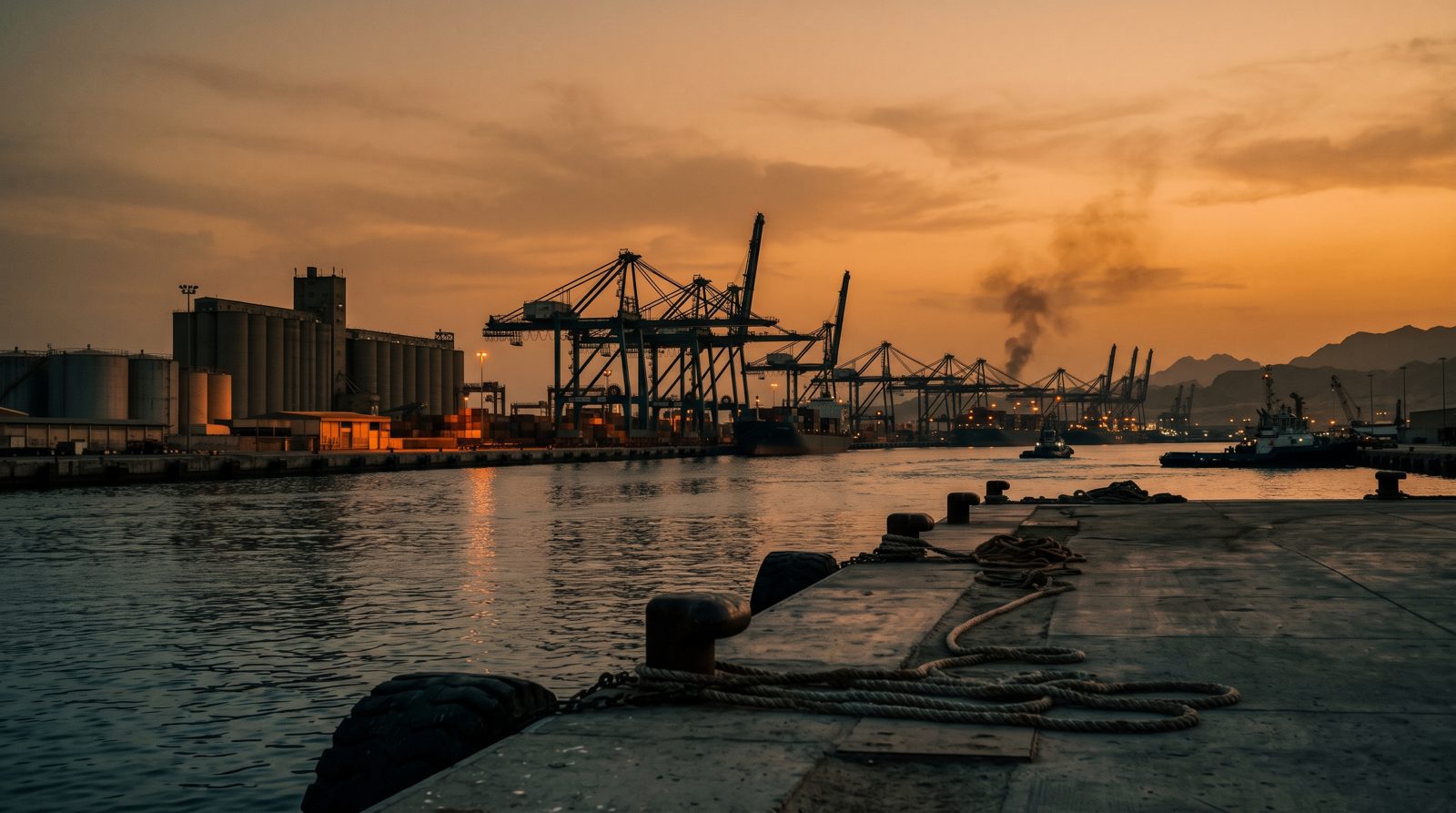
TL;DR
- On Friday, November 20, the Saudi-led coalition told civilians to leave Hodeidah port, then struck what its spokesman called "operational capabilities" there, a day after a Houthi attack damaged Riyadh's 385-metre Public Investment Fund Tower. The Houthis had promised to hit Jeddah and every Saudi port on the Red Sea if Hodeidah was attacked.
- Most coverage reads this as one more round of retaliation. The more useful reading is that both sides now hold the other's main sea gateway at risk: Hodeidah carries most of what northern Yemen eats and burns, and the Saudi Red Sea coast carries most of what the kingdom exports, plus a large share of the cargo rerouted to the Gulf, while Hormuz stays restricted.
- That second fact is new. In 2018, the last time Hodeidah was the centre of the war, Saudi Arabia's Gulf coast was wide open. In 2026 its Red Sea ports are its main open door, and the UN mission created to keep Hodeidah out of the fighting closed in March.
The warning came first, as a map. On Friday morning, November 20, the Saudi-led coalition fighting Yemen's Houthi movement told civilians to leave the area around Hodeidah port for their own safety and published the zone it meant. The coalition gave no timetable. Soon after, Houthi military spokesman Yahya Saree answered on X: if the coalition bombed Hodeidah, Jeddah port and "all ports of the Saudi enemy on the Red Sea coast" would become targets, and workers and residents near them should "evacuate them immediately," according to Middle East Eye and Reuters. He told shipping companies to move their vessels out of those ports and warned airlines that Saudi airspace would be "the scene of our operations in the coming hours," with only the skies over Mecca and Medina excepted.
By the evening, the coalition had gone ahead. Its spokesman, Turki al-Malki, said it had "targeted operational capabilities" at Hodeidah port used for smuggling and for moving weapons and ballistic missiles, and had hit missile and drone facilities and a supply depot in Sanaa, with operations under way in Saada and Taiz, AFP and Reuters reported. Yemen's internationally recognised government, the coalition's ally, said something revealing about the same strike: its information minister told Reuters that the port remained fully operational and that the flow of goods would continue.
The trigger was in Riyadh. On Thursday, November 19, a Houthi attack damaged the Public Investment Fund Tower in the King Abdullah Financial District, an 80-storey, 385-metre building that houses the kingdom's sovereign wealth fund, according to AFP and Gulf News. Saudi Civil Defence said windows were shattered and the facade damaged across several floors, with damage to nearby buildings, and reported no casualties. It was the second prominent building in the district to be damaged in under two weeks, after debris hit an Aramco administrative building on November 8.
Read one at a time, these are moves in a familiar sequence: a strike, a reprisal, a threat, a counter-threat. Read together, they describe something more specific and more dangerous. Both sides have now named the other's main sea gateway as a target, and both have said so out loud in the same 24 hours. This analysis argues that the Saudi-Houthi war has become a standoff over ports, explains why that standoff is far less comfortable for Riyadh than the last one in 2018, and sets out what to watch to see whether it holds.
Two gateways, one equation
The mechanism is simple enough to state in a sentence. Each side's war effort, and each side's population, depends on a short stretch of Red Sea coastline, and each side now has the means to damage the other's.
On the Yemeni side, the stretch is Hodeidah and its two smaller neighbours, the port of Salif and the Ras Isa oil terminal. Reuters describes Hodeidah as the main port bringing food and other supplies into Houthi-controlled northern Yemen. The UN's humanitarian office, OCHA, said that as of July 2025 more than 80 percent of the country's humanitarian aid, essential goods and fuel flowed through Hodeidah, on which 28 million Yemenis depend, figures cited by the Sanaa Center for Strategic Studies. The country imports the great majority of its food. A port that handles that share is not one target among many. It is the throat.
On the Saudi side, the stretch is longer but, this year, just as central. The kingdom has two coasts. Its Gulf coast, with Ras Tanura, Dammam and Jubail, has sat behind a restricted Strait of Hormuz since the United States and Israel went to war with Iran on February 28. Its Red Sea coast has taken the strain. Oil leaves through Yanbu, at the end of the East-West pipeline, where exports went from roughly 750,000 barrels a day before the war to about 4 to 4.5 million, by the estimates of the Middle East Economic Survey and the tracking firm Kpler that we examined in our report on Saudi Arabia's Hormuz escape route. Goods arrive through Jeddah, which CNN described in March as the kingdom's largest port, where officials then expected a 50 percent surge in arrivals as ships bound for the Gulf diverted. From Jeddah, a Saudi scheme called the Logistics Routes Initiative trucks cargo onward to Gulf neighbours; Saudi officials told CNN that more than 94,000 outbound trucks crossed the kingdom's land borders between February 28 and March 18.
Here is the image worth carrying through the rest of this piece. Each side is now holding a hostage, and the hostage is the other side's port. A hostage has value only while it is alive and only while the captor can credibly threaten it. Kill it and the leverage is gone; never threaten it and nobody believes you would. That is why the language on Friday was so carefully conditional. The Houthis did not say they would hit Jeddah. They said they would hit Jeddah if Hodeidah was hit. The coalition did not say it would close Hodeidah. It said it was hitting "capabilities" at Hodeidah, after a warning, and its Yemeni ally said the port was still working.
The phrase the Houthis themselves chose for this logic predates Friday. When they declared an embargo on Saudi shipping on July 20, they called it a "siege for a siege," as the Associated Press and The National reported at the time, retaliation for restrictions on sea and air travel to Yemen that Riyadh enforces at the request of the Yemeni government to keep Iranian weapons out. Saudi Arabia denies imposing a siege. Four months later, the siege-for-a-siege idea has acquired an address on each side of the water.
Neither side wants the other's port destroyed. Each wants the other to believe it could be.
How the war came back to the coast
The road to Friday ran through an airport. On July 13, according to the Associated Press, a Saudi airstrike hit the runway at Sanaa airport to stop an Iranian flight, operated by the US-sanctioned carrier Mahan Air and carrying a senior Houthi delegation, from landing without the coalition's permission, a requirement the coalition has imposed for a decade. The Houthis answered with an attack on Abha airport in southern Saudi Arabia, then declared their embargo on Saudi shipping. A Gulf official told AP that the coalition later let the Iranian flight land at Hodeidah, as part of an Omani effort to stop the slide. It is a small detail that now reads differently: in July, Hodeidah was the compromise.
The compromise did not hold. The truce that had kept the two sides from open war since April 2022 collapsed over the summer, and the UN envoy Hans Grundberg warned in August that Yemen faced "a greater risk of renewed large-scale conflict than at any point since" that truce, AP reported. The Houthis struck Saudi tankers in the Red Sea in July and August, a campaign set out in our Red Sea shipping intelligence guide. They advanced down Yemen's western coast, taking the port of Mokha in September. In October, an attack on the domestic terminal at Riyadh's King Khalid International Airport killed at least 12 people by the count of Saudi Arabia's civil aviation authority, as reported by The Times of Israel; AFP has since put the toll at 14. Most international flights were cancelled, Reuters reported, and the kingdom postponed or cancelled major events, including football's AFC Asian Cup.
Saudi strikes in Yemen have killed civilians too. The Houthi-run health ministry said a strike east of Sanaa in early November killed 44 people, a figure carried by Middle East Eye and Al Jazeera that AFP said it could not independently verify. Claims from both sides in this war are hard to check, and casualty figures from either should be read as claims unless confirmed.
On the ground, the month has gone badly for the coalition's Yemeni partners. On November 15, Yemen's government said it was pulling back from areas near the Bab al-Mandab strait to concentrate on defending Aden, the temporary capital, according to France 24 and The National. The next day, a royal decree carried by the Saudi Press Agency removed Lieutenant General Fahd bin Hamad al-Salman as coalition commander, a post he had held since August 2024, and named the chief of the general staff, General Fayyad al-Ruwaili, in his place. Reports in mid-November placed Houthi forces somewhere between about 60 and 100 kilometres from Aden, depending on the outlet and the day. Reuters now describes the Houthis as holding Yemen's Red Sea coast.
That last fact matters for the port equation. In 2018, Hodeidah was a city that the coalition's ground forces were trying to take. In November 2026, those forces are falling back toward Aden, and Hodeidah sits deep inside a coastline the Houthis control. The coalition's leverage over the port is now almost entirely from the air.
The coalition can reach Hodeidah with aircraft. It can no longer reach it with an army, and both sides know it.
The two coastlines at stake
- Hodeidah port (Houthi-held). Main entry point for food, fuel and aid into northern Yemen. More than 80 percent of aid, essential goods and fuel passed through it as of July 2025, according to OCHA. Struck by Israel repeatedly since July 2024, by the United States in 2025 and by the coalition this year.
- Ras Isa and Salif (Houthi-held). The oil terminal and the second port covered, with Hodeidah, by the 2018 Stockholm Agreement. Ras Isa was hit in US airstrikes in April 2025.
- Jeddah Islamic Port (Saudi). The kingdom's largest port and the landing point for cargo rerouted from the Gulf since February. Named by the Houthis on November 20 as a target if Hodeidah was attacked.
- Yanbu (Saudi). Terminal of the East-West pipeline and the main outlet for Saudi crude while Hormuz is restricted. War-risk premiums for Saudi-linked tankers there were about 3 percent of hull value in September, Reuters reported.
- Jazan and Shuqaiq (Saudi). On the southern coast, closest to Yemen. On November 20 the Houthis said they had attacked a power station at Shuqaiq and a port in Jazan; the coalition said it intercepted two ballistic missiles aimed at Jazan province, with shrapnel falling in the Shuqaiq area.
The turn: Saudi Arabia's exposure is new
The usual frame for a Saudi-Houthi exchange is asymmetry in Riyadh's favour. The kingdom is rich, has an air force, partners and money; the Houthis have missiles, drones and patience. On that frame, a threat against Saudi ports is noise, and a strike on Hodeidah is the stronger party reminding the weaker one of its dependence. It is a reasonable frame for the war of 2015 to 2022. It fits the war of 2026 much less well.
The reason sits in the Strait of Hormuz, nowhere near Yemen. During the earlier war, the kingdom's Gulf coast was open. When the Houthis threatened the Red Sea, Saudi Arabia could lean on the east, where most of its crude normally left from Gulf terminals. This year the opposite is true. With Hormuz restricted, the Red Sea coast carries most of the kingdom's oil exports and much of the cargo trucked onward to its Gulf neighbours. When the East-West pipeline was knocked out in September, Lloyd's List Intelligence found Saudi-linked supertankers running through Hormuz at their highest weekly rate of the war, a sign that Riyadh will go back through the strait when it must. But that is a fallback under fire, not an open door.
So the hostage the Houthis hold is worth more to Saudi Arabia in November 2026 than at any time in the decade-long war. Jeddah is not only Saudi Arabia's port; for now it is part of the emergency supply chain for the Gulf. Yanbu is not one export terminal among several; it is the main one. A credible threat against them reaches oil prices, insurers and neighbouring governments, which is exactly why the Houthis say it loudly. On Friday morning, Khaleej Times reported that oil prices rose on concern over the Houthi attacks on Riyadh.
This is the reversal. The common reading treats the Hodeidah strike as a show of Saudi strength over a dependent enemy. The record of the past four months suggests that, at the ports, the dependence now runs both ways, and Saudi Arabia's is newer and less hedged. Northern Yemen has lived for a decade with one fragile gateway and an economy shaped around scarcity. The kingdom has spent the same decade building an economy, symbolised by the very tower hit on Thursday, that depends on being seen as a safe place to land money, ships and people.
The hostage image needs one caveat, and it is an important one. In a real hostage standoff the hostage is a third party, and so it is here, only in larger numbers. The people who would go hungry if Hodeidah stopped working, or who would face shortages if Jeddah's cranes stopped, are not at the bargaining table and have no say in the threats made in their name. The image explains the strategy. It undersells the cost.
The stronger army does not always hold the stronger hand. At the water's edge this year, Riyadh has fewer exits than the movement it is fighting.
2018: the last time Hodeidah was the war
Hodeidah has been here before, and the precedent is the clearest guide to what is at stake. In 2018, forces backed by the coalition, including the United Arab Emirates, pushed up the coast to take the city and port. Aid agencies warned of disaster. The International Rescue Committee said 14 million people could be at risk of starvation and called the port "the country's lifeline"; the International Crisis Group warned that a final battle for the city would likely push millions into famine. In mid-November 2018, after nearly two weeks of fighting inside the city, the coalition ordered a halt, under pressure from the United States and European governments and amid the fallout from the killing of the journalist Jamal Khashoggi, Al Jazeera and Reuters reported at the time.
The halt led to Sweden. On December 13, 2018, the parties signed the Stockholm Agreement, whose core was a deal on the city of Hodeidah and the ports of Hodeidah, Salif and Ras Isa. Forces were to withdraw from the ports and the city, and port revenues were to be paid into the Hodeidah branch of the Central Bank of Yemen to help pay public salaries, according to the text and the UN envoy's office. Much of it was never fully implemented. The Middle East Institute described "imaginary progress" a year on, and the economic questions were skated over rather than settled. Yet a UN review credited the deal with averting a deterioration that would have put hundreds of thousands of lives at risk. Its real achievement was negative: it kept the decisive battle for the port from happening.
To watch over that arrangement, the Security Council created the UN Mission to Support the Hodeidah Agreement, UNMHA, in January 2019. For seven years it was the institutional reminder that Hodeidah was supposed to sit outside the war. On January 27, 2026, the Council voted 13 to 0, with China and Russia abstaining, to end it, according to Xinhua and Arab News. Resolution 2813 extended the mission one last time to March 31, ordered a drawdown, and moved any remaining functions to the office of the UN special envoy; liquidation began on April 1. A US deputy ambassador said Houthi intransigence had made the mission ineffective.
The timing is worth noticing. The mission closed a month after the regional war began and four months before the Yemeni truce came apart. Nobody planned it that way. But it means that the one standing piece of international machinery dedicated to the port at the centre of this week's events no longer exists. The UN's reaction on Friday came from New York. Farhan Haq, the Secretary-General's deputy spokesman, said the UN remained "deeply concerned about the ongoing military escalation in and around Yemen," urged all parties "to uphold their obligations under international humanitarian law," and added: "We reiterate that ultimately there is no military solution to the conflict," The National reported. The UN said continued fighting could threaten the supply routes millions of Yemenis rely on.
In 2018 the world stopped a battle for Hodeidah and built a mission to keep it stopped. In 2026 the mission is gone and the battle has moved into the air.
The port has been hit before. What changed on Friday
It would be wrong to present Friday's strike as the first attack on Hodeidah in years. Israel has struck the port repeatedly since July 2024, in response to Houthi missile and drone attacks on Israel, and US strikes hit the Ras Isa terminal in April 2025. The Sanaa Center, citing WFP data, found that food imports through Houthi-controlled Red Sea ports fell 20 percent and fuel imports 27 percent in the first eight months of 2025 compared with a year earlier, attributing the decline partly to damage from US and Israeli airstrikes. In this year's round, AP reported in August that the coalition had struck Hodeidah and Kamaran island, and on November 18 the Houthi health ministry said a coalition strike on a sponge factory in Hodeidah killed at least 15 people, according to AP, a figure that has not been independently verified.
Three things were different on November 20. The first is the explicit warning and map, which turned the port itself, rather than targets near it, into the stated object. The second is the conditional Houthi threat issued in advance, which turned the strike into a test of whether the Houthis would honour their own rule. The third is the response. Within hours, the Houthis said they had attacked a power station at Shuqaiq and a port in Jazan, and the coalition said it intercepted two missiles aimed at Jazan province. Neither side has published evidence of damage to a Saudi port, and we found no confirmed report of one as of Saturday. On Saturday morning, the coalition said it intercepted three ballistic missiles fired toward Riyadh, Al Jazeera reported, the third night of alerts in the capital.
That pattern is consistent with a standoff in which each side tries to prove its threat is real without spending the hostage. Jazan is a port on the Saudi Red Sea coast, so the Houthis can say they kept their word. It is not Jeddah or Yanbu, so they have not yet pulled the lever that would move oil markets and shipping insurance the most. Whether that restraint is deliberate or simply a reflection of what reached its target is unknown. The coalition, for its part, struck capabilities rather than berths, if its own description is accurate, and its Yemeni ally publicly insists the port still works. Both sides, in other words, behaved on Friday as if the hostage mattered.
A threat that is never tested stops being believed. A threat that is tested on the biggest target stops being a threat.
The wider lens: why the Hormuz talks cannot see this
The diplomacy of November has been about a different strait. Qatar and Pakistan have carried messages between Washington and Tehran on a framework in which, as reported, the United States would lift its blockade of Iranian ports and Iran would stop attacking shipping in Hormuz and reopen it, with nuclear talks to follow; our analysis of Iran's offer to reopen Hormuz within 48 hours walked through its conditions. On November 20, Khaleej Times and other outlets reported that President Donald Trump said there was no rush on a decision about Iran and pointed to next year, comments he gave to Axios.
None of the public accounts of that framework that we reviewed mention Yemen. The Houthis are Iran-aligned, and the Yemeni government says the port is used to receive smuggled Iranian weapons, an accusation Tehran and the Houthis reject. But a link is not a switch. The war on the Red Sea coast has its own trigger (an airport runway in July), its own calendar and its own ground campaign, and the Houthis increasingly frame it as a fight over Yemeni sovereignty. Ahmed Nagi of the International Crisis Group told AP in August that the Houthis had moved from seeking confidence-building steps, such as civil servant salaries, to framing the conflict around sovereignty, and "have raised the political stakes and made future compromise considerably more difficult."
That gap creates an awkward possibility for Riyadh. A Hormuz deal would help the kingdom more than almost anyone, because it would reopen the Gulf coast and shrink the value of the Red Sea hostage overnight. But a Hormuz deal that leaves Yemen out would also leave the Houthis holding a threat against Saudi ports that no one in Doha or Islamabad has been asked to remove. Saudi Arabia's answer so far has been to build its own security net, from the Mecca pact with Turkey and Pakistan to the Gulf's new defence pacts, rather than to wait for Washington, which has provided intelligence and advisers but, as far as we can find, no strikes on the Houthis in this round. Pakistan condemned the attack on the financial district, and Syria condemned the Houthi attacks on the kingdom, Khaleej Times reported.
There is a related thread on the other side of the peninsula. On the same Friday, Iraqi forces entered Jurf al-Sakhar, the militia stronghold at the centre of an oil smuggling inquiry, after the Iraqi government reached what reports described as a compromise with the Iran-backed group it had accused. September's drone attack on the East-West pipeline was launched from Iraqi territory, according to Riyadh and Baghdad. Saudi Arabia's export system has been hit from the south and from the north-east this year, and the ports at its Red Sea end are where those threats converge.
A deal on Hormuz could reopen one door for Saudi Arabia. It would not, on its own, unlock the other one.
The numbers, and what they can and cannot tell you
Four sets of figures frame the standoff, and each comes with a caveat.
The first is dependence. OCHA's figure of more than 80 percent of aid, essential goods and fuel moving through Hodeidah dates from July 2025, before this year's fighting resumed. It may understate the port's weight now that the coast is contested, or overstate it if traders have shifted to government-held ports in the south; through August 2025, the Sanaa Center reported, food imports through government-controlled ports rose 45 percent while those through Houthi-held ports fell. The projected number of Yemenis facing high levels of acute food insecurity for September 2025 to February 2026 was 18.1 million, according to the same review of WFP and food security data. Those projections were made before the summer's escalation.
The second is Saudi exposure. Yanbu's export estimates of 4 to 4.5 million barrels a day come from MEES and Kpler and are not official Aramco figures. OPEC data published on November 11 showed group output nearing pre-war levels, with Saudi increases among the main drivers, according to Al Jazeera and Asharq Al-Awsat, which suggests the kingdom has kept crude moving despite the attacks. That is reassuring about capacity and says nothing about what a strike on a loading terminal would do.
The third is price. Reuters reported in September that war-risk premiums were about 0.2 to 0.3 percent of a ship's value for tankers with no Saudi link, about 3 percent for Saudi-linked tankers at Yanbu and above 7 percent for calls further south. Those quotes predate Friday's threats against Jeddah and every Saudi Red Sea port. Insurance quotes are private and move daily, and published figures lag.
The fourth is traffic. Lloyd's List Intelligence counted 1,363 transits of Bab al-Mandab by ships over 10,000 deadweight tonnes in October, still 46 percent below pre-crisis levels, while the Suez Canal Authority reported 1,490 vessels in October, its busiest month since late 2023. Many ships cross the southern Red Sea with tracking switched off, so counts differ between providers, sometimes widely.
Every number in this story was measured before Friday. The next set will show whether the threats moved anything real.
What we know, and what we don't
We know that the coalition warned civilians to leave Hodeidah port and then struck what it described as weapons-related capabilities there, along with targets in Sanaa, Saada and Taiz. We know the Houthis had publicly conditioned attacks on Jeddah and other Saudi Red Sea ports on exactly such a strike. We know the Public Investment Fund Tower was damaged on November 19 with no reported casualties, and that the UN has voiced concern and called for Red Sea ports to stay operational. We know UNMHA no longer operates.
We do not know what the strike destroyed, or whether anyone was killed; neither side had published casualty figures for the port strike by Saturday, and Houthi-run media reported a separate coalition raid on a power station in Mokha that we could not confirm. We do not know whether the Houthi claim of an attack on a port in Jazan reflects damage or only an attempt. We do not know whether the coalition intends further strikes on the port itself or considers its point made. We do not know how much influence Tehran has over Houthi targeting decisions, or whether it would use any it has. And we do not know whether any mediator, Omani, Qatari or the UN envoy, has put the ports on the table.
Six signals that show whether the standoff holds
- Ship arrivals at Hodeidah. If tankers and grain carriers keep berthing in the coming week, the strike was a message. A sharp drop, whether from damage, insurance or fear, would mean the hostage has been wounded, and the humanitarian clock starts.
- The first confirmed hit on a major Saudi Red Sea port. Jazan was named on Friday. A confirmed strike on Jeddah or Yanbu would mean the Houthis have decided to spend their biggest threat, and the standoff would turn into a contest of damage.
- War-risk quotes for Jeddah and Yanbu. Insurers price threats faster than governments admit them. A jump for ships calling at Jeddah, not only Saudi-flagged tankers, would show the market believes the threat has widened beyond the July embargo.
- Who the coalition says it is hitting. The word "capabilities" carries a lot of weight. A shift to language about berths, cranes or the port's operation would mark a decision to squeeze the gateway itself, which is what Stockholm was designed to prevent.
- Whether a mediator names the ports. Oman has run a back channel between the two sides since the summer, AP reported. A proposal that trades restraint at Hodeidah for restraint at Saudi ports, even informally, would be the first sign that someone is negotiating the hostages rather than the war.
- Whether Yemen appears in the Hormuz text. If a US-Iran framework surfaces that mentions the Red Sea or the Houthis, the two conflicts become one negotiation. If it does not, Saudi Arabia should expect the Red Sea standoff to outlast any deal on Hormuz.
Hostages, not targets
The easiest way to misread the week is to count it as escalation and wait for the next, bigger strike. Escalation is happening; three nights of alerts in Riyadh and an evacuation map for Hodeidah are not routine. But the more useful question is not how hard each side can hit. It is how long each can keep its hostage alive while convincing the other that it would not hesitate to harm it.
On that measure, the conventional picture flips. Saudi Arabia has the aircraft, the alliances and the money. The Houthis hold a coastline that, for the first time in this war, sits beside the kingdom's only fully open sea door. For a decade Riyadh treated Hodeidah as leverage over an enemy that could not afford to lose it. This week Hodeidah also became the price of its own ports staying quiet. Watching the ports, rather than the missiles, is the way to see which side remembers that first.
For more on the region's security landscape, see our Gulf coverage, and for the earlier phase of the Red Sea crisis, our six-month tally of Houthi attacks.
FAQ
Why did the Saudi-led coalition strike Hodeidah port?
The coalition said it targeted capabilities at the port used for smuggling and for moving weapons and ballistic missiles, after warning civilians to leave the area. The strike on November 20 came a day after a Houthi attack damaged the Public Investment Fund Tower in Riyadh's financial district.
Is Hodeidah port still operating?
Yemen's internationally recognised government, which is allied with the coalition, said the port remained fully operational and that goods would keep flowing. The extent of the damage has not been independently confirmed.
Have the Houthis attacked Jeddah?
As of November 21 we found no confirmed attack on Jeddah port. The Houthis threatened Jeddah and all Saudi Red Sea ports if Hodeidah was struck, and later said they had attacked a power station at Shuqaiq and a port in Jazan. The coalition said it intercepted two missiles aimed at Jazan province.
What happened to the UN mission in Hodeidah?
The UN Mission to Support the Hodeidah Agreement, set up in 2019 to monitor the 2018 Stockholm deal, was ended by Security Council Resolution 2813 on January 27, 2026. Its mandate ran to March 31, and its remaining functions passed to the office of the UN special envoy for Yemen.