Saudi Arabia's Hormuz Escape Route Is Now a Front Line
TL;DR
- Between November 8 and 10, Saudi Arabia reported an attack on Aramco's East-West pipeline in the Medina region, debris damage to an Aramco office building in Riyadh, and missiles intercepted over the capital, where schools moved online. The kingdom blames the Houthis for the Riyadh attacks.
- The pipeline is the route Saudi Arabia built in the 1980s to escape a closed Strait of Hormuz. This year it has carried most of the kingdom's exports, and it has been hit from Yemen, from Iraq and, in April, by a strike on a pumping station.
- The diplomacy now running through Doha is described as a Hormuz deal between Washington and Tehran. The Houthi war on Saudi Arabia has its own causes and its own calendar, and as reported, Iran's proposal does not mention Yemen. With the US declining to fight that war, Riyadh is assembling a defensive coalition with Pakistan, Turkey, Egypt and now Syria.
On Monday, November 9, a source at Saudi Arabia's Ministry of Energy gave the state news agency a statement of a few lines. The East-West pipeline had been "targeted" in the Medina region. There had been "a limited fire that was extinguished immediately." No one was hurt, and the line's operations were not affected. The statement did not say what hit the pipeline, who fired it, or where exactly it landed.
The day before, the same ministry had reported that an "attempted attack" on Riyadh had sent debris into an Aramco administrative building, blowing out windows across several floors, according to Reuters reporting carried by NBC News. On Tuesday, the Saudi-led coalition said its air defenses had destroyed missiles aimed at Riyadh and at the south of the kingdom, and a drone over the Eastern Province. Riyadh schools told parents that classes would be online "beginning tomorrow, Tuesday," with no end date, in a message seen by AFP. For the third day running, residents of the capital received phone alerts telling them to take shelter from an "aerial threat," Middle East Eye reported.
Each of those events was reported briefly and on its own. Read together, they describe something larger than a run of interceptions. Saudi Arabia's escape route from the Strait of Hormuz, the 1,200-kilometer pipeline that has carried the bulk of its oil exports through eight months of regional war, is now the target of a separate war that the diplomacy in Doha is not designed to end.
That is the gap this analysis is about. The working assumption in most coverage is that the energy crisis in the Gulf is a Hormuz problem, and that a deal between Washington and Tehran to reopen the strait would largely solve it. The assumption skips over the place where Saudi oil actually leaves the kingdom today, and over the people now aiming at it. What follows explains how the bypass works, why it has turned into a front line rather than a refuge, what Washington's restraint has set in motion in Riyadh, and which signals will show whether the route holds.
How a pipeline became the kingdom's main door
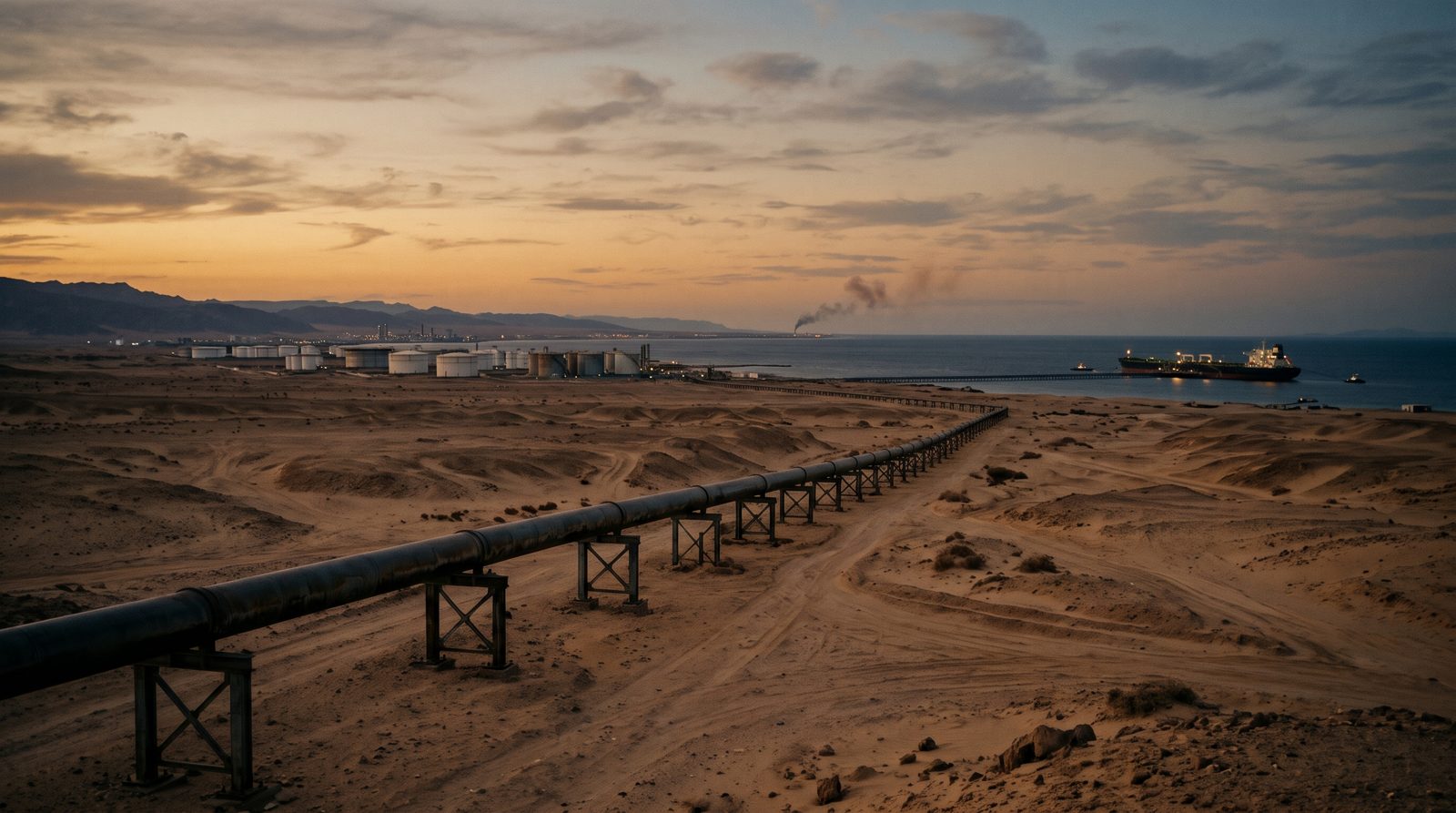
The plumbing comes first, because the plumbing is the story. The East-West pipeline, also called Petroline, runs roughly 1,200 kilometers from the Abqaiq processing hub in the Eastern Province, close to the Gulf, across the desert to the port of Yanbu on the Red Sea. It was commissioned in 1981, during the Iran-Iraq war, when attacks on tankers in the Gulf raised the fear that Hormuz itself could be shut. Crude that enters it in the east comes out on the other side of the Arabian Peninsula, where tankers can load without ever going near the strait.
For most of its life the line ran well below its limits. Before this year's war, Yanbu exported roughly 750,000 barrels a day, according to estimates by the Middle East Economic Survey (MEES) cited by OilPrice. Then the United States and Israel struck Iran on February 28, Hormuz became largely impassable to non-Iranian shipping, and Aramco pushed the system to its announced maximum, which OilPrice and other industry accounts put at about 7 million barrels a day. By late summer, the ship-tracking firm Kpler estimated the pipeline was moving about 5.5 million barrels a day, roughly 4.5 million of it bound for export from Yanbu. CNN put the figure at about 5 million. MEES estimated that the route allowed Saudi Arabia to keep about 65 percent of its pre-war oil exports flowing outside the strait. A shipping-sector estimate published by Engine puts the share of exports moving through Yanbu at about 70 percent.
Here is the image worth carrying through the rest of this piece. The pipeline is a fire escape. It was built for one specific emergency, a fire in the Gulf, and it does exactly what a fire escape should do: it lets the occupants leave the building by a route the fire cannot reach. A fire escape, though, is only as safe as three things: the stairwell itself, the landing at the bottom, and the street the landing opens onto. In the Saudi case, the stairwell is the line and its pumping stations, the landing is Yanbu, and the street is the Red Sea, which empties into the Indian Ocean through the narrow strait of Bab al-Mandab, off the coast of Yemen.
For most of 2026, the stairwell held, the landing grew busier than it had ever been, and the street stayed passable at a price. That is no longer a safe description of any of the three.
A route built to avoid one enemy is only as good as the assumption that the enemy is in one place.
Fire from three directions
The first serious test came from an unexpected quarter. On September 10 and 11, drones struck pumping stations on the line in the Riyadh and Medina regions. Saudi Arabia's foreign ministry said the attack was carried out by "several drones originating from Iraq," and the energy ministry shut the pipeline as a precaution. Iraq's prime minister's office later said investigations had confirmed the drones were launched from a location inside Maysan, a southern province on the border with Iran, and the commander of Maysan operations was dismissed, as Al Jazeera and Bloomberg both reported. Saudi Arabia chose not to retaliate, at the request of Iraqi Prime Minister Ali al-Zaidi. Iran-aligned Iraqi militias denied involvement.
The damage was real. Kpler reported that the pipe itself was only lightly damaged but that pumping infrastructure was hit hard, with at least one station extensively damaged and a temporary bypass being installed, according to OilPrice. The line restarted at reduced rates on about September 22, Reuters reported, with weeks needed to recover full capacity. Loadings at Yanbu halted for longer, and European refiners were told they would not receive the Saudi crude they expected the following month. Oil prices rose above $100 a barrel for the first time in months, according to CNBC and Al Jazeera reports at the time.
That attack was not the first on the line this year. In April, a strike on a pumping station briefly cut throughput by roughly 600,000 to 700,000 barrels a day, according to differing accounts relayed by AFP and others. And since late October the Houthis, formally known as Ansar Allah, have claimed repeated attacks on the line's pumping stations, along with Aramco facilities at Yanbu and the Rabigh refinery, announced by their military spokesman Yahya Saree on Telegram. Saudi Arabia has not confirmed most of those claims. It did confirm Monday's fire.
So in a single year, a route designed to be out of reach has been hit from Iraqi territory to the north-east, from Yemen to the south, and, in April, at the height of the direct war with Iran. Geography explains why. A pipeline that crosses an entire country from coast to coast is long, fixed and exposed, and its pumping stations sit in open desert at predictable points. Defending a strait means defending a few dozen kilometers of water. Defending this line means defending its whole length, and the port at the end of it.
The fire escape now has smoke in the stairwell, and the smoke comes in through more than one window.
The turn: the escape route ends at another chokepoint
The obvious worry about the pipeline is the stairwell: pumping stations knocked out, flows interrupted. The less discussed problem is the street at the bottom.
Most of the crude loaded at Yanbu does not go north to Europe through Suez. S&P Global data cited by OilPrice put Yanbu loadings in the second quarter at about 3.9 million barrels a day, more than double the year before, with about 80 percent of it headed east of Suez, which in practice means south through the Red Sea and out through Bab al-Mandab toward Asian buyers. The pipeline was designed to avoid one narrow strait. In this war it delivers most of its oil to another.
That second strait has become a contested coastline. In September, Houthi forces pushed down Yemen's Red Sea coast toward Bab al-Mandab, seizing the port town of Mokha as Saudi-backed Yemeni forces withdrew, Axios reported. Control of the strait's islands has since been claimed by both sides at different moments, and the picture remains disputed. The security firm Dryad Global estimated in September that traffic through Bab al-Mandab had fallen to about 30 vessels a day, against roughly 80 in normal conditions, OilPrice reported. The Houthis have also declared most of Saudi airspace "not safe" and warned airlines away, according to Middle East Eye.
Insurers have priced the change. War-risk premiums for Saudi-linked tankers loading at Yanbu roughly tripled between early July and late September, to about 3 percent of a vessel's value, Reuters reported, as cited by OilPrice. On a $100 million tanker, that is about $3 million per voyage. At Saudi ports farther south, rates were reported as high as 7 percent, close to the 6 to 9 percent quoted for Hormuz itself.
Then comes the most revealing detail of the year. When the pipeline went down in September, Lloyd's List Intelligence reported that Saudi-linked supertanker transits through Hormuz hit their highest weekly level since the war began. Engine reported that Aramco raised exports from its Gulf terminals and used ship-to-ship transfers near Oman to make up part of the loss. In other words, when the fire escape failed, the kingdom went back through the burning building, and it got enough cargo out to matter.
That is the reversal hiding in the data. The frame in most coverage treats Hormuz as the problem and the bypass as the answer. The record of 2026 suggests the two are now a single system, and that Saudi export security depends on keeping at least one of them usable at any given moment. An adversary does not need to close both. It needs only to make the cheaper one expensive at the same time the other is shut.
A note on the limits of the fire escape image. It suggests a single building and a single fire, and that undersells one thing: the arsonists are not the same people. Iran controls the pressure on Hormuz. The Houthis control the pressure on the Red Sea route. Iraqi territory produced the September drones. Their interests overlap, and Western and Saudi officials argue they are coordinated, but they do not answer to one desk, and that is precisely why a single negotiation cannot switch them all off.
Saudi Arabia did not escape the chokepoint problem. It traded one strait for two.
The talks that leave Yemen out
The diplomacy of the past week has been intense, and almost all of it has been about Hormuz. On Monday, November 9, Qatar's prime minister, Sheikh Mohammed bin Abdulrahman Al Thani, met President Donald Trump and Vice President JD Vance in Washington. Afterward he wrote on X: "I appreciate the positive discussions on reaching an agreement and bringing peace to the region." On Tuesday, Ibrahim Al-Hashimi, a Qatari foreign ministry spokesman, told reporters in Doha that "mediation efforts between Washington and Tehran are still ongoing, and there have been positive responses from both sides," according to Anadolu as published by Middle East Monitor.
The positions remain far apart. Secretary of State Marco Rubio called Tehran's conditions "outrageous and ridiculous and really not realistic," Reuters reported via NBC News. Trump told CNN it was "highly unlikely" that resuming strikes would be necessary if talks progressed, while the US has kept up what he called "minor" strikes, including one on November 6 that destroyed an air-defense system near the strait, and has kept its naval blockade of Iranian ports in place. Iran's Revolutionary Guard, for its part, claimed on November 8 that three tankers caught fire after using what it called an "illegal channel" through the strait, a claim that has not been independently verified. Our earlier analysis of Iran's offer to reopen Hormuz within 48 hours walked through the conditions themselves.
The shape of the proposal, as Reuters described it on November 9, is telling: the United States would lift its blockade of Iran's ports, ease some sanctions and halt bombing, Iran would stop its own blockade of Hormuz, and talks on the nuclear program and further sanctions would follow. Yemen does not appear in that description. Earlier accounts of Iran's seven conditions, as our November 4 piece noted, included an end to fighting on other fronts, with Lebanon named. None of the public accounts we reviewed names Yemen or the Saudi-Houthi war specifically.
That omission matters because the Houthi campaign against Saudi Arabia does not run on the same clock as the US-Iran war. A truce between the Houthis and the kingdom collapsed in July, Al Jazeera and other outlets have reported, and the group has escalated steadily since. On October 4, Saudi Arabia launched a new offensive against the Houthis in support of Yemen's internationally recognized government, Al-Monitor reported. On October 10, a missile that Saudi Arabia attributed to the Houthis hit the terminal complex for domestic flights at Riyadh's King Khalid International Airport. Saudi Arabia's civil aviation authority put the toll at at least 12 dead and more than 300 injured, as reported by The Times of Israel and CNN, which counted 13 dead. Saudi strikes on Yemen have also killed civilians. The Houthi-run health ministry said a weekend strike east of Sanaa killed 44 people, including 21 children, figures carried by Middle East Eye and Al Jazeera that have not been independently verified.
There are real links between the two wars. The Houthis have tied their campaign against the kingdom to the wider war and to the US blockade of Iran, and Saudi-aligned sources accuse Iran's Revolutionary Guard of guiding the offensive, which Tehran denies. But a link is not a switch. A US-Iran agreement could lower the temperature in Yemen, and Iran may have influence it could use. Nothing in the public record shows that Tehran has offered to use it, that the Houthis would accept it, or that the Saudi offensive, now five weeks old, would stop on someone else's signature. As Anwar Gargash, an adviser to the president of the United Arab Emirates, put it on November 9, the region should "prepare for a long period of uncertainty."
This is the question almost nobody is asking in public. If Doha produces a Hormuz deal next week, the Strait of Hormuz may reopen while the pipeline built to replace it is still under fire. Saudi Arabia, the region's largest oil exporter, could find itself the one Gulf producer whose war did not end with the deal.
A Hormuz deal can reopen a strait. It cannot, by itself, end a war it does not mention.
The bypass chain: five links, five exposures
- The source. Abqaiq, in the Eastern Province, where crude enters the line. It sits close to the Gulf and was the site of the September 2019 attack that briefly knocked out about half of Saudi output.
- The stairwell. About 1,200 kilometers of pipe and a chain of pumping stations across open desert. Hit in April, in September (by drones launched from Iraq, according to Riyadh and Baghdad) and again on November 9.
- The landing. Yanbu on the Red Sea, which went from roughly 750,000 barrels a day of exports before the war to about 4 to 4.5 million, by MEES and Kpler estimates. The Houthis claim repeated attacks there; Saudi Arabia has not confirmed most of them.
- The street. The Red Sea and the exit at Bab al-Mandab, where Houthi forces advanced along the Yemeni coast in September. War-risk premiums for Saudi-linked tankers at Yanbu roughly tripled between July and September, Reuters reported.
- The fallback. Hormuz itself. When the pipeline went down in September, Saudi-linked supertanker transits through the strait reached their highest weekly level of the war, according to Lloyd's List Intelligence.
Washington said no, so Riyadh is building its own guard
If the fire escape is under attack, the natural question is who guards it. For four decades the answer for Saudi Arabia has been, ultimately, the United States. This autumn that answer changed, quietly and without a formal announcement.
On September 10, as Houthi forces advanced on the coast, Crown Prince Mohammed bin Salman called Trump twice, several hours apart, to urge American strikes on the Houthis, and Trump declined both times, Axios reported, citing US officials. A senior administration official told Axios that "the United States is focused on protecting our core national security interests" and that Washington's priority was keeping the Red Sea open while regional partners led. Instead, the US would provide intelligence and targeting information, and about 200 American personnel already in the kingdom were providing what an official called non-kinetic support. Reuters said it could not immediately verify the Axios account, which rests on anonymous officials and should be read with that caveat. After the Riyadh airport attack a month later, Trump was asked whether the US would join Saudi strikes. "We may," he said, according to The Times of Israel. "We're going to look at it." Reporting since has continued to describe the American role in terms of intelligence and advisers, and we found no confirmed report of US strikes on the Houthis in this round of fighting.
Riyadh's response has been to assemble a defensive coalition of its own, built from partners that, until recently, few analysts would have grouped together.
The core is the Mecca Joint Defence Agreement, signed in Mecca on August 7 by Saudi Arabia, Turkey and Pakistan. Under its terms, an armed attack on one member is treated as an attack on all, Al-Monitor and Middle East Eye reported. The text runs to 16 articles, has no expiry date and allows withdrawal only after ten years, according to Middle East Eye. It builds on a track that this site followed in April, when we looked at the Saudi-Pakistan security memorandum and what its silences implied. On October 5, after the first wave of airport attacks, senior officials from the three countries met in Riyadh and agreed to provide the promised forces and deploy them quickly, according to Al-Monitor. Pakistan and Saudi Arabia ratified the pact in October.
Turkey's parliament followed last week, approving the pact by 279 votes to 119, with the ruling coalition in favor and the Yeni Party and the pro-Kurdish DEM Party against, according to Al-Monitor and Middle East Eye. Ratification does not send troops. Ankara still needs a separate parliamentary mandate to deploy forces and a status of forces agreement with its partners. Defense Minister Yasar Guler said in October that the main purpose of Turkish support "would be to strengthen deterrence," and that Turkey did not foresee entering "any conflict with the Houthis." Foreign Minister Hakan Fidan has said any deployment would be defensive and that Turkish forces would not operate in Yemen.
Egypt moved in parallel. In late October, its parliament authorized President Abdel Fattah al-Sisi to take "all necessary measures" to help Saudi Arabia defend itself, Reuters reported, as cited by Engine.
Then came the most surprising name. On November 4, Syrian President Ahmed al-Sharaa met the crown prince in Riyadh, and the two governments announced a military cooperation agreement. On November 8, the Associated Press, citing three officials, reported that Syria was preparing to send fighters to deploy along Saudi Arabia's border and potentially to help against the Houthis, with a Syrian official saying "an initial force of about 600 Syrian special forces fighters is expected." Syrian advisers were already in the kingdom, AP reported, but no Syrian fighters had been sent to Yemen. The Jerusalem Post noted that AP, Reuters and AFP gave differing accounts of the numbers. A Syrian diplomatic official told the state agency SANA that the agreement focuses on training and building capabilities, and Damascus has denied plans to send forces into Yemen. AP also reported that Saudi Arabia agreed during the visit to lend Syria more than $400 million for reconstruction, and that Syria is discussing joining the Mecca pact.
Each of these steps is modest on its own. Turkey talks of training and deterrence, Syria of advisers and border duty, Egypt of an authorization rather than a deployment. Taken together, they amount to a shift in how the kingdom insures itself. The guards on the stairwell are no longer expected to arrive from Washington. They are being recruited from Ankara, Islamabad, Cairo and Damascus, under a treaty Riyadh wrote with its partners rather than one written for it.
In this war on its own soil, Saudi Arabia's backup plan is no longer American.
An old weakness, in a new war
None of this vulnerability is new. What is new is that it is being tested at full load.
The pipeline was born out of the Tanker War of the 1980s, when Iran and Iraq attacked each other's shipping and both threatened Gulf traffic. The logic then was simple: if Hormuz were shut, Saudi crude could still reach the Red Sea, far from the Gulf's war. For decades, that assumption held.
It began to fail in the war in Yemen. Saudi Arabia led a coalition into Yemen's civil war in 2015 on the side of the internationally recognized government. In May 2019, Houthi drones struck pumping stations on this same pipeline, briefly shutting it. In September 2019, drones and missiles hit Abqaiq and the Khurais field, knocking out about half of Saudi crude output for a time. The Houthis claimed that attack; Washington blamed Iran. The US did not respond militarily. In hindsight, that was an early sign that the American backstop was conditional. A truce in Yemen from 2022 lowered the temperature for nearly four years. When it collapsed this July, the kingdom found that the fire escape now opened onto a street partly held by the people it had been fighting.
The difference in 2026 is volume. In 2019 the pipeline was a reserve. This year it has carried the majority of Saudi exports for months, which turns every pumping station into a strategic target and every week of outage into a measurable gap in world supply. A reserve can be lost for a few days without anyone noticing. A main artery cannot.
There is a parallel worth noting elsewhere in the region. Iraq, which normally ships most of its crude through the Gulf, has been trying to push more oil north through Turkey on the Kirkuk-Ceyhan line, Bloomberg has reported. The Gulf states, in other words, are all searching for exits that avoid Hormuz, and each exit runs through someone else's war or someone else's territory. This is the deeper pattern behind what we described in April as the architecture of a post-war Middle East: the region's energy map is being redrawn around risk rather than distance.
The pipeline was built for a world in which the Red Sea was the safe side. That world ended before this war began; the war simply sent the bill.
The numbers, and what they can and cannot tell you
The figures in this story come from different firms, measured at different times, and they do not always agree. A few cautions are in order before anyone uses them.
Pipeline throughput is estimated, not published. Kpler's figure of about 5.5 million barrels a day before the September attack, CNN's figure of about 5 million and other accounts of 4 to 5 million are all reconstructions from tanker loadings, satellite imagery and industry sources. Aramco does not publish daily flows. The same is true of the share of exports the route preserves: MEES estimates about 65 percent of pre-war exports, Engine about 70 percent. Those numbers measure different things (a share of pre-war volume versus a share of current exports) and should not be treated as competing answers to the same question.
Capacity is not throughput. The 7 million barrel a day figure is a nameplate maximum. Before the war, the line rarely ran near it, OilPrice noted, and the loading capacity at Yanbu, not the pipe, is the binding limit on how much can actually be shipped.
Attack claims are lopsided. The Houthis claim far more hits on Saudi energy sites than Saudi Arabia confirms. Saudi Arabia, for its part, discloses little about damage, as Monday's statement shows. Neither side's account can be taken at face value, and independent confirmation, usually from satellite imagery or ship tracking, often arrives days later or not at all.
Casualty figures are partisan on both sides. The Riyadh airport toll comes from Saudi authorities. Tolls from Saudi strikes in Yemen come from Houthi-run institutions, and Reuters has said it could not verify some of them. Both deserve to be reported, and both deserve the label.
Finally, insurance and shipping data lag. The premium and traffic figures above date from late September, and conditions in the Red Sea have moved since. They show direction, not the current price.
What we know, and what we don't
We know that the East-West pipeline has been hit at least three times this year, in April, in September and on November 9, the last two confirmed in Saudi official statements. We know the September drones came from Iraqi territory, because both Riyadh and Baghdad said so. We know that the Houthis are conducting a sustained missile and drone campaign against Saudi cities, airports and oil sites, that Saudi Arabia is conducting an air and ground offensive in Yemen, and that civilians are dying on both sides. We know that Turkey's parliament ratified the Mecca pact and that Syria and Saudi Arabia signed a military cooperation agreement.
We do not know who fired at the pipeline on Monday. Saudi Arabia did not say, and the Houthis, who have claimed many earlier attacks on the line, had not claimed that one in the reporting we reviewed. We do not know how much damage the November 9 strike caused beyond the ministry's account. We do not know whether Syrian combat troops will actually deploy, where, or under whose command, since the AP account and Damascus's own description differ. We do not know whether a Turkish deployment mandate will reach parliament, or how large any force would be.
Most importantly, we do not know whether a US-Iran agreement would include any commitment on Yemen. The public descriptions of the Doha framework do not, but those descriptions are partial, and side understandings would not necessarily be published. Readers should treat the omission as a reported gap, not as a confirmed exclusion.
Six signals that will show whether the bypass holds
- Yanbu loadings, not ministry statements. The clearest test of whether Monday's attack mattered is tanker loadings at Yanbu over the next two weeks, as reported by trackers such as Kpler and Vortexa. A statement that operations are "not affected" is a claim; a full loading schedule is evidence.
- Saudi traffic through Hormuz. In September, the kingdom fell back on Hormuz when the pipeline failed. A rise in Saudi-linked transits of the strait would suggest the bypass is under strain again, even before anyone admits it.
- The word "Yemen" in any Doha text. If a US-Iran framework is announced, the first thing to check is whether it addresses "all fronts," names Yemen, or stays silent. Silence would mean the Saudi front continues on its own terms.
- Red Sea insurance and Bab al-Mandab traffic. War-risk premiums at Yanbu and daily transits through Bab al-Mandab measure the street at the bottom of the fire escape. A deal on Hormuz that leaves those numbers high would confirm that the risk has moved rather than ended.
- Turkey's deployment mandate and the Syrian arrival. A bill in Ankara authorizing forces in Saudi Arabia, and confirmed Syrian units on Saudi soil, would show that the Mecca pact is becoming an operating alliance rather than a statement.
- A change of tone from Washington. Any shift from intelligence support to US strikes on the Houthis would reverse the most consequential decision of this autumn. Continued restraint would cement the kingdom's move toward regional partners.
The fire escape and the building
Most of the world will measure the end of this crisis by one image: tankers moving freely through Hormuz again. That image may come, perhaps soon, if the talks in Doha deliver. It will be a real relief, and it will be incomplete.
The deeper lesson of 2026 is that an escape route is not a place of safety. It is a different place, with its own neighbors, and those neighbors get a vote. Saudi Arabia built its fire escape for one fire. It now has a stairwell that can be reached from Iraq and Yemen, a landing within missile range, a street partly overlooked by the Houthis, and a set of new partners recruited because the old one declined to come.
For anyone trying to read the region in the weeks ahead, the useful question is not whether Hormuz reopens. It is which exits stay open after it does, and who is guarding them. On the evidence of this week, the answer for the Gulf's largest oil exporter is being written in Medina and Riyadh, in Ankara and Damascus, and not only in Doha. For a wider view of how these threads connect, our Gulf coverage and energy reporting follow them week by week.
FAQ
What is the East-West pipeline and why does it matter now?
It is a roughly 1,200-kilometer crude oil line, also called Petroline, that runs from Abqaiq near the Gulf to Yanbu on the Red Sea. It was built in the 1980s to let Saudi Arabia export oil if the Strait of Hormuz were closed. Since the Iran war began in February 2026 it has carried most Saudi exports, which makes it a major strategic target.
Who is attacking it?
Saudi Arabia and Iraq said drones launched from Iraq's Maysan province hit it in September. The Houthis have claimed repeated attacks on its pumping stations and on Aramco sites at Yanbu, most of which Saudi Arabia has not confirmed. Saudi authorities did not name the attacker in the November 9 incident in the Medina region.
Would a US-Iran deal on Hormuz stop the Houthi attacks on Saudi Arabia?
Not necessarily. Public descriptions of the proposal under discussion in Doha cover the US blockade of Iranian ports, sanctions and Iran's blockade of Hormuz, and do not mention Yemen. The Saudi-Houthi fighting resumed after a separate truce collapsed in July, so it may continue even if the strait reopens.
What is the Mecca defence pact?
A mutual defense agreement signed in Mecca on August 7, 2026, by Saudi Arabia, Turkey and Pakistan, under which an attack on one member counts as an attack on all. Turkey's parliament ratified it in early November, though Turkish troop deployments need a separate vote. Egypt has authorized support for Saudi Arabia, and Syria is reported to be preparing to send forces and to be discussing membership.