Red Sea Shipping Intelligence, November 2026: The Strait Is Open, but It Checks Your Papers
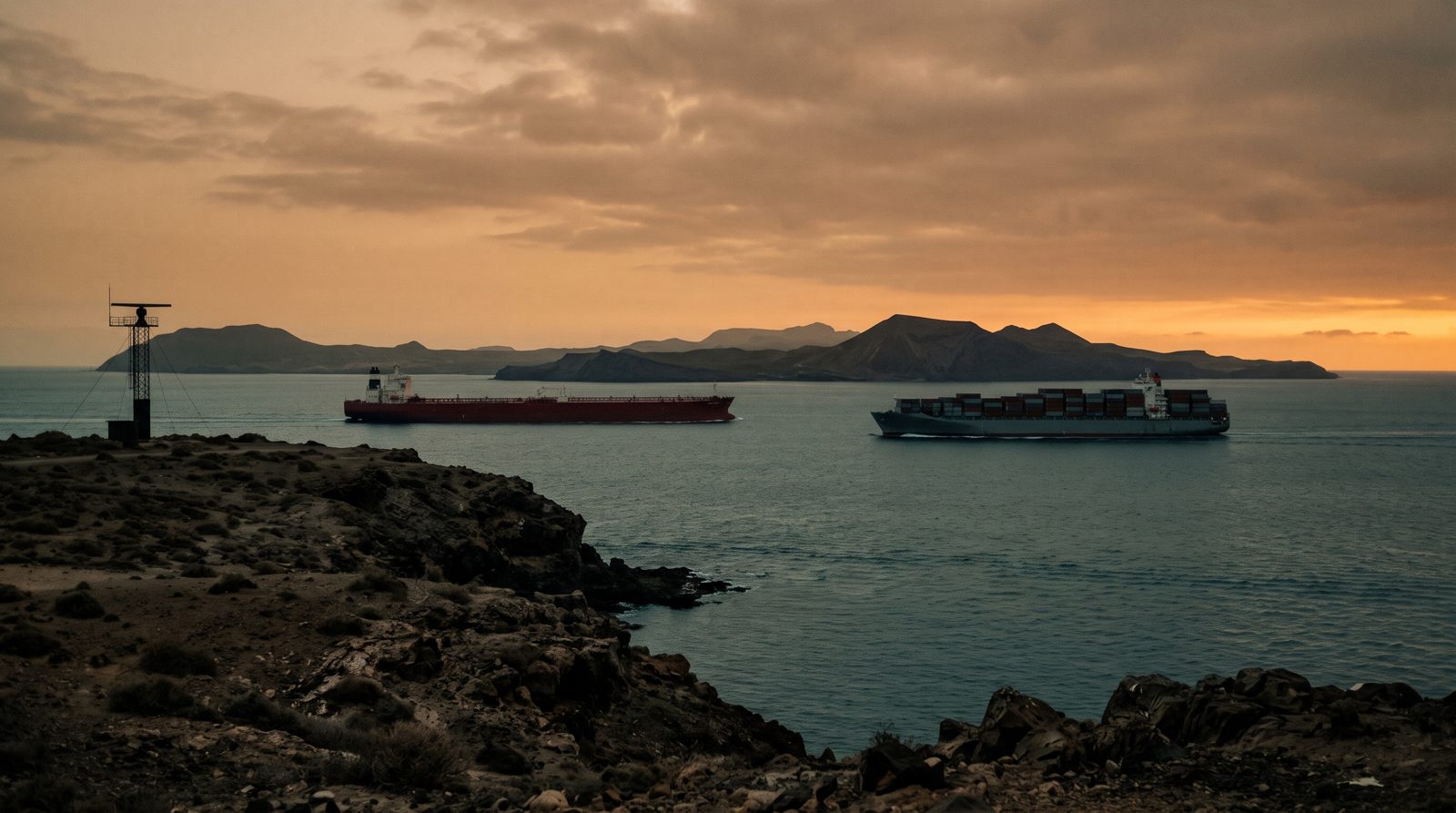
TL;DR: Red Sea shipping intelligence, facts checked in November 2026
- The Red Sea is open, and the Suez Canal is busier than at any point since late 2023, but the route is not equally safe for every ship. UKMTO's weekly overview of November 13 and Lloyd's List Intelligence's November 12 brief both report no attack on merchant shipping since August 24. The Joint Maritime Information Center's update of November 15 still rates the threat in the southern Red Sea as "substantial."
- Risk now depends on who a ship is, not only where it sails. Since the Houthis declared an embargo on Saudi shipping on July 20, Reuters has reported war risk quotes of about 0.2 to 0.3 percent of a ship's value for tankers with no Saudi connection, about 3 percent for Saudi-linked tankers calling at Yanbu, and above 7 percent for calls further south.
- Part of the recovery is a war statistic. The Suez Canal handled 1,490 ships in October, its busiest month since the crisis began, helped by the closure of Hormuz, which pushed Saudi crude to the Red Sea. Bab al-Mandab traffic was still 46 percent below pre-crisis levels in October, by Lloyd's List Intelligence's count.
- Free and paid transit counters disagree, sometimes on direction, because many ships cross with tracking switched off. Below: current readings, targeting, insurance, a timeline, a source comparison and a pre-voyage check.
Red Sea shipping intelligence in November 2026 comes down to one finding: the route is open, canal traffic is at its highest since the attacks began in late 2023, and it remains dangerous for a specific class of ship. Yemen's Houthi movement says vessels linked to Saudi Arabia may not pass. Almost everyone else is crossing, in growing numbers, at a fraction of the insurance cost. Knowing which group a ship falls into, and how it looks from the Yemeni shore, is now most of the work.
That is a change from the first phase of the crisis. Between late 2023 and late 2025, the Houthis attacked more than 100 merchant ships, sank four and killed at least nine seafarers, according to tallies by Reuters and the Associated Press. Most large carriers simply left, and the question for a shipowner was close to binary: go around Africa or accept the risk. In 2026 the question has split in two. One answer applies to a Chinese-owned container ship bound for Europe, another to a Saudi-flagged tanker that has just loaded at Yanbu.
This guide is for the people who make that call or have to explain it: charterers, shipowners, traders, insurers and analysts. It gives the current numbers with sources and dates, the targeting logic, the cost of insurance, the crisis timeline, a comparison of intelligence sources and a pre-voyage check. One image runs through it. The southern Red Sea no longer behaves like a minefield, which hurts whoever wanders in. It behaves more like a border post, which looks at your papers first.
The Red Sea shipping intelligence picture in November 2026
These are the readings that matter, each with its source and date. All were checked between November 14 and 16, 2026.
| Indicator | Latest reading | Source and date |
|---|---|---|
| Attacks on merchant ships | None reported since August 24, 2026 | UKMTO weekly overview, November 13; Lloyd's List Intelligence Red Sea Brief, November 12 |
| Official threat level | Southern Red Sea and Bab al-Mandab: substantial. Gulf of Aden: substantial. Northern Red Sea and Suez: moderate | Joint Maritime Information Center (JMIC) Update 114, November 15 |
| Unexplained events | A large explosion observed near Bab al-Mandab on November 6, cause unknown | Lloyd's List Intelligence, November 12 |
| Bab al-Mandab transits | 1,363 in October by ships over 10,000 dwt: up 43 percent on a year earlier, 46 percent below pre-crisis levels | Lloyd's List Intelligence, November 12 |
| Suez Canal transits | 1,490 vessels in October, up 32 percent on October 2025; revenue $724 million | Suez Canal Authority chairman Osama Rabie, November 5 |
| Container ships at Bab al-Mandab | 426 transits in October, against 230 a year earlier; about half of container transits are "dark," by the same estimate | Lloyd's List Intelligence, November 12 |
| War risk premium, tanker with no Saudi link | About 0.2 to 0.3 percent of hull value, often with discounts | Reuters, citing four industry sources, September 25 |
| War risk premium, Saudi-linked tanker | About 3 percent at Yanbu; above 7 percent for calls south of Yanbu | Reuters, September 25 |
| Insurance listed area | Red Sea south of latitude 25.5 north (Egyptian waters excluded), Gulf of Aden, plus Yemen and Saudi Arabia | Joint War Committee circular JWLA-035, September 16 |
| Declared Houthi policy | Navigation "safe" except for vessels covered by the embargo on Saudi shipping | Houthi statement of September 10, reported by Lloyd's List |
Two things stand out. The calm is real but young: the last confirmed strike on a merchant ship came less than three months ago, and it hit a Saudi supertanker. And the official threat rating has not moved with the traffic. JMIC still rates the southern approaches as substantial, and Lloyd's List Intelligence reports that UKMTO has logged more cases of ships being contacted by people claiming to be Yemeni authorities.
There is a second threat in the same waters, and it has nothing to do with Saudi Arabia. Piracy has returned to the Gulf of Aden and the Somali Basin. The Tanzanian-flagged tanker Asana, seized on July 17 about 65 nautical miles southwest of Mukalla, was still being held in November, according to JMIC updates and UKMTO. On November 16 UKMTO warned that a tanker had been approached by a possible mothership and a skiff carrying armed men about 430 nautical miles east of Socotra.
The traffic is voting for recovery. The threat ratings are not, and both can be right at once.
From minefield to border post: how the threat changed in 2026
The literal mechanism is a targeting rule. On July 20, 2026, the Houthis declared what they called a maritime embargo on Saudi Arabia, a "siege for a siege," as the Associated Press and The National reported. The movement framed it as retaliation for Saudi restrictions on sea and air travel to Yemen, which Riyadh enforces at the request of Yemen's internationally recognised government to block Iranian weapons, according to an analysis by the Foundation for Defense of Democracies' Long War Journal. The statement did not define which ships it covered.
The attacks that followed filled in the definition. On July 22 the Saudi-flagged products tanker Encelia was struck about 70 nautical miles southwest of Al Shuqaiq and caught fire; UKMTO reported the strike and the Saudi state news agency confirmed the fire. Saudi Arabia confirmed on July 24 that the Saudi-operated tanker NCC Masa had been damaged and had continued its voyage. On August 24 the Saudi-flagged supertanker Amzan, owned by the national shipping company Bahri, was hit about 63 nautical miles west of Yanbu, far north of the Houthi coast. Its crew were unhurt, and the Houthis claimed the attack. Martin Kelly of the security firm EOS Risk Group told gCaptain that the pattern fitted ships that are Saudi-flagged, Saudi-owned or managed, or calling at Saudi ports, and that there had been no confirmed attacks on non-Saudi ships solely because they had called at Saudi Red Sea ports.
The written rules are broader than the attacks so far. The Houthis' Humanitarian Operations Coordination Center, which also issued their January 2025 notice to shipping, followed the declaration with a notice that "all vessels loading or discharging cargo at or from any Saudi ports are prohibited," gCaptain reported on July 22. The EU naval mission Aspides read that as an embargo defined by commercial activity at Saudi ports rather than by flag or ownership, and advised ships linked to Israeli, US or Saudi interests to avoid the Red Sea and the Gulf of Aden until the threat decreased. The gap between the notice and the record matters: the list on paper is long, while the confirmed strikes have hit Saudi tonnage.
On September 10, Houthi forces took the port of Mokha, roughly 70 to 80 kilometres north of the Bab al-Mandab strait, according to Reuters and AFP reports carried by The National and Euronews. Some reports also put them on the strait's islands, including Perim, though that was less consistently confirmed. The same day, the movement said navigation in the Red Sea remained safe except for vessels covered by its embargo on Saudi shipping. Lloyd's List summed up the effect: safe for most shipping, while Saudi-linked vessels "remain firmly within their declared targeting criteria." The US Maritime Administration's current advisory for the region, issued on September 23, adds that ships belonging to fleets that call at Saudi ports face a higher risk.
That is why a minefield is the wrong mental model. A minefield is indifferent: it damages whatever crosses it, and the only useful intelligence is where the mines lie. The 2026 Red Sea works more like a border post on a contested frontier. The guard has a list, announced loosely and enforced with missiles, and the guard decides who passes by reading papers: flag, owner, manager, last port, next port, cargo. For most ships the post is open. For a few, it is shut. Intelligence that describes only the road, without describing the traveller, now answers the wrong question.
The defending side of the frontier changed too. On July 30, Saudi Arabia's defence ministry announced a multinational maritime coalition for the Red Sea, Bab al-Mandab and the Gulf of Aden with 13 other countries, among them Egypt, Pakistan, Turkey, Qatar and Djibouti, according to Anadolu Agency and Al Jazeera. The United States and the European Union were not among the founding members. The coalition belongs to a wider pattern of the Gulf's new defence pacts, and so far it has not changed the targeting rule. The EU's own escort mission, Aspides, has a mandate running to February 28, 2027, but Lloyd's List Intelligence reported on November 12 that EU governments have not supplied the extra warships the mission asked for.
In 2024 the first question was where the missiles were. In 2026 it is who the missiles are looking for.
The papers ships now show at Bab al-Mandab
If the threat reads papers, ships answer with papers, and they do it in a field that was never designed for the purpose. Merchant ships broadcast an Automatic Identification System (AIS) signal with their position, identity and a free-text "destination" field. In the Red Sea that field has become a declaration to the shore.
An analysis published on August 5 by Breakwave Advisors, built on Vortexa ship-tracking and cargo data, logged 175 tanker transits of Bab al-Mandab in the 13 days after the July 20 embargo. In 141 of them, or 81 percent, the destination field carried text beyond a port name. Twenty-nine announced armed security on board. Twenty-one named a nationality or owner, with entries such as "CHINA CREW & OWNER," "ALL CREW CHINESE" and "RUSSIAN CREW ONBOARD." Eight stated what the cargo was not, for example "SUEZ NO SAUDI CARGO." The maritime analytics firm Windward separately recorded a Malta-flagged products tanker switching its destination to "NO LINK ISR/US/UK" before going dark in the Gulf of Aden in late July.
The Breakwave study found that most "no Saudi cargo" messages came from ships that had never carried Saudi crude, such as cargoes loaded in Sudan, India or Southeast Asia, which suggests the messages were mostly precautionary. Ships that did carry Saudi-origin crude mostly avoided the strait or crossed without any signal. That second option points to the other half of the picture: ships that show no papers at all. Lloyd's List Intelligence counted an average of 70 tankers a month moving through the Red Sea with AIS switched off between April and June, rising to 86 in July. Windward reported that by late July, tankers at berth in Yanbu were operating entirely dark. And by November, Lloyd's List Intelligence estimated that about half of all the container ship transits it tracks in the Red Sea were dark.
Here the border-post comparison needs a caveat, because the real guard is worse at the job than the image suggests. The papers are self-declared, and nobody verifies them; the Breakwave authors stress that destination-field text cannot be checked. The list is vague. And ships whose papers did not match the list have still been hit. On August 4 the Indian-flagged trading vessel Faize Noore Oliya sank about 13 nautical miles south of Hodeidah after being struck, and all 14 crew were rescued, according to FreightWaves and Maritime Executive. On August 11 the Egyptian-owned cargo ship Tihamah was attacked at anchor northeast of Perim Island; Yemen's government said four crew and two rescuers were killed, the rescuers in a follow-up strike, Reuters and Al Jazeera reported. Neither attack was claimed, and the Yemeni government blamed the Houthis. On the public record, neither ship fits the declared Saudi profile.
Papers lower the risk. They do not remove it, because the border post is also a battlefield.
The turn: the busiest month since 2023 is partly a war statistic
Most coverage reads the canal numbers as a scoreboard. Traffic up means the crisis is easing; traffic down means it is back. October's figures invite that reading. The Suez Canal Authority said 1,490 vessels used the canal that month, the highest monthly total since the crisis began in October 2023, carrying 88 million net tons and earning $724 million, against 1,128 vessels and $373 million a year earlier. Back in July, canal revenue had already reached about $505 million, the highest monthly figure since December 2023, according to data from Egypt's statistics agency reported by Bloomberg and Lloyd's List.
Look at why, though, and the scoreboard flips. Bloomberg and Lloyd's List both attributed much of the summer's rise to the war with Iran. Since the United States and Israel struck Iran on February 28, the Strait of Hormuz has been largely closed to normal traffic, and Saudi Arabia has pushed crude across the peninsula through Saudi Arabia's East-West pipeline to Yanbu, on the Red Sea. After the Houthi embargo, Lloyd's List Intelligence reported in August, supertankers carrying Yanbu crude chose to leave north through Suez and avoid Bab al-Mandab altogether.
The two ends of the sea now tell different stories about tankers. At the northern gate, Lloyd's List Intelligence counted 301 crude tanker voyages through Suez in the four weeks to October 25, the most since mid-2023. At the southern gate, the firm's tracking of mainstream tankers in the southern Red Sea showed 91 transits in the week before the embargo and 53 in the week after, and its November brief says the recovery at Bab al-Mandab is being driven by container ships "rather than crude tankers." The free IMF PortWatch data we pulled shows the same shape on its AIS-based count: tanker transits of Bab al-Mandab dropped by roughly two-fifths after July 20, while tanker transits of Suez held steady at about 16 a day.
So much of the oil filling the canal's record month never touches the southern strait at all. It enters the Red Sea by pipeline and leaves by Suez. The record says less about the Houthis standing down than about Hormuz staying shut.
A rising Suez count no longer proves the Red Sea is safer. Part of it proves that Hormuz is closed.
Bab al-Mandab, Hormuz and the Iran blockade: two chokepoints, one war
For anyone pricing a Gulf or Red Sea voyage in 2026, the two straits have become one system. Hormuz has the larger volumes and the bigger diplomacy, from the fight over who runs Hormuz to the war-damages claims now before the UN Security Council. The Red Sea is where much of the displaced oil ends up.
Three facts tie them together. First, Hormuz remains a war zone: UKMTO had recorded 144 security events in the area since the conflict began, through the end of October, with ships able to continue their voyages in about three-quarters of cases, according to Lloyd's List Intelligence's November 5 Hormuz brief. JMIC rates the threat there as severe. Second, the "Iran blockade" that traders discuss is an American operation. Washington began enforcing the US naval blockade of Iranian ports on April 13, according to US Central Command statements reported by gCaptain and Gulf News, and in early November the command put the number of merchant vessels redirected at 144, Lloyd's List Intelligence reported. Third, the Red Sea bypass depends on Houthi restraint toward everyone except Saudi Arabia, with little outside protection. Pankaj Khanna, chief executive of Heidmar Maritime Holdings, told Reuters in September that "it's easier to do the Strait of Hormuz right now," because the United States provides some cover there and none in the Red Sea.
Any move on the Iran front therefore reaches Bab al-Mandab quickly. A Hormuz deal would pull tankers back to the Gulf and drain some of the Suez boom. A new escalation, such as a renewed Israeli or US strike on Iran, could widen the Houthi target list beyond Saudi Arabia, as Houthi officials threatened on March 2.
Tankers
Tankers carry the sharpest split. Saudi-linked crude and product tankers are the declared targets, and many of them now leave the Red Sea northward through Suez. Other tankers still cross Bab al-Mandab, many of them broadcasting their nationality or switching AIS off. Dryad Global's chief executive told Reuters in September that tanker transits of the strait were "only a handful of vessels per day."
Container ships
Container lines are the clearest sign of recovery. Maersk had moved its AE15 Asia-Europe loop and a second service back to the Suez route by July, Lloyd's List reported. Lloyd's List Intelligence counted 426 container ship transits of Bab al-Mandab in October, up from 315 in September and 230 a year earlier, and more than 100 Suez transits by the largest container ships since early September. On November 12 the firm reported that Evergreen had become the last Ocean Alliance carrier to resume Suez transits, ending an absence of nearly three years. The same brief warned that the capacity coming back, combined with slowing demand, risks pushing the Asia-Europe trade toward oversupply.
Cargo vessels and car carriers
Lloyd's List Intelligence's preliminary data in late October showed growth at Bab al-Mandab led by container ships, general cargo ships and product tankers. Vehicle carriers are a revealing case: the firm counted 144 vehicle carrier voyages through Bab al-Mandab in the third quarter, the most since late 2023, mainly by Chinese operators while many international competitors stayed away. That is the border post again. Ships whose owners expect to be waved through are using the route; ships whose owners are unsure are not.
War risk premium and insurance: what Red Sea cover costs now
Insurance is where the identity logic turns into a number. War risk cover for the Red Sea is bought per voyage, usually for seven days, and underwriters review quotes every 24 hours, Reuters reported. The additional premium is quoted as a percentage of the ship's insured value, so even small changes add hundreds of thousands of dollars to a seven-day voyage, according to the same reporting.
Reuters' coverage traces the 2026 curve. Before the July 20 declaration, indicative premiums for the southern Red Sea stood at about 0.3 percent of a ship's value. By July 23 they had passed 1 percent, and some Saudi-linked ships and Saudi port calls were quoted as high as 3 percent, while Jeddah and Yanbu calls were then quoted around 0.1 percent. By late September, after the Amzan strike off Yanbu, the market had split cleanly. Saudi-linked tankers calling at Yanbu were quoted around 3 percent, up from under 1 percent in early July. Calls south of Yanbu, such as Jizan, could reach 7 percent; David Smith, head of marine at the broker McGill and Partners, said he had seen rates "certainly north of 7%" for all calls south of Yanbu. Tankers with no Saudi connection typically paid 0.2 to 0.3 percent, often with discounts. "If you have a Saudi connection, then you have a problem," Khanna of Heidmar told Reuters.
In money, Reuters estimated that a voyage from Yanbu could carry about $3 million in war cover, and about $7 million from Saudi ports further south or through Hormuz, against at least $100,000 before the war. Hormuz transits were quoted at 6 to 9 percent.
The terms have changed as well as the prices. On July 29, London's Joint War Committee replaced its separate listings for Saudi Arabia's Gulf and Red Sea coasts with a single listing for the whole country, and moved the Red Sea boundary of its listed waters to latitude 25.5 north, excluding Egyptian waters, according to a circular from the Hong Kong Shipowners Association. That line puts Jeddah and Yanbu inside the listed area, and the current circular, JWLA-035 of September 16, keeps it. Lloyd's List Intelligence reported in August that the International Group of P&I clubs had introduced buyback cover after reinsurers withdrew support for some war risk products, and that Saudi-owned, operated and flagged ships appeared to face blanket exclusions under charterers' buyback arrangements, while cover for other ships was assessed case by case. The Saudi cabinet has appointed Saudi Reinsurance Company to lead a national marine war risk pool, Reuters reported.
One limit applies to every number in this section. These are quoted rates. Reuters noted that agreed rates can differ and that there is no public data on what owners actually pay. Treat them as the market's opening position, not a price list.
The same water costs about ten times more for a ship with the wrong passport.
Pocket glossary: reading a Red Sea security advisory
- UKMTO. UK Maritime Trade Operations, the Royal Navy centre that takes reports from merchant ships in the region and issues incident warnings. A master in trouble calls UKMTO first.
- JMIC. The Joint Maritime Information Center, run under the Combined Maritime Forces in Bahrain. Its updates, distributed through UKMTO, give threat levels and incident summaries by area.
- Threat level. JMIC's rating of attack likelihood. "Substantial," the current rating for the southern Red Sea and Bab al-Mandab, means an attack is a strong possibility; "severe," the rating for Hormuz, is higher.
- MSCIO. The EU's maritime security centre for the Indian Ocean, formerly known as MSCHOA, which registers ships and issues alerts alongside the Atalanta and Aspides missions.
- Listed area. Waters that London's Joint War Committee names as enhanced risk. Entering one usually means notifying war underwriters in advance, and an additional premium may be charged.
- AWRP. Additional war risk premium, the per-voyage charge quoted as a percentage of hull value.
- Dark transit. A passage with AIS switched off. It hides a ship from attackers and from free trackers alike, which is why counts disagree.
- Destination-field message. Free text a ship types into its AIS destination, such as "ALL CREW CHINESE," to signal who it is not.
- Saudi-linked. The working definition used by security firms: Saudi-flagged, Saudi-owned or managed, or calling at Saudi ports. The Houthi notice bans ships loading or discharging at any Saudi port, but the confirmed attacks so far have hit Saudi tonnage.
Red Sea crisis timeline, 2023 to 2026
The crisis has run in three phases: the main Houthi campaign of 2023 to 2025, a pause from late 2025, and the Saudi-focused campaign that began in July 2026 inside the wider Iran war. Each date below is confirmed by at least two independent reports or by an official statement.
- November 19, 2023. Houthi forces seize the car carrier Galaxy Leader in the southern Red Sea and take its 25 crew to Hodeidah.
- December 15 to 18, 2023. Maersk and Hapag-Lloyd pause Red Sea transits, followed by MSC and CMA CGM. On December 18 the United States announces Operation Prosperity Guardian.
- January 12, 2024. The first US and UK strikes on Houthi targets in Yemen.
- February 19, 2024. The European Union launches its defensive naval operation, Aspides.
- March 2 and 6, 2024. The Rubymar sinks, the first ship lost. Four days later three crew are killed on the True Confidence in the Gulf of Aden, the first deaths.
- June and August 2024. The Tutor sinks after a June 12 attack, with one crew member missing and presumed dead. The tanker Sounion is attacked and set ablaze in August and later towed away without a spill.
- January 2025. After the Gaza ceasefire of January 19, the Houthis say they will target only Israel-linked ships. Galaxy Leader's crew are freed on January 22.
- March 15 to May 6, 2025. A large US air campaign against the Houthis ends in an Oman-brokered ceasefire that covers US ships but not Israel.
- July 2025. The Magic Seas and the Eternity C are sunk. At least four of the Eternity C's crew are killed and others go missing; the United States says some were abducted.
- September 29, 2025. The Dutch-flagged Minervagracht is hit in the Gulf of Aden, and one crew member dies.
- November 2025. After the October Gaza ceasefire, the Houthis signal a halt to attacks on shipping.
- February 28 to March 2, 2026. The United States and Israel strike Iran, and Hormuz closes to most traffic. Houthi officials threaten to resume attacks on shipping, and Maersk sends some services back around the Cape.
- July 20, 2026. The Houthis declare a maritime embargo on Saudi shipping. Strikes on Saudi-linked tankers follow from July 22.
- July 30, 2026. Saudi Arabia and 13 other states announce a Red Sea maritime coalition.
- August 4, 11 and 24, 2026. The Faize Noore Oliya sinks off Hodeidah; six people are killed in the attack on the Tihamah near Perim, by the Yemeni government's count; the Saudi supertanker Amzan is hit west of Yanbu.
- September 10, 2026. Houthi forces take Mokha, on the approach to Bab al-Mandab.
- October 2026. The Suez Canal records its busiest month since the crisis began, with 1,490 transits.
- November 2026. No attack on merchant shipping reported since August 24; JMIC keeps the southern Red Sea at "substantial."
The Africa Center for Strategic Studies, a US Defense Department academic institution, counted 12 Houthi attacks or attempted attacks on commercial ships in the southern Red Sea between July and late September 2026. We found no credible public tally covering the whole of 2026.
Free and paid sources of Red Sea intelligence, compared
Red Sea intelligence comes from three kinds of source: official advisories, which are free and authoritative but slow to describe trends; open data, which is free and quantitative but blind to ships that go dark; and commercial services, which fill both gaps for a fee. Each entry reflects the source's own pages in mid-November 2026.
| Source | Run by | What you get | Cost | How current (mid-November 2026) | Blind spot |
|---|---|---|---|---|---|
| UKMTO warnings and weekly overview | Royal Navy | Incident warnings, a weekly regional overview, the voluntary reporting scheme for ships | Free | Warning issued November 16; overview No. 15 dated November 13 | Lists verified incidents only; says little about traffic or prices |
| JMIC advisory updates | Combined Maritime Forces, Bahrain | Threat levels by area, incident summaries, Houthi and piracy context | Free | Every three to four days; Update 114 dated November 15 | Its weekly dashboard and monthly statistics pages lag months behind |
| US MARAD advisories | US Department of Transportation | Six-month advisories and short alerts | Free | Advisory 2026-013, in force from September 23, 2026 to March 22, 2027 | Written mainly for US-flagged and US-linked ships |
| EU Aspides and MSCIO | European Union | Close protection for some ships, registration, alerts | Free | Releases several times a week; mandate to February 28, 2027 | Few warships for a large area; some pages are out of date |
| Joint War Committee listed areas | London insurance market (LMA and IUA) | Where war cover requires notice and may cost extra | Free circular | JWLA-035, September 16, 2026 | Says nothing about price or about which ships are targeted |
| IMF PortWatch | International Monetary Fund | Daily transit counts by ship type for 28 chokepoints, with an open data feed | Free | Latest day November 8 when checked on November 16 | Built on AIS, so it misses dark transits |
| Lloyd's List Intelligence Red Sea Brief | Lloyd's List Intelligence | Transit analysis for ships over 10,000 dwt, including dark transits it identifies | Brief free; full platform paid | Fortnightly; latest November 12 | One provider's sample; ship-level detail sits behind the paywall |
| Suez Canal Authority | Government of Egypt | Official canal transits, tonnage and revenue | Free | Quarterly statistics online; October figures given in a November 5 statement | No security information; monthly data appear mainly in statements |
| Maritime security firms (Ambrey, EOS Risk Group, Dryad Global, Vanguard Tech) | Private companies | Voyage and port risk assessments, alerts, round-the-clock watchkeeping | Paid; Dryad Global lists a voyage assessment at £400 and a plan at £99 a month | Continuous | Cost; methods are proprietary |
| Ship-tracking analytics (Windward, Kpler, Vortexa, S&P Global) | Private companies | Ship-level tracking, dark-activity detection, cargo origin | Paid platforms; free blogs | Continuous | Price and access; public posts are selective |
The table cannot show how differently the counters behave, so we tested that. On November 16, 2026 we pulled the IMF PortWatch daily series for Bab al-Mandab, Suez and Hormuz through its public data feed; the most recent day available was November 8, an eight-day lag. At Suez, the counts agree closely. PortWatch logged 1,335 canal transits in October, Lloyd's List Intelligence counted 1,338 ships over 10,000 dwt, and the canal authority, which counts every vessel, reported 1,490. A ship cannot pass through a canal without dealing with the people who run it.
At Bab al-Mandab the counters disagree even on direction. PortWatch logged 864 transits in October, down from 1,119 a year earlier. Lloyd's List Intelligence counted 1,363, up 43 percent on a year earlier. UKMTO's November overview put traffic about 24 percent below its level before the July embargo. The gap is mostly dark ships: an AIS-based counter cannot see a vessel that is not broadcasting, and in a strait where about half the container ships cross with AIS off, that is a large blind spot. Hormuz shows the same effect in extreme form: PortWatch saw 118 transits in the whole of October, while Lloyd's List Intelligence was counting more than 100 a week of non-Iranian-linked cargo ships.
The practical rule follows. Free AIS counts are good for spotting a trend at a glance and for canal traffic. They are a poor basis for a statement about how many ships are "back" at Bab al-Mandab. Anyone writing a client note, a trading view or a board paper should name the counter used and say what it cannot see. For context on how forecasting tools performed in this war, see our look at how intelligence estimates fared against market forecasts and at what prediction markets priced about Hormuz traffic.
Who should not rely on free sources alone: owners and charterers of Saudi-linked tonnage, operators of fleets with any Saudi, Israeli or US connection, and anyone whose cargo or crew would make a ship a target. For them, a paid voyage assessment and direct contact with the naval centres are a minimum, not an extra.
What we know, and what we don't
Several parts of this picture are solid. The July 20 embargo, the strikes on Encelia, NCC Masa and Amzan, the capture of Mokha and the October canal record are each confirmed by official statements or several independent outlets. The insurance figures are well sourced, as quotes.
Other parts are weaker. The Houthis claimed hits on ships, including the supertanker Layla in July, that nobody has independently confirmed. The two deadliest incidents of the summer, the sinking of the Faize Noore Oliya and the attack on the Tihamah, were never claimed, and their attribution rests on Yemen's government. The cause of the large explosion near Bab al-Mandab on November 6 is still unknown. Who holds which island in the strait has been reported inconsistently since September. The transit counts disagree, as shown above. And there is no public record of the premiums owners actually pay.
Finally, "no attack since August 24" describes the past, not the future. JMIC still rates the threat as substantial. In August the Long War Journal reported that Saudi Arabia had discussed de-escalation with the Houthis through Oman, which Riyadh denied, and no Saudi-Houthi arrangement has been announced since.
A pre-voyage Red Sea risk check in eight steps
The steps below turn the border-post logic into a routine. They do not replace a security provider's voyage assessment, and owners of Saudi-linked tonnage should treat them as a floor.
- Read the latest JMIC update and UKMTO warnings for the southern Red Sea, Bab al-Mandab and the Gulf of Aden, and note the date of each. In this sea, a two-week-old advisory is history.
- Write down the ship's papers as the shore would read them: flag, registered owner, manager, operator, charterer, last three ports, next port and cargo origin. Any Saudi link in that list puts the ship inside the declared target profile.
- Check the fleet, not only the ship. MARAD's current advisory warns that ships in fleets that call at Saudi ports face higher risk, so a sister vessel's trading pattern can count against a ship whose own record is clean.
- Get a war risk quote early, and again on the day of entry. Quotes are reviewed every 24 hours, and the gap between a Saudi-linked ship and an unlinked one is roughly tenfold.
- Agree on AIS behaviour before entering the area, with the security provider and in line with flag-state guidance. Going dark and broadcasting a declaration both carry costs, and neither is a guarantee.
- Register with UKMTO's voluntary reporting scheme and brief the crew on how to respond if contacted by anyone claiming to be Yemeni authorities, which UKMTO says is happening more often.
- Compare at least two transit counts before telling a client that "traffic is back," and say which counter you used and whether it sees dark ships.
- Set re-routing triggers in advance. Name the events that would send the ship around the Cape: a confirmed attack on a ship with a similar profile, a change in JMIC's rating, a Houthi statement widening the embargo, or a break in the Iran talks.
Reading the shore, not the sea
For two years, Red Sea intelligence meant mapping danger onto water: which stretch, which hours, how far from the Yemeni coast. That work still matters, because the guard at this border post carries a gun and does not always check before firing. But the larger change in 2026 is that the danger has moved from the map to the manifest. The same sea, on the same day, is a reopened trade route for one ship and a closed frontier for another, and insurers have already priced the difference at about ten to one.
So the useful question is no longer whether the Red Sea is safe. It is how a particular ship looks from Hodeidah and Mokha, and how quickly that view could change if the Iran war moves. Our energy coverage and conflict reporting will keep tracking both. The people who read the Red Sea best this year have been the ones who stopped watching only the water and started watching the guard.
FAQ
Is the Red Sea open to shipping right now?
Yes, with a large exception. As of mid-November 2026, no attack on a merchant ship had been reported since August 24, and the Suez Canal had its busiest month since 2023 in October. But the Houthis still declare Saudi-linked ships a target, JMIC rates the threat as substantial, and Bab al-Mandab traffic remains about 46 percent below pre-crisis levels, by Lloyd's List Intelligence's count.
Which ships are the Houthis attacking at Bab al-Mandab and in the Red Sea?
Since their July 20, 2026 embargo, the declared targets are Saudi-linked ships: Saudi-flagged, owned or managed, or tied to Saudi ports. Confirmed strikes hit the Saudi tankers Encelia, NCC Masa and Amzan. Two unclaimed summer attacks hit Indian and Egyptian vessels, so other ships are not risk-free, and in July the EU mission Aspides told ships linked to Israeli, US or Saudi interests to avoid the area.
How much is the war risk premium for the Red Sea?
It depends on the ship. In late September, Reuters reported quotes of about 0.2 to 0.3 percent of hull value for tankers with no Saudi connection, about 3 percent for Saudi-linked tankers calling at Yanbu, and above 7 percent for calls south of Yanbu. Cover usually runs for seven days, quotes are reviewed daily, and agreed rates are not published.
What is the Red Sea crisis timeline in brief?
The Houthis seized Galaxy Leader on November 19, 2023, then attacked more than 100 ships through 2025, sinking four. They paused after the October 2025 Gaza ceasefire. After the US and Israel struck Iran on February 28, 2026, they declared an embargo on Saudi shipping on July 20, hit Saudi tankers through August and took Mokha on September 10.