The Board of Peace Fears Gaza's Truce Will Collapse. The Bigger Risk Is That It Holds
TL;DR
- On November 17, exactly one year after the Security Council endorsed it, Donald Trump's Board of Peace sent the Council its second report on Gaza. According to copies seen by Reuters, the Associated Press and the Times of Israel, the report says both Israel and Hamas have failed to meet their commitments, and it warns that the truce could collapse.
- Almost every piece of the plan is still waiting. The Palestinian technocratic committee is still in Cairo, vetted police recruits are still waiting for Israel to let them leave for training, the stabilization force has not deployed, and about $280 million of roughly $17 billion in pledges has been put to work.
- The usual reading is that the ceasefire is about to break. Our reading is that the bigger risk is the opposite: a truce that holds with nothing built on top of it, until its temporary line becomes a border.
On Wednesday, November 18, two things happened on Gaza's northern and central edges within a few hours of each other. At the Erez crossing, closed to aid since February 2025, a vehicle scanner on loan from Germany began inspecting humanitarian trucks. A security source told the Times of Israel that only a few dozen trucks would pass through it before going on to Kerem Shalom for a second check. The ceasefire terms call for 600 trucks a day.
Later that day, Israeli tanks pushed west of the Yellow Line into central Gaza. Witnesses told Reuters that some reached the Salahudeen road, the strip's main north-south artery, and dozens of displaced families left their tents. The Israeli military said it was targeting Hamas infrastructure and called it the first ground operation since the ceasefire took effect in October 2025. The National reported that the advance came near the Bureij and Nuseirat camps. Hamas called it a violation and a "dangerous escalation."
So on one day there was a small opening and a small advance. Neither undid the ceasefire, and neither moved it forward. That stalemate is the subject of the twelve-page report the Board of Peace sent to the UN Security Council the day before.
The report's headline warning, reported by Reuters and the AP, is that "a ceasefire that delivers nothing visible cannot be sustained indefinitely." The coverage that followed took this at face value: both sides are failing, so the truce may collapse. This piece questions that reading. A ceasefire that delivers nothing visible has, in fact, lasted for thirteen months. What it has produced is not reconstruction or a new administration. It has produced a line. The section after the Board's own account explains why that line, and not a sudden collapse, is the outcome to watch, and why Israel's unfinished election makes it more likely.
What the Board told the Council
Start with the document, since it is easy to over-read. The Board of Peace is the body Trump set up to oversee his 20-point plan for Gaza. On November 17, 2025, the Security Council adopted Resolution 2803 by 13 votes to none, with China and Russia abstaining. The resolution welcomed the Board as a transitional administration, authorized a temporary International Stabilization Force under a command acceptable to the Board, and kept both authorized until the end of 2027. The UN's own meeting coverage records the vote. China called the text "vague and unclear" on the structure and terms of reference of the Board and the force.
The Board's first report covered the period up to mid-May 2026. Nickolay Mladenov, the former UN Middle East envoy who serves as the Board's High Representative for Gaza, briefed the Council on it on May 21. The November report is the second. The AP described it as the first annual assessment, and Reuters and the Times of Israel counted it as the second report. Both descriptions are correct, because it is the second six-monthly report and it marks the plan's first year. Reuters reported that the Board is expected to present the findings at a Council meeting in New York at the end of November.
On substance, the outlets that saw the text agree on the main points. The report says the gap between what was agreed and what is happening on the ground is "the principal risk to the process." It says Israel has not let the technocratic civil administration begin work inside Gaza, and has not made the decisions needed to train, deploy and return a civilian Palestinian police force. It calls on the Israeli government "to take these decisions without delay." It says Israeli restrictions on supplies and equipment, together with funding shortfalls, have held back winter preparations, and that civilians face "another winter in tents and rubble." Reuters added that the report says near-daily Israeli strikes delay any test of whether Hamas will keep its commitments.
The report is just as direct about Hamas. It says Hamas military activity has continued, including attacks on Israeli troops, and that the commitment to stop military operations "has not been met in full by the parties." Reuters and The National both report that the Board accuses Hamas of taxing goods that enter Gaza, which drives up the cost of basic commodities. The AP quoted a line meant for both sides: "Neither party may treat the other's delay as license for its own inaction."
The change in tone since May matters. The Times of Israel reported at the time that the May report named "Hamas's refusal to accept verified decommissioning" as "the principal obstacle," and noted Israeli violations without naming Israel. Six months later, the Board spreads the blame almost evenly, and its most specific demands are addressed to the Israeli government. The Times of Israel also reported that the Board largely held back from pressing Israel during the campaign for the October 27 election. The November report reads like a body that has decided the campaign is over and its restraint can end too.
In May, the Board's main complaint was about weapons. In November, it is about decisions that nobody is making.
A plan in which everything is waiting
A plan like this one rests on a few structures, each meant to replace a function that Hamas or the Israeli army now performs. Thirteen months in, the most useful way to read the report is to ask where each of those structures actually is.
The civil administration exists on paper and operates from another country. The National Committee for the Administration of Gaza, a 15-member body of technocrats headed by Ali Shaath, began work in Cairo on January 16, 2026, according to contemporaneous reports by Middle East Monitor and TRT World. Within days, Israel was reported to be blocking its members from entering Gaza. In July, Hamas announced it was dissolving its own emergency governing committee so the national committee could take over. Late in July, the Israeli government was reported to have approved the committee starting work in Gaza, without setting a date. As of this week, the report says, it has still not entered.
The police force exists as a list of names. The plan foresees 10,000 to 12,000 Palestinian officers trained in Egypt. Ynet reported that Israeli vetting has cleared about 16,000 candidates who are not affiliated with Hamas. In late October, Israel's public broadcaster Kan and the daily Israel Hayom reported that Prime Minister Benjamin Netanyahu had held back the departure of between 5,000 and 7,000 cleared recruits for training. Anadolu, summarizing Kan, reported that the postponed steps also included the entry of the stabilization force and the committee, as well as preparations for a planned new city at Rafah. Netanyahu's office has denied that the timing had anything to do with the election. It says reconstruction and a new police force will wait until Hamas has disarmed and Gaza is demilitarized.
The stabilization force exists as a commander and a set of pledges. Maj. Gen. Jasper Jeffers was named its commander in January. At the Board's first meeting in February, Indonesia, Morocco, Kazakhstan, Kosovo and Albania were named as the first troop contributors, as the Foundation for Defense of Democracies and Al Jazeera both reported. On November 9, the Jewish Chronicle, citing the Israeli outlet Walla, reported that Israel had approved an initial contingent of about 250 foreign soldiers, with no timetable. A force planned to grow to as many as 20,000 has been cleared to start with roughly one percent of that.
The money exists as pledges. At the February conference, the Times of Israel reported, the United Arab Emirates, Qatar, Saudi Arabia and Kuwait each pledged at least $1 billion, and Trump announced $10 billion from Washington, which Axios noted would need approval from Congress. The November report, as summarized by The National, counts about $17 billion in pledges, of which $280 million has been "deployed for the preparation phase." MS NOW reported in September that Board officials said they had called up $280 million so far and described the slow pace as deliberate, with money requested once delivery plans are ready. The UN-backed estimate of Gaza's recovery needs, cited by both the Times of Israel and MS NOW, is $71.4 billion over a decade.
Scorecard: the five parts of the plan, thirteen months in
- The ceasefire itself. In effect since October 10, 2025. Gaza's health authorities say more than 1,600 Palestinians have been killed since then, and the Israeli military says five of its soldiers have died. Major combat has largely stopped. Strikes have not.
- The administration. The national committee formed in Cairo in January 2026. Israel approved its work in principle in July. It has not entered Gaza.
- The police. The goal is 10,000 to 12,000 officers, and thousands of recruits have been vetted. Their departure for training was held back from October onward, according to Kan and Israel Hayom.
- The force. A commander has been named since January, and pledges came in February. Israel cleared about 250 troops in November, according to Israeli media. None has been confirmed inside Gaza.
- The money. About $17 billion has been pledged and about $280 million deployed, set against a $71.4 billion estimate of need.
Taken one at a time, each delay has an explanation, and each side's account blames the other. Taken together, they add up to something neither side's account describes. Every structure meant to replace the war's arrangements is waiting at the border, and the war's arrangements are the only ones actually working.
The turn: the truce that holds is the problem
Here is the part of the report that deserves more questioning than it has had. The Board warns that if the ceasefire collapses, "there would be no road map to return to, no administration to deploy and no enabling environment to rebuild." That is true, and it frames the danger as a cliff, something sudden and visible. But there is a second way for this process to fail, one that needs no collapse at all and is already well under way.
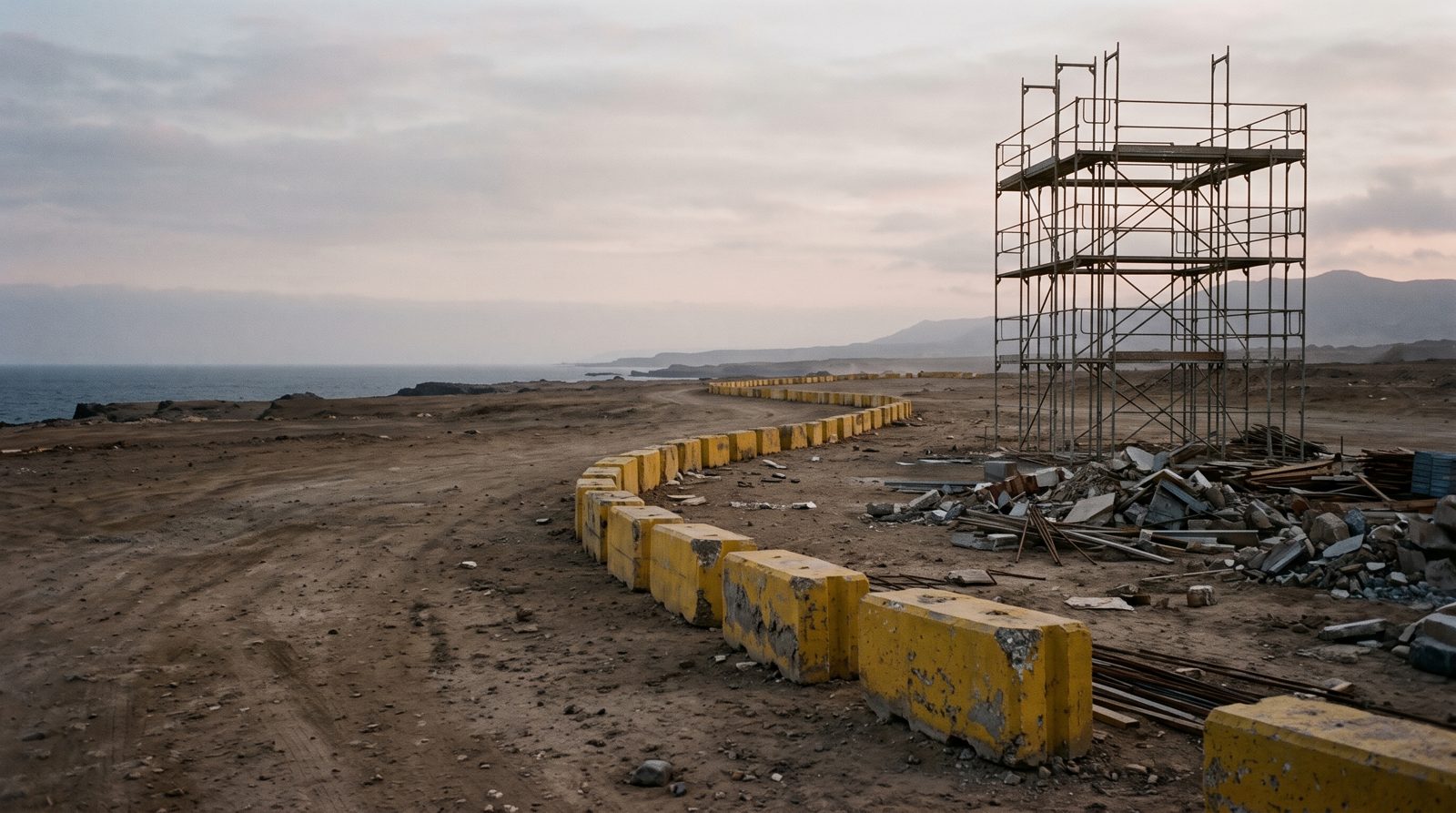
The image that fits is scaffolding. Scaffolding goes up so that a building can be built. It is supposed to be temporary, and everyone involved agrees on that. But if the building stalls, the scaffolding does not come down by itself. People start to work around it, then to depend on it, and eventually the neighbourhood forgets it was ever meant to come down.
In Gaza the scaffolding is the Yellow Line. It began as the first-phase withdrawal line of the October 2025 agreement, which left Israeli forces in about 53 percent of the strip. It was meant to be the first rung of a phased withdrawal tied to Hamas disarmament and the arrival of the stabilization force. Instead it has moved the other way. The UN's Independent International Commission of Inquiry, in its October report to the General Assembly, found that by September 2 the Israeli-controlled area had grown from 53 percent to at least 60 percent. It also found that a further restricted "Orange Line" zone set up in mid-March covers another 11 percent. Al Jazeera, citing the UN humanitarian office, put the restricted area at about 65 percent in October. Reuters now describes more than two million Palestinians crowded into roughly a third of the strip, mostly in tents and damaged buildings in areas Hamas controls.
Read against that map, the Board's central sentence turns around. A ceasefire that delivers nothing visible does not have to end. It can be sustained, as long as the parties are willing to live with what it has turned into: a partition, managed by strikes on one side and taxes on the other, with neither side bearing the full cost of governing what it holds. Israel keeps security control of most of the territory without responsibility for the people inside it. Hamas keeps its weapons and its role in the enclave it controls, without having to show it can rebuild anything. For both, this is not a good outcome. For both, it is a bearable one, and that makes it the most stable arrangement on the table.
The analogy needs one correction. Real scaffolding is inert, and this line is not: its markers have moved west repeatedly, sometimes overnight, according to Al Jazeera's mapping, and the UN inquiry's figures show the controlled area growing. Wednesday's advance happened on its far side. That makes the risk worse. A frozen line at least tells people where they stand. A moving line that everyone still calls temporary combines the permanence of a border with the uncertainty of a front.
Collapse would at least force a decision. A truce that holds without anything built on it lets everyone avoid one.
Israel's decisions are waiting on a government
The report asks the Israeli government to decide. The difficulty, which the Board's own officials anticipated, is that there is currently no government able to decide.
In September, a Board of Peace official told the Times of Israel that the panel had no leverage over Netanyahu before the election, because he had "100% entered campaign mode" and any pressure would let him run against it. The official predicted that leverage would return after October 27 regardless of who won, because no new prime minister would want to block a US-led initiative with broad international backing. The logic was simple: get past the vote, and someone accountable will be there to answer.
The vote did not produce that person. Netanyahu's bloc won 53 seats, the opposition bloc around Gadi Eisenkot won 48, and Arab-led parties won 19, a result reported by the AP and Al Jazeera. President Isaac Herzog gave Eisenkot the mandate on November 8. His initial 28 days run to December 6, with room for an extension. Netanyahu stays in office as caretaker prime minister in the meantime, with the constraints and the disputed powers this site examined last week in our piece on who holds the keys to an Israeli strike on Iran during the transition.
On the evening the Board's report reached the Council, the Knesset elected Matan Kahana of Eisenkot's Yashar party as Speaker by 66 votes to 52, over Likud's Ofir Katz. The Times of Israel reported that the vote came after a six-hour filibuster by Netanyahu's bloc. Kahana's support came from Eisenkot's four-party bloc together with both Arab parties. Likud called the result "an eternal disgrace." The next morning, the Times of Israel reported, the Knesset held preliminary votes to repeal Netanyahu-era laws on judicial appointments and the attorney general's powers.
This is where the Gaza story and the Israeli political story meet, though they are usually told separately. The new majority can control the Knesset's agenda, but it does not control the cabinet. The caretaker cabinet controls the crossings, the vetting, the troop approvals and the army's orders, but it has no new mandate. The decisions the Board is asking for are executive decisions: let the committee in, let the recruits out, set a date for the force. They need someone with both the authority and the political cover to own the result. As of this week, the authority sits with one camp and the majority with the other.
Israel's stated position has not changed through any of this. On November 18 Defense Minister Israel Katz repeated, as Reuters and The National reported, that Israeli forces will not withdraw until Hamas is dismantled and Gaza is demilitarized. Whoever forms the next government inherits that commitment, and the Yellow Line with it.
Hamas's side of the ledger
The Board's even-handedness only works if Hamas's record is examined as closely as Israel's, and that record is mixed in its own ways.
On July 30 the Board announced a 15-point roadmap for phased disarmament and Israeli withdrawal, and Hamas said it accepted it. Al Jazeera and the Long War Journal reported the announcement and the acceptance at the time. Hamas's negotiators described the acceptance in conditional terms from the start. Hamas negotiator Ghazi Hamad described the framework as difficult and painful, and analysts at the Arab Center Washington DC and the Israel Policy Forum noted that Hamas had tied any start of disarmament to Israel ending military operations, increasing humanitarian deliveries and withdrawing. Israel rejected the roadmap and insisted on full disarmament before any withdrawal. The basic dispute, which side moves first, has not changed since.
Meanwhile, the November report finds that Hamas has continued armed activity and has taxed goods entering the enclave. In September the Times of Israel quoted a second Board official saying the hold on police recruits "actually prolongs the existence in Gaza of Hamas police armed with AK-47s." That sentence cuts both ways. It blames Israel for the delay, and it confirms that Hamas's armed police are the ones filling the space while recruits wait.
This is the familiar problem of an armed movement that also runs territory. It is the same problem that faces any government trying to bring an armed group's enclave back under civilian authority, as our recent analysis of Iraq's standoff over Jurf al-Sakhar described in a very different setting. The group gives up its guns only if it trusts what comes after, and what comes after arrives only once the guns are gone. Without someone to break that loop, the guns stay and the line stays.
An old story: when ceasefire lines become borders
This region knows the pattern better than most. The borders of the Gaza Strip were never drawn as borders. They are the armistice line agreed between Egypt and Israel at Rhodes on February 24, 1949, a temporary military line that the agreement itself said did not decide final political claims. It has held for more than seven decades, through Egyptian rule, Israeli occupation, disengagement and several wars. The territory now being argued over exists in its current shape because a ceasefire line hardened.
The pattern goes well beyond Gaza. The Korean armistice of July 1953 ended the fighting without a peace treaty, and the demarcation line it drew still divides the peninsula. In Cyprus, the UN force deployed in 1964 as a temporary measure still patrols a buffer zone across the island that has existed since 1974. Each began as an interim arrangement meant to buy time for a political settlement. In each case the settlement never arrived, and the interim arrangement turned out to be more durable than anything negotiated afterward.
None of this makes partition inevitable. Lines have dissolved when a political deal was strong enough to replace them. What the history shows is the default: when the bridge that a ceasefire was meant to lead to is not built, the ceasefire line does not disappear. It becomes the outcome. Resolution 2803 recognized this risk in its own way, by giving the Board and the force a mandate that ends on December 31, 2027. That date is now a little over thirteen months away, about as long as the ceasefire has already lasted.
The wider ceasefire system in the region shows the same dynamic. The war with Iran produced its own interim arrangements around Hormuz, which our coverage of the fractured ceasefire and the architecture of a post-war Middle East tracked from April. Talks over the strait have since turned, as we argued earlier this month, into a fight over who runs it rather than whether it opens. The lesson is the same in both places: an interim regime that nobody has to sign also costs nobody anything to keep.
The numbers, and what they cannot tell you
Three sets of numbers anchor most of the coverage, and each needs a caveat.
The first is the death toll. Gaza's health authorities, quoted by Reuters and The National, say more than 1,600 Palestinians have been killed since the ceasefire began. Anadolu, citing the same ministry, gave 1,551 on October 25, which means dozens more deaths were recorded in the three weeks that followed. The ministry's figures do not separate combatants from civilians, and Israel disputes the framing of many incidents as civilian deaths. The Israeli military reports five soldiers killed over the same period. Both figures are far below wartime levels, which is the ceasefire's real achievement. Neither is consistent with a truce in the full sense.
The second is territory. The figures of 53, 60 and 65 percent are not all measuring the same thing. The first is the agreed withdrawal line. The second is the UN inquiry's measure of Israeli-controlled area by early September. The third, from the UN humanitarian office as reported by Al Jazeera, counts areas where access is restricted, which is a wider category. The trend is clearer than any single number, and the trend points west.
The third is money. The comparison between $280 million deployed and $17 billion pledged is striking, but it is not quite a measure of donor bad faith. Board officials have said they draw money as projects become deliverable, and very little can be delivered while the administration is in Cairo and heavy equipment is held at the crossings. The low drawdown is a symptom of the political block, not a separate failure. That is why it is a useful indicator: when the drawdown speeds up, it will mean the political block has started to give.
The money is not missing. It is waiting at the same crossings as the committee and the trucks.
Why the rest of the region is not watching
The Board's report landed in a week when the Council's attention, and Washington's, was mostly elsewhere. On November 17 and 18, Iran's army said it had targeted US installations at Ali Al Salem air base in Kuwait, Kuwait's foreign ministry called it a "dangerous escalation," Bahrain reported intercepting Iranian attacks, and ADNOC's shipping arm said one of its vessels had been struck in the Strait of Hormuz, with one crew member missing and eleven injured. Stars and Stripes, citing US officials, reported that a third US aircraft carrier had entered Central Command's area, which CENTCOM later confirmed. Days earlier the same Council chamber had heard Gulf states demand compensation from Iran, the dispute we covered in the Iran war's unpaid bills.
This affects Gaza directly. Several of the Board's financial backers are Gulf states now under fire or on alert. The UAE, one of the few to have transferred money, sent $100 million for police training, according to the Times of Israel. Saudi Arabia is fighting a Houthi campaign that reached its own east-west pipeline. Qatar and Turkey, two of the ceasefire's mediators, have spent the month building the new defence pacts they now see as insurance. Egypt, which hosts the Gaza committee and has offered to train the police, is also managing a Red Sea corridor that, as our Red Sea shipping intelligence briefing found, is open but heavily conditioned. Ynet reported that Indonesia, once considered for a contingent of up to 8,000 troops, withdrew during the war with Iran and is exploring a return.
A plan that depends on the sustained attention of Washington and the Gulf is competing with a regional war for both. That does not explain why Gaza has stalled, but it explains why little pressure is being applied to restart it.
What we know, and what we don't
What is established: the report exists, was delivered on November 17, and its central findings and quoted lines appear in the accounts of Reuters, the AP and the Times of Israel, each of which saw a copy. The national committee has not entered Gaza. No stabilization force deployment inside Gaza has been confirmed. The Israeli-controlled share of the strip has grown beyond the 53 percent agreed in October 2025, according to the UN inquiry. Israel's November 18 operation west of the Yellow Line was described by its own military as the first ground operation since the ceasefire.
What is reported but not settled: the precise number of police recruits vetted and held, which varies from 5,000 to 16,500 depending on the outlet and the stage of vetting described. The reasons behind the October postponements, which Kan and Israel Hayom linked to the election and which Netanyahu's office denies. The exact daily throughput at Erez, given as a few dozen by one security source and 20 trucks a day by another report. Whether the roughly 250 troops Israel reportedly approved have a deployment date.
What nobody knows yet: who will be prime minister when the Council meets later this month, and whether that person will treat the Board's demands as an inheritance or as a predecessor's commitment. Whether Hamas's July acceptance would survive an actual weapons collection process. And whether the Board, whose chairman has also become a party to the regional war, can be accepted as an honest broker while its chairman's government is also fighting a war with Iran.
How to tell a bridge from a border: six signals
Since the ceasefire's direction will show up in practical details before it shows up in statements, these are the indicators most worth tracking over the next six weeks.
- The committee's first day inside Gaza. The single clearest sign that the scaffolding is being used to build something. A date announced without an entry is not the signal. Officials physically working in the strip is.
- The first busload of police recruits leaving for Egypt. Vetting has been done many times. Departure is the decision the Board keeps asking for, and it is a decision only the Israeli government can make.
- Foreign troops on the ground, and whose. A first contingent of about 250 would be small, but it would establish the principle. The contributing country matters too, because Indonesia's return or absence will indicate whether the force can grow toward its planned size.
- The direction the line moves. The reported shifts of the Yellow Line markers since October 2025 have gone west. One movement east, tied to a step on disarmament, would show the phased design still works. More operations like Wednesday's would show the reverse.
- The drawdown ratio. Watch the share of the $17 billion that is actually being spent. While it stays near two percent, reconstruction is only planned, not under way.
- What the Council does with the report. A statement that simply "takes note" would mean the Council has accepted the stalemate. Language that sets deadlines or reporting milestones before the 2027 expiry would mean someone intends to make the interim arrangement end.
The scaffolding and the building
It is natural to read the Board's warning as a countdown, as if the danger were a single bad night when the strikes and the tunnels finally break the truce. That night may come, and the Board is right that if it does, there is nothing ready to fall back on. But the quieter outcome is the more likely one, and in the long run the more consequential: a ceasefire that never formally ends, a line that never formally becomes a border, and a plan that never formally fails, while all three slowly harden into the permanent shape of Gaza.
On November 18, a scanner opened at Erez and tanks crossed the line on the Salahudeen road. Neither event broke the arrangement, and that is the point. The scaffolding still stands, and nothing is being built inside it. The useful question about Gaza is no longer whether the ceasefire will hold. It is what is being built while it holds. Thirteen months in, the honest answer is almost nothing except the line itself. More on that line, and the diplomacy around it, is collected in our Israel-Palestine coverage.
FAQ
What is the Board of Peace?
It is the body Donald Trump created to oversee his 20-point plan for Gaza. Its charter was signed at Davos in January 2026, with Trump as chairman. The UN Security Council's Resolution 2803 of November 17, 2025 welcomed it as a transitional administration for Gaza and authorized an International Stabilization Force under a command acceptable to the Board, both until the end of 2027. Nickolay Mladenov is its High Representative for Gaza.
What does the November 2026 report say?
According to Reuters, the AP and the Times of Israel, which saw copies, it says both Israel and Hamas have failed to meet their commitments. It faults Israel for not allowing the technocratic administration into Gaza, not deciding on police training and restricting winter supplies. It faults Hamas for continued military activity and for taxing goods entering Gaza. It warns that the truce could collapse without immediate action.
What is the Yellow Line?
It is the line Israeli forces withdrew to under the first phase of the October 2025 ceasefire, which left them in about 53 percent of Gaza. It was meant to be the first stage of a phased withdrawal. The UN's Commission of Inquiry found that Israeli-controlled territory had grown to at least 60 percent by September 2026, and the UN humanitarian office put the restricted area at about 65 percent in October.
Why can't Israel simply make the decisions the Board asks for?
Formally it can. The caretaker cabinet still controls crossings, vetting and troop approvals. Politically, the October 27 election left no bloc with a majority. Gadi Eisenkot holds the mandate to form a government, the opposition now controls the Knesset speakership, and Netanyahu governs as caretaker. Decisions with long-term consequences for Gaza fall between a cabinet without a new mandate and a majority without a cabinet.