Taftan Border Crossing in November 2026: Open, Closed, or Somewhere in Between
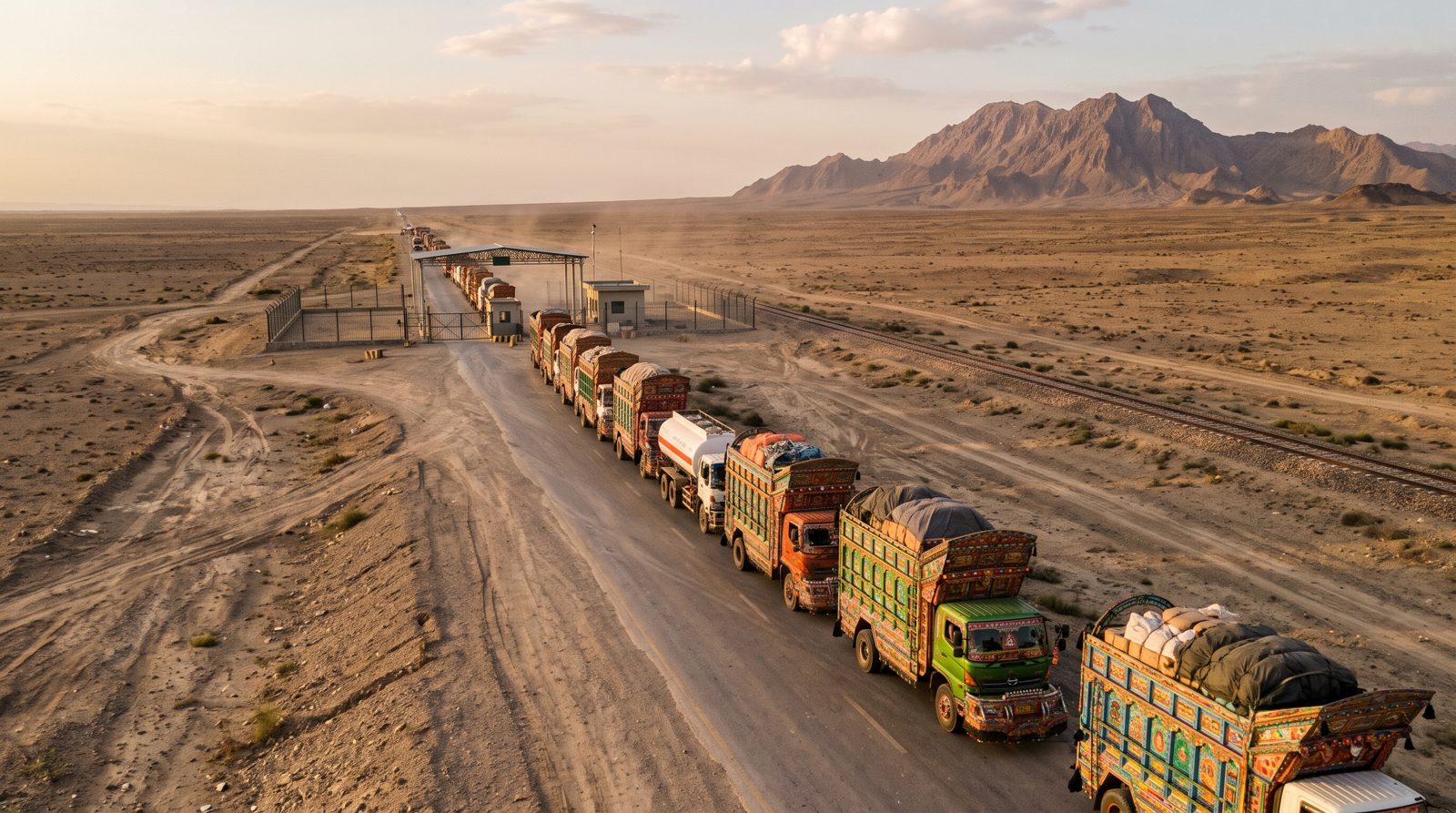
TL;DR (facts checked November 20, 2026)
- The Taftan border crossing is Pakistan's main official land gate into Iran. It sits at the town of Taftan in Chagai district, Balochistan, facing the Iranian border post near Mirjaveh in Sistan and Baluchestan, where Pakistan's N-40 highway, Iran's Road 84 and the Quetta to Zahedan railway meet.
- Right now it is partly open. Pakistan suspended commercial trade on October 17. Imports from Iran, led by LPG tankers, started moving again from October 24, but we found no confirmation that Pakistani exports or ordinary passenger traffic through the immigration gate are back to normal.
- Quetta is about 610 km away on the N-40 and Zahedan roughly 85 to 90 km. Foreigners need a No Objection Certificate and a convoy, and the UK government advises against all travel to Balochistan.
Is the Taftan border crossing open? On November 20, 2026, the accurate answer is: partly, and it depends on who you are. The Taftan border crossing is Pakistan's main official land gate into Iran, the official crossing point at the edge of the small town of Taftan in Balochistan's Chagai district, facing the Iranian post near Mirjaveh. Since October 24, trucks carrying Iranian liquefied petroleum gas have been rolling through again after a week-long trade suspension. What remains unclear is almost everything else: Pakistani exports, ordinary passengers, and the import paperwork that decides whether a cargo can be cleared at all.
That ambiguity is the reason this guide exists. Searches for the crossing tend to ask simple things: where it is, how far it is from Quetta or Karachi, what the weather does, and above all whether it is open or closed. The pages that answer them are mostly travel blogs written for a calmer year, or news stories that capture one day of a closure and never update. This page puts the current status, the geography, the distances and the rules in one place, and it says plainly where the evidence runs out. Every fact below was checked during the week of November 16 to 20, 2026, against named Pakistani, Iranian and international sources.
It also makes one argument, because the status question cannot be answered well without it. Taftan is not a single gate that opens and shuts. It behaves more like a building with several doors, each with its own key holder, and in 2026 those doors have rarely all been open at once.
Taftan border open or closed: the status in November 2026
The latest disruption began on Friday, October 16, when Pakistan's Ministry of Commerce issued an office memorandum withdrawing an October 3 order that had extended a waiver on the Electronic Import Form for goods from Iran. Dawn and The Express Tribune both reported the memorandum, and the Tribune gave its reference number. By Saturday, commercial traffic at Taftan had stopped, and the Tribune's Quetta correspondent reported that the Federal Investigation Agency's immigration gate at Taftan had been closed on instructions from senior officials in Islamabad, with no notification and no timeline.
Officials on each side described the same event differently. Shahid Rind, adviser to the Balochistan chief minister, called the suspension temporary and said it was meant to address security concerns, prevent smuggling and make the border system more effective, according to Dawn. Bakhtiar Ismail, the deputy commissioner of Chagai, the district that contains Taftan, wrote on X that the closure was a temporary measure to improve border management in support of counterterrorism, as Al Jazeera reported. In Tehran, Foreign Ministry spokesperson Esmaeil Baghaei told the IRNA news agency the cause was technical issues.
The reopening was just as uneven. Arab News reported on October 25 that the southern Gabd-Rimdan crossing had reopened the day before, while at Taftan, LPG importer Hajji Liaquat said trade had been only partly restored: trucks stranded on the Iranian side, including LPG tankers, were being let in, but exports from Pakistan had not yet resumed. Bloom Pakistan quoted another importer, Shaukat Isa Zai, as saying about 1,700 LPG containers had entered from Iran over two days, 400 of them through Taftan. Al Jazeera, reporting on October 26, quoted the head of the Balochistan Goods Truck Owners Association saying Pakistani rice and bananas were crossing again, without specifying through which gate.
Iran's ambassador to Pakistan, Reza Amiri Moghadam, said in a statement on X, quoted by Arab News, The News and Al Jazeera, that Iran had placed no restrictions on exports and that its borders remained open. He blamed the changed E-Form procedure, writing that traders were "effectively and literally unable to dispatch cargo from Iran to Pakistan." Asked about conditions on the ground, Pakistan's Foreign Office spokesperson Sajjad Haider Khan said he had no direct knowledge of them and that Pakistan adheres to all applicable sanctions regimes, according to The News.
We searched Pakistani, Iranian and international outlets for any report from November 2026 confirming a full return to normal at Taftan, and found none. That absence is itself information. Here is the picture by type of traffic, as of November 20:
| Traffic at Taftan | Status on November 20, 2026 | Basis |
|---|---|---|
| Imports from Iran (LPG, food) | Moving again since October 24, partly | Arab News, Bloom Pakistan, Al Jazeera, October 25 to 26 |
| Pakistani exports to Iran | Unclear: not resumed at Taftan on October 25; some exports reported crossing a day later | Arab News; Al Jazeera |
| Pakistani passengers (FIA immigration gate) | Closed on October 17 to 18; no confirmed reopening found | The Express Tribune |
| Foreign travellers | Possible only with a Home Department NOC and a convoy; UK advises against all travel to Balochistan | Saiga Tours guide, July 2026; UK FCDO, updated November 18 |
| Iranian side | Iran says its border is open | Ambassador Moghadam, October 25 |
A border can be open on one side, half open on the other, and still move almost nothing.
Where the crossing is: location, map and the town of Taftan
On a map, the Taftan border sits close to the western corner of Pakistan, about 28.95 degrees north and 61.58 degrees east, in open desert, with the volcanic massif of Mount Taftan across the line in Iran. On Google Maps or any other online map, the crossing sits at the western edge of Taftan town, where the N-40 runs out at the line; the Iranian post faces it a short distance to the west, and the Iranian town of Mirjaveh lies beyond it. The N-40 highway arrives from the east, through Nokkundi and Dalbandin, and becomes Iran's Road 84 on the far side. The railway runs parallel, crossing the line on its way from Quetta to Zahedan.
Pakistan and Iran share a border of 909 kilometres, according to both the standard reference data and an August 2026 Arab News report, running from the tripoint with Afghanistan down to Gwatar Bay on the Gulf of Oman. Four official crossings operate along it: Taftan facing Mirjaveh, Gabd facing Rimdan near the coast, Mand facing Pishin, and Chedgi facing Kuhak. Balochistan Pulse listed the same four in its October coverage. Taftan is the only one of the four with a railway.
Taftan city and Taftan, Pakistan
"Taftan city" is a generous name. Taftan is a tehsil, an administrative subdivision, of the Western Chagai district, whose headquarters is in Nokkundi, and the 2023 census counted 19,259 people across it. The town itself is a border settlement built around customs, trucking, a railway station and cross-border trade. One Pakistani travel operator's 2026 guide puts it bluntly, advising travellers to change money and buy food in Taftan because the village offers little else.
The name causes a small but real confusion. Taftan is also a mountain, an active volcanic peak that stands entirely inside Iran, about 62 kilometres southwest of the town. They are not the same place.
The Mirjaveh Taftan border crossing from the Iranian side
On the Iranian side the crossing is usually called Mirjaveh, after the county town nearby, and the pair is often written as Mirjaveh-Taftan or Taftan-Mirjaveh. Mirjaveh had 9,359 residents at Iran's 2016 census. The crossing lies roughly 82 to 90 kilometres southeast of Zahedan, the provincial capital, depending on the source, according to the World Food Programme's logistics capacity assessment and a travel route guide. The railway that crosses here does not run straight through: Pakistan's broad-gauge track and Iran's standard-gauge network meet at Zahedan, where cargo has to be moved between wagons.
Iran also manages truck queues at many of its land borders through a public web system called Border Park, which is why "borderpark.ir" turns up among the searches linked to Taftan. We opened the site on November 20, 2026. It is a Persian-language web app for truck parking and border queues: its interface code includes screens for TIR park tariffs, parking fees, delay fines, an internet queue ticket, the fleet waiting in line and an estimated number of hours until a truck is called forward, and it references Iran's Ministry of Roads and Urban Development and its customs administration. When we requested the system's public list of crossings that day, it returned 12 borders. Two of them were on the Pakistani frontier, Rimdan and Pishin. Mirjaveh was not on the list. That does not prove Mirjaveh has no queue system, only that drivers heading for Taftan should not count on Border Park to manage their place in line.
Distances: Taftan border to Quetta, Karachi and Zahedan
Distances along this frontier are quoted loosely, and the numbers below come with their sources so the differences make sense. The N-40 national highway runs 610 kilometres from Lakpass, on the southern approach to Quetta, to Taftan, as a two-lane road maintained by the National Highway Authority. Measured from central Quetta the drive is a little longer. The railway is longer again: Dawn has put the Quetta to Taftan line at about 635 kilometres, with another 95 kilometres from Taftan to Zahedan.
| Route | Approximate distance | Notes |
|---|---|---|
| Taftan border to Quetta (road) | About 610 km from Lakpass | N-40 via Nokkundi and Dalbandin; foreigners travel in convoy |
| Taftan to Quetta (rail) | About 635 km | Quetta to Taftan line; freight is slow and irregular |
| Taftan border to Karachi (road, via Quetta) | Roughly 1,300 km (our estimate) | Karachi to Quetta is about 690 km by road on route planners, plus the N-40 |
| Taftan to Karachi (direct trade route) | Shorter; no official figure published | Karachi to Khuzdar to Dalbandin to Taftan, one of the six transit routes notified in April 2026 |
| Crossing to Zahedan (road) | About 82 to 90 km | Via Mirjaveh on Road 84 |
| Taftan to Zahedan (rail) | About 95 km | Break of gauge at Zahedan |
Kilometres tell only part of the story. Two Pakistani travel operators that publish 2026 guides agree that the Quetta to Taftan leg is not a same-day trip for foreigners, because movement is limited to organised convoys that stop at checkposts. One of them describes the full Zahedan to Quetta journey as taking two to three days. For freight, the constraint is security rather than distance. An Arab News investigation published on August 5, 2026, citing government data, counted 107 freight trucks set on fire on Balochistan's provincial highways since January, most of them on the N-40 and the N-25 Quetta to Karachi road. A Taftan LPG importer and clearing agent, Hajji Shoukat Essazai, told the paper his business had fallen by more than 90 percent in three months.
How the gates work: the building with several doors
Here is the literal mechanism. A crossing like Taftan is not one decision but a stack of separate permissions held by different institutions. Pakistan's customs service, under the Federal Board of Revenue, clears goods. The Federal Investigation Agency runs the immigration gate for people. The Frontier Corps handles security on the line and escorts. The Balochistan Home Department issues permits for foreigners and notifies changes such as the return of business visas. The Ministry of Commerce sets the trade rules, including which import forms a bank must process before a cargo can be paid for. Iran runs its own mirror image on the other side. Any one of these can close its part of the crossing without the others moving.
It is a bit like a building with several doors, each with its own key holder. The freight door, the passenger door, the visitor's door and the paperwork door all lead into the same hall, but a memo from Islamabad can lock one, a gunman on the highway can block another, and a bank can quietly jam a third. Ask whether "the building" is open and nobody can give you a straight answer, because the question is about the wrong unit.
The comparison is useful but undersells one thing: these doors are not independent. When the paperwork door jams, the freight door may be technically open while nothing actually comes through it. That is exactly what Ambassador Moghadam described in October, when he said several hundred LPG trucks had crossed from Rimdan into Gabd and sat there for weeks without being unloaded or cleared.
Pocket glossary: the words you will meet at Taftan
- FIA gate. The immigration checkpoint run by Pakistan's Federal Investigation Agency. When it closes, people cannot cross even if trucks can.
- E-Form or EIF. The Electronic Import Form, which records a commercial import and the bank arrangement that pays for it. Imports from Iran had a waiver from it; the waiver's withdrawal on October 16 started the latest stoppage.
- NOC. A No Objection Certificate from the Home Department in Quetta, which foreigners need to travel through the region.
- Convoy. Escorted movement between Quetta and Taftan, organised by security forces at checkposts.
- Land customs station. A formally notified customs post. Taftan's railway station received that status in June 2026.
- Transit order. Pakistan's April 25, 2026 Transit of Goods order, which designated six road routes from Karachi, Port Qasim and Gwadar to Gabd and Taftan for third-country goods bound for Iran.
- Border Park. Iran's web system for truck parking and border queues at its land crossings.
- Zaireen. Pilgrims, many of them Pakistani Shia Muslims travelling by road to shrines in Iran and Iraq, who have long used the Taftan road.
The turn: in 2026, Taftan has rarely been simply closed
The instinct behind the searches is understandable. People want a yes or a no. But the record of the past eighteen months shows that the binary hides the real pattern, which is selective closure. In the episodes reported since 2025, Pakistan has almost never sealed Taftan completely. It closes one door and leaves another ajar, and the choice of door tells you what the state is worried about.
The pattern was visible in June 2025, during the twelve-day war between Israel and Iran. AFP, quoted by The Star, reported that Pakistan closed its crossings with Iran indefinitely. Arab News, reporting the same days, said pedestrian crossings were shut at Taftan and Gabd-Rimdan while trade and customs operations continued, and Dawn headlined that three crossings in Balochistan were shut while Taftan remained operational. All three were describing the same border; they were looking at different doors.
It repeated in reverse after the US-Israeli war on Iran began on February 28, 2026. Then the passenger door was the one that mattered: Muhammad Bahram Khan, director of the FIA in Balochistan, told Dawn that 10,619 passengers had been recorded travelling through Taftan between February 28 and April 8, including pilgrims, businesspeople and students leaving Iran. Dawn had reported about two weeks earlier that legal trade through the Makran crossings, Taftan included, was continuing despite the strikes. Yet by June, ARY News reported that the business visa facility at Taftan was only being restored after a long suspension, with the FIA gate reopening on a limited basis for registered Pakistani traders holding valid business visas. Radio Pakistan carried the same news the same day.
And in October the freight door slammed while Iran insisted its own side stood open. Seen this way, "Taftan border open or closed" is a question with at least five answers at any moment. The useful question is which door you need, and who holds its key this week.
Taftan is rarely shut. It is filtered, and the filter changes faster than the maps.
Why the doors keep changing: security, sanctions and paperwork
Three pressures act on the crossing at once, and the official explanations usually name only one.
The first is security. Balochistan has lived with a separatist insurgency for decades, and the routes to Iran have become targets. The Pakistan Institute for Conflict and Security Studies recorded 131 of the country's 225 armed attacks in September 2026 in Balochistan, according to Al Jazeera. On October 22, gunmen attacked trucks waiting near the Gabd crossing and set five food-laden vehicles on fire, Arab News reported, and the military said ten attackers were killed in follow-up operations. In the days before the October suspension, the commissioner of Rakhshan Division and at least 20 police constables were kidnapped in separate incidents, according to reporting compiled by the analysis outlet CommandEleven from The Nation and other Pakistani papers. The Balochistan government has said it plans a dedicated highway protection force for the N-40, Arab News reported in August.
The second is sanctions pressure, which nobody in Islamabad names on the record. The United States has imposed a naval blockade on Iranian ports during the war, a story we have followed through the fight over who runs Hormuz and the fractured ceasefire that followed the first months of fighting. When the sea route closed, Pakistan's land crossings became Iran's eastern lifeline: in April, Pakistan notified six transit routes for third-country goods to Iran, three of them ending at Taftan, after Dawn reported that more than 3,000 Iran-bound containers were stuck at Karachi port. In October, CommandEleven noted that US Treasury Secretary Scott Bessent had said on October 9 that Washington was working with Türkiye and Pakistan to close Iran's land routes, though CommandEleven itself did not attribute the suspension to US pressure. On November 7, US Central Command announced Task Force Iron Gate, a staff of about 20 people in Tampa set up to disrupt the movement of weapons, dual-use goods and sanctioned material across Iran's land borders and the Caspian Sea, as Al Jazeera and Stars and Stripes reported. CENTCOM did not say how it would work with the governments along those borders.
The analyst Imtiaz Baloch, who studies Balochistan, told Al Jazeera that US "maximum pressure" may have played a direct or indirect role, possibly through banks or LPG companies, but added that no concrete statement links the closure to US policy. That caution is warranted, and we share it. The same pressure is visible in Iraq's oil smuggling crackdown and in the way Türkiye is repositioning in the region, but a shared direction is not proof of an order.
The third is paperwork, which sounds dull and decides everything. The E-Form exists so that every import has a matching, bank-processed payment. Iranian firms are largely cut off from international banking, so a waiver from that form was what made formal trade through Taftan possible at all. Withdraw the waiver and the freight door stays technically open while the goods cannot legally be paid for. The News reported on October 26, citing unnamed sources, that the E-Form question could be taken up later as part of wider policy. Read plainly, that means the paperwork door has not been reopened on any announced date.
The money that crosses at Taftan
Every estimate of trade through this frontier carries an asterisk, because much of it is informal. With that warning, the figures that are publicly attributed give a sense of scale.
- Total trade. Balochistan's provincial chamber of commerce estimates bilateral trade at 2.8 billion dollars, Arab News reported in August; The Cradle, in a November analysis, put official trade at about 3 billion dollars a year. Neither is a Taftan-only figure.
- LPG. The Pakistan LPG Association reported that about 7,000 metric tonnes of LPG enter Pakistan from Iran daily, according to Bloom Pakistan, and Dawn reported that over 4,000 tonnes a day came through Gabd-Rimdan alone before the suspension. Arab News, citing the Payne Institute, put Iran's share of Pakistan's LPG imports above 60 percent.
- Prices. During the October stoppage, traders told Bloom Pakistan that a 12-kilogram LPG cylinder rose from about Rs4,500 to Rs7,000 in Balochistan. Arab News separately reported shortages and rising cylinder prices across Punjab.
- Exports. According to official documents cited by INP-WealthPk, 1,121 trucks of Pakistani mangoes crossed into Iran through Taftan in June and July 2026, alongside 1,209 trucks of rice through Gabd.
Two caveats matter. These numbers come from chambers, associations and importers with an interest in the border staying open, and none of them is an official throughput statistic for Taftan; we could not find one published. And the growing weight of Gabd-Rimdan, which Dawn described in October as a major energy route, means Taftan's share is smaller than its fame suggests. The data is good enough to show that Taftan is a household-level issue for Pakistan, through gas prices, and not good enough to measure a single day's loss with any honesty.
Taftan border weather: what the desert does to a crossing
Weather is not a side question here. Taftan sits in one of the hottest inhabited corners of Pakistan. The Pakistan Meteorological Department's monthly climate summary for July 2024 recorded a high of 49.0 degrees Celsius at both Nokkundi and Dalbandin, the two N-40 stations closest to the crossing, on July 4, and named them the warmest places in the country that month, with a mean daily maximum of 45.1 degrees. The same report listed Nokkundi as absolutely dry, with no rain all month.
November is far kinder. Observations from the Nokkundi station published by the UK Met Office, which we read on the morning of November 20, 2026, ranged from 17.5 to 28 degrees Celsius over the previous 24 hours, with light winds. Nokkundi is about 110 kilometres east of Taftan, so the border itself can differ by a few degrees. Even in that mild spell, the lowest reading sat more than ten degrees below the highest, and desert nights keep falling as winter sets in. For anyone waiting in a truck queue or a convoy, the practical meaning is simple: water, shade and a working vehicle matter more than any timetable, and a closure that would be an inconvenience in Quetta becomes a hazard here in June.
A longer view: how Taftan became Pakistan's door to Iran
The crossing is older than Pakistan itself. The railway reached across the line to Zahedan in 1940, under British rule, and the boundary itself was confirmed by treaty between Iran and Pakistan in 1958 and 1959, mapped and marked with pillars. For decades Taftan was the overland route for everything: Pakistani pilgrims heading for Mashhad, Qom and on to Karbala; Western overland travellers on the old road between Europe and India; and a steady flow of Iranian fuel, food and building materials into Balochistan.
Recent years added walls and gates. Both governments have fenced long stretches of the frontier, citing smuggling and militant attacks. In May 2024 the Federal Board of Revenue ordered the trade gate at Taftan to stay open around the clock to clear chronic truck backlogs, The Express Tribune reported. In 2025, before the Arbaeen pilgrimage, Interior Minister Mohsin Naqvi barred Pakistani pilgrims from travelling to Iran and Iraq by road for security reasons, according to Dawn and Business Recorder, leaving hundreds stranded in Quetta.
The war year then pulled the crossing in two directions at once. It formalised: in June 2026 the Federal Board of Revenue notified Taftan's railway station, 11.75 acres, as a land customs station, Dawn reported, and the tenth session of the Pakistan-Iran Joint Trade Committee in early August agreed on round-the-clock customs at all crossings and more capacity at Taftan-Mirjaveh, according to Dawn and INP-WealthPk. And it fractured, with closures, kidnappings and burned trucks. Our coverage of who pays for the Iran war's damage traces the same tension at regional scale: infrastructure built for normal trade, operated under wartime rules.
What we know and what we don't
We know the following with confidence. Pakistan suspended commercial trade at Taftan and Gabd-Rimdan on October 17 after withdrawing an import-form waiver. Gabd-Rimdan reopened on October 24. Imports from Iran, including LPG, resumed at Taftan around the same time. Iran says its side is open. The UK government advises against all travel to Balochistan, in advice updated on November 18. The US has created a task force aimed at Iran's land borders.
We do not know whether Pakistani exports through Taftan are now flowing normally, whether the FIA immigration gate has reopened to ordinary Pakistani passengers or only to registered traders, or whether the E-Form waiver has been restored or replaced. We found no official reopening notification for Taftan. Anyone who tells you with certainty that the Taftan border is fully open today is going further than the public record allows, and so is anyone who says it is closed.
The weakest evidence on this page is the status of passenger traffic. It rests on one newspaper's report of the gate closure in October and on the absence of any later report that it reopened.
Who should not use the Taftan crossing right now
Honesty about the downsides belongs in a guide like this. On the evidence available in November 2026, the following people should not plan on Taftan:
- Foreign tourists and overlanders. The UK advises against all travel to Balochistan, the route requires a NOC and a convoy, and at least one Pakistani tour operator says it does not currently recommend travel to Iran at all because of the conflict with the United States. Flights are the safer option.
- Pilgrims travelling on their own. Pakistan barred road travel for pilgrims during the 2025 Arbaeen season, and rules announced that year route pilgrims through registered organisers. Check with the Ministry of Religious Affairs or a registered group operator before booking anything overland.
- Traders without cleared paperwork. The Quetta Chamber of Commerce and Industry told members in October to pause new purchases and bookings with Iran until import-form requirements were clear. A truck that reaches the gate without them may wait for weeks.
- Anyone on a fixed schedule. Convoys, checkposts and sudden closures make Taftan a poor choice for any trip that cannot absorb several days of delay.
For journalists, researchers and logistics firms with a real reason to be there, the crossing remains usable, but only with current local information and a plan for being stuck.
How to check the Taftan border status before you go
Because the doors change independently, the only reliable method is to check each one separately and close to the day. A practical sequence:
- Identify your door. Decide whether you are moving goods, crossing as a Pakistani citizen, crossing as a foreigner, or travelling as a pilgrim. Each has a different rule holder.
- Check official Pakistani statements. Look for notifications from the Balochistan Home Department, the Federal Board of Revenue and the Ministry of Commerce, and for statements from the Balochistan government's spokesperson. In October, the provincial government explicitly told the public to rely on official statements rather than social media rumours.
- Check the Iranian side. Statements by Iran's embassy in Islamabad and its ambassador have been the clearest guide to whether the Mirjaveh side is accepting traffic.
- Ask the people who use it daily. The Quetta Chamber of Commerce and Industry, the Gwadar chamber and the Balochistan Goods Truck Owners Association have repeatedly been first to say what is actually moving.
- Check the road, not just the gate. Security on the N-40 decides whether you can reach Taftan at all. Foreigners must confirm convoy arrangements and NOC rules with the Home Department in Quetta.
- Read your own government's travel advice. Advice for Balochistan and for Iran changes often; the UK's was updated two days before this page was checked.
- Plan for delay. Carry water, cash in both rupees and rials, copies of documents and at least two buffer days, as one 2026 operator guide advises.
For context on the wider route picture, our Red Sea shipping intelligence report and our look at Saudi Arabia's pipeline around Hormuz show how the region's sea and pipeline alternatives are faring, and our review of what the Hormuz markets knew over eight months of war shows how fast expectations about these chokepoints have swung. If Israel's political transition revives the question of new strikes, covered in who holds the keys to an Israeli strike on Iran, Taftan's passenger door is the one most likely to change again.
The building and its key holders
The searches that bring people to Taftan are practical, and they deserve practical answers: the crossing is near Mirjaveh, about 610 kilometres from Quetta by the N-40, hot in summer, mild in November, and partly open today. But the deeper answer is about how to ask the question. For most of 2026, the people who misjudged Taftan were the ones who treated it as a switch. Traders who read "reopened" in October and loaded trucks found the paperwork door still jammed. People who heard "closed" in June 2025 did not know that trucks were still moving, and Pakistanis who heard "open" this June found the passenger gate letting through only registered traders with business visas.
Taftan is a building with several doors, and the key holders sit in Islamabad, Quetta, Tehran, a few bank compliance offices and, increasingly, Washington. The most reliable way to know whether you can get through is to stop asking whether the building is open, and to find out who holds the key to your door this week.
FAQ
Is the Taftan border open or closed right now?
As of November 20, 2026, it is partly open. Imports from Iran, mainly LPG and food, have moved since October 24 after a week-long suspension. Pakistani exports and passenger crossings through the FIA immigration gate had no confirmed full reopening in public reports. Iran says its side is open. Check official Balochistan and Iranian statements before travelling.
What is the distance from the Taftan border to Quetta?
The N-40 highway runs about 610 kilometres from Lakpass, just south of Quetta, to Taftan, through Dalbandin and Nokkundi. The railway is slightly longer, at about 635 kilometres. Foreigners must travel in escorted convoys that stop at checkposts, so the trip usually takes more than a day, and security incidents on the highway can add further delays.
How far is the Taftan border from Karachi?
By road through Quetta it is roughly 1,300 kilometres: about 690 kilometres from Karachi to Quetta, plus the 610-kilometre N-40. A more direct trade route runs from Karachi through Khuzdar and Dalbandin to Taftan and was notified as an official transit route in April 2026, though no official distance has been published for it.
Where exactly is the Taftan border located?
Taftan is in the Western Chagai district of Balochistan, in Pakistan's far west, at roughly 28.95 degrees north and 61.58 degrees east. The Iranian post faces it, with the town of Mirjaveh beyond and Zahedan about 85 to 90 kilometres away. On any online map, the crossing sits at the western edge of Taftan town, where the N-40 highway ends.
Are Mirjaveh and Taftan the same crossing?
Yes. Taftan is the Pakistani side and Mirjaveh is the Iranian side of the same crossing, which is why it is often written as Taftan-Mirjaveh or Mirjaveh-Taftan. It carries Pakistan's N-40 highway into Iran's Road 84 and the railway from Quetta to Zahedan. The volcano called Taftan is a different place, inside Iran.
What is borderpark.ir?
Border Park is an Iranian web system for truck parking and queues at land border crossings, with queue tickets, parking tariffs and estimated waiting times. When we checked its public list of crossings on November 20, 2026, it showed 12 borders, including Rimdan and Pishin on the Pakistani frontier, but not Mirjaveh, the Iranian side of Taftan.