Riyadh Can Intercept the Missiles. It Cannot Intercept the Cancellations
TL;DR
- On Tuesday, November 24, a drone struck the Public Investment Fund Tower in Riyadh's King Abdullah Financial District, wounding 11 people, according to Saudi Civil Defence. It was the third strike on the district in 17 days, after the Aramco building on November 8 and the same PIF tower on November 19. The Houthis claimed the attacks.
- Saudi officials attributed the damage in two of those three incidents to falling shrapnel or debris, which means an interception over a dense business district can still end with broken glass, a closed district and a news photo of a damaged skyscraper.
- The usual tally of missiles fired and missiles downed misses what is actually being hit. Riyadh's economic model depends on people agreeing to come: executives, conference delegates, regional headquarters staff, football fans. Since October, a flagship investment conference has been pushed to 2027, five oil major chiefs dropped off an energy congress agenda and the 2027 Asian Cup has been delayed. None of that can be shot down.
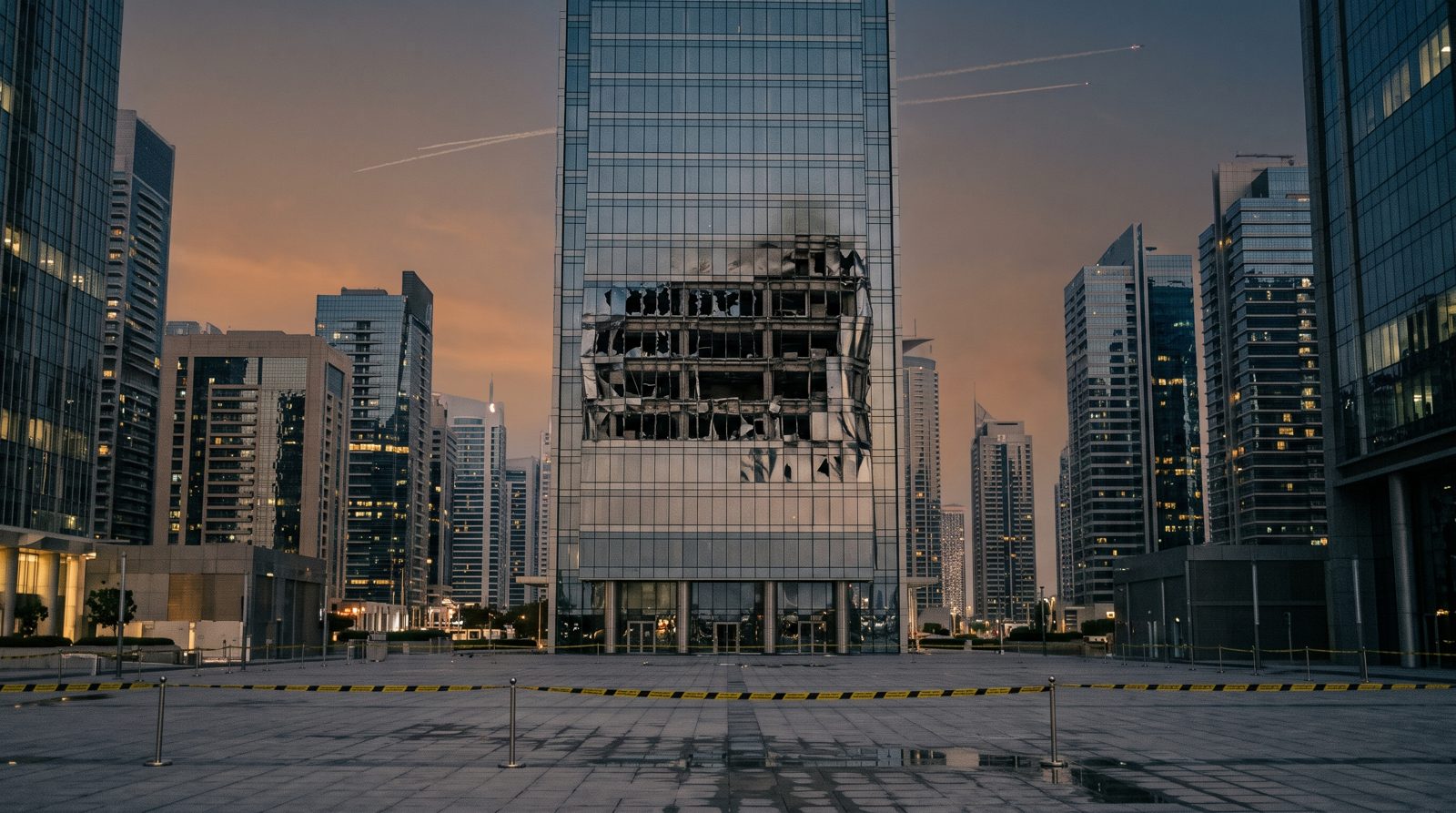
The tower had already been hit once that week. When the second strike came on Tuesday, people were hurt, and according to Agence France-Presse, no alert reached mobile phones in the Saudi capital beforehand. Instead, a vehicle with a loudspeaker drove through the King Abdullah Financial District warning pedestrians to take cover. Three witnesses told AFP that a drone had hit the Public Investment Fund Tower, the 385-metre glass spire that houses the kingdom's sovereign wealth fund and is the tallest building in Riyadh.
Saudi Civil Defence counted 11 wounded: two Saudi citizens, two Indians, three Nepalis and four Egyptians. The list is worth reading slowly, because it says something the statements around it do not. The people hurt in the attack on the symbol of Saudi Arabia's economic future were, in the main, the foreign workforce that the future depends on. India's foreign ministry condemned the strike the next day and said its embassy was assisting the two injured Indians and their families.
The coalition fighting the Houthis in Yemen called it a "cowardly terrorist attack," in the words of its spokesman, Major General Turki al-Maliki. Within a day, coalition aircraft had struck the Houthi-held port of Hodeidah. By Wednesday, the Houthis said they had fired at the Saudi ports of Jeddah and Jazan, and early on Thursday, November 26, the coalition said its air defences had destroyed two more ballistic missiles fired toward Riyadh.
Most coverage of this exchange reads it the way wars are usually read: as a contest of launches and interceptions, damage and retaliation. That frame is not wrong, but it rests on an assumption that almost nobody is questioning, namely that a missile shot down is a missile defeated. Over a desert air base, that is close to true. Over a district of glass towers that exists to persuade foreigners to move to Riyadh, it is not. What follows explains why the Saudi interception record, which is real, protects less than it appears to, what the Houthis are actually aiming at, and why the most important casualty list in this campaign may be a list of events that will now take place later, somewhere else, or not at all.
Seventeen days in the financial district
The sequence matters, so it is worth laying out plainly.
On Sunday, November 8, loud explosions were heard across Riyadh after Civil Defence issued an early warning. The Saudi-led coalition said its air defences had intercepted and destroyed two ballistic missiles fired toward the capital. Afterward, the Energy Ministry said on X that an "attempted attack" had left "falling shrapnel that caused minor damage" to an Aramco building, with no injuries. A Reuters witness, quoted by Middle East Eye, saw windows blown out across several floors of the Aramco Tower in the financial district, and UPI reported that CNN had verified video showing damage to several floors. The Houthis claimed the strike as one of six operations that day.
On Thursday, November 19, at about 4:45 in the morning, a pre-dawn mobile alert was followed by what one resident told The National was "the loudest explosion I have heard since arriving in Riyadh in September." Civil Defence said the attack had caused "material damage to several floors" of a tower and nearby buildings. According to Reuters, as published by NBC News, the blast blew out windows on seven to eight floors and bent parts of the metal facade, and three sources identified the building as the PIF Tower. The coalition said it had "dealt with a missile threat" and that debris had fallen, and The National reported that the coalition's initial assessment blamed falling debris for the damage. No injuries were reported. The financial district was closed to visitors. Houthi military spokesman Yahya Saree said the group had fired cruise missiles at the financial centre and at King Khalid International Airport and that they had "directly hit" their targets, calling the operation a response to Saudi attacks on civilian sites in Yemen.
The timing of that strike drew notice. The Jerusalem Post, carrying Reuters reporting, noted that the explosion came shortly after the Saudi Press Agency reported that Crown Prince Mohammed bin Salman had met Admiral Brad Cooper, the head of US Central Command, in Riyadh.
Then came Tuesday, November 24: the drone, the loudspeaker vehicle, the 11 wounded. The Houthis claimed an attack on the financial district "in three phases," and the following day claimed a strike on the Ras Tanura refinery on the Gulf coast as well. The coalition said its air defences destroyed four drones near Ras Tanura and that fragments fell after the interceptions, with no casualties in its initial assessment. It did not confirm that the refinery itself had been hit.
Three strikes on one business district in 17 days. In two of them, by Saudi officials' own account, the visible damage came from falling shrapnel or debris. The official language describes a defensive success. The photographs describe a damaged skyscraper. Both can be true at once, and that is the problem.
Why a successful interception can still break the windows
Begin with the literal mechanism. An interceptor missile does not make an incoming weapon vanish. It destroys or deflects it, usually by exploding close to it, and what remains of both the attacker and the interceptor keeps travelling: fuel tanks, motor casings, guidance sections, fragments of warhead. Gravity decides where it lands. Over open desert, that is a footnote. Over a cluster of high-rise towers, a falling motor casing or a cloud of metal fragments can shatter curtain-wall glass across several floors, start fires and injure anyone standing nearby.
Saudi Arabia has its own record of this. On October 21, the Energy Ministry said, in a statement reported by AFP and carried by The Times of Israel, that debris from the interception of a drone aimed at the Shaybah oil field near the UAE border had killed two people, a Filipino and a Nepali, and wounded two others. "The attempted attack resulted in the deaths of two individuals," the ministry said. The phrase "attempted attack" is accurate in the narrow sense that the drone did not reach its target. Two men are still dead.
The image worth holding onto for the rest of this piece is an invitation. Riyadh's economic strategy for the past decade has been, at its core, a series of invitations: to investors, to multinational companies, to conference delegates, to tourists, to football's biggest tournaments. An invitation is a promise about safety and normality, made in advance, to people who are free to decline. Air defence protects the building. It cannot fully protect the promise. A drone that is shot down directly above a financial district still tells everyone who received an invitation that the sky over that district is contested.
Ali Shihabi, a Saudi analyst, made the defensive case bluntly to Time magazine in October: "Expecting a country the size of Saudi Arabia to intercept every missile is simply unrealistic." He is right, and the point cuts deeper than he may have intended. Even a perfect interception rate would not solve the problem described here, because interceptions over a city are part of the problem.
The turn: the target is attendance, not architecture
If the aim were to destroy Saudi Arabia's economic capacity, the Houthis' choice of targets in Riyadh would be odd. Office towers are hard to bring down, expensive to strike and quick to reglaze. A sovereign wealth fund's investment decisions do not live on an upper floor of a tower; they live in contracts, bank accounts and the heads of people who can work from anywhere. Aramco's oil does not flow through its administrative building.
Read instead as an attack on attendance, the choice makes sense. The King Abdullah Financial District is where the invitations are issued. It is the address foreign executives are asked to move to, the backdrop for the conferences, the place a visiting banker is driven to from the airport. On November 20, the day after the first strike on the PIF Tower, Saree declared Riyadh's financial centre a "military target" and urged people working or living there to leave immediately, according to Middle East Eye and the Lebanese outlet This Is Beirut. That is not the language of a group trying to collapse a building. It is the language of a group trying to empty one.
Mahmoud Shehrah, a Yemeni analyst at Chatham House, described the Houthi aim to Time as an effort to "squeeze Saudi Arabia's arms to push them to a political settlement," with pressure on the economy, the airports and security. Squeezing, in that sense, does not require hits. It requires doubt.
And the doubt is visible in the record. After a strike on King Khalid International Airport on October 10 killed 13 people and wounded more than 300, according to figures reported by Reuters and Time, the chief executives of ExxonMobil, TotalEnergies, Shell, Chevron and BP were missing from the agenda that organisers of the World Petroleum Council's energy congress in Riyadh released on October 12, according to Reuters reporting carried by Daily Sabah. A BP spokesperson said the company had "made every effort to participate" but that "due to travel disruption we are unable to be there in person." The congress, originally planned for April and already delayed once by the Iran war, went ahead. Energy Minister Prince Abdulaziz bin Salman thanked those who came and added a line that deserves more attention than it got: "our gathering here does not mean the risk is gone."
A week later, the kingdom postponed the Future Investment Initiative, the annual conference nicknamed "Davos in the Desert," until 2027, as Reuters and Al Jazeera both reported in October. The FII is not just another event. It is the single most visible invitation Riyadh issues to global capital each year, and one closely associated with the PIF. The National later reported that the Asian Football Confederation had pushed the Asian Cup, which Saudi Arabia is hosting and which was due to begin in January 2027, back to December 2027.
The Houthis do not need to bring down a single tower. They need the people who were invited to wonder whether to come.
Who was in the building
There is a second layer to this, and it involves a policy choice Riyadh made long before the current war.
In 2021, the Saudi government announced that from January 2024 it would stop awarding government contracts to foreign companies that did not run their regional headquarters from inside the kingdom. The regional headquarters programme, run by the investment ministry with the Royal Commission for Riyadh City, has since licensed hundreds of firms, most of them based in Riyadh. Published tallies of the exact number vary widely, from roughly 540 to more than 700, and none should be treated as precise. The direction is not in dispute. The policy was designed to concentrate the region's corporate decision-makers in one city, and the financial district was built to receive many of them.
Concentration is efficient in peacetime. It is also, in a war with a group that has shown it can reach the capital repeatedly, a description of exposure. The same rule that brought regional staff to Riyadh now places them under the flight path. The 11 people wounded on November 24 were not, as far as any report shows, senior executives. But a multinational's security department does not need its chief executive to be hurt to change its travel policy. It needs a precedent.
One such signal was reported by The National after the November 19 strike: an expatriate who said he was leaving Riyadh by road to Doha and flying out from there, because he "didn't want to take the risk of flying out of Riyadh airport." One anecdote is not a trend, and nobody has published data on headquarters relocations. But the incentive structure has quietly reversed. The rule that made Riyadh compulsory for contracts did not anticipate a period in which the capital itself would be the risk a board had to weigh.
Reading a coalition statement: a pocket glossary
"Intercepted and destroyed." The incoming weapon was hit before it reached its target. It does not mean nothing landed. Fragments of the weapon and the interceptor fall somewhere, and over a city that somewhere has an address.
"Attempted attack." The Energy Ministry's phrase for both the November 8 Aramco building strike and the October 21 Shaybah incident, in which debris killed two men. It describes the attacker's failure to hit the intended point, not the outcome on the ground.
"Falling debris" or "falling shrapnel." The official explanation for the visible damage in two of the three financial district incidents. It is a factual description and also, usefully for the state, a framing that keeps the interception record intact.
"Material damage to several floors." Civil Defence wording for November 19. Reuters reporting put the visible damage at windows blown out on seven to eight floors.
"Directly hit." The standard Houthi claim, made by spokesman Yahya Saree after the November 19 strike. Houthi claims of accuracy are often broader than what can be independently confirmed and should be read as claims.
"Operational capabilities." The coalition's description of what it struck at Hodeidah port on November 25. It does not specify whether that means cranes, berths, storage, fuel or military sites.
The war that came back to Riyadh
None of this happened in a vacuum, and the speed with which it escalated explains why Riyadh's invitations are under such strain.
Saudi Arabia entered Yemen's war in 2015, leading a coalition to restore the internationally recognised government after the Houthis seized Sanaa. A UN-brokered truce in April 2022 brought the cross-border fire largely to a halt, and for several years the kingdom could present its capital as largely insulated from the fighting around it. The wider war began in February 2026, when the United States and Israel attacked Iran, a conflict this site has followed through the fight over who controls the Strait of Hormuz and Iran's claims about tankers striking its mines.
The Saudi-Houthi truce collapsed in July. Accounts of the trigger differ. The Houthis said Saudi Arabia struck Sanaa airport, targeting a Houthi delegation returning from Iran, and responded with ballistic missiles, according to Time; Middle East Eye described the kingdom as having resumed the fight after years of uneasy ceasefire. Either way, the Houthis then declared a blockade on Saudi ports and began firing at Aramco facilities, later turning to airports. Since then, according to Reuters reporting carried by NBC News, the Houthis have seized Yemen's Red Sea coast, including the Bab el-Mandeb Strait, and surrounded the city of Taiz. Government-aligned forces said on November 22 that they were withdrawing from an area overlooking the strait, The National reported, and a Yemeni army spokesman said Houthi forces had come within 60 kilometres of Aden, the government's temporary capital, a figure AFP also reported.
The human cost inside Yemen is severe and poorly counted. UN humanitarian chief Tom Fletcher, arriving in Aden on November 25, said 364,000 civilians had been displaced by the recent fighting. "Civilians are being killed. Hospitals and first responders are under attack," he said, according to The National. Houthi-run outlets have reported heavy casualties from coalition strikes, including 33 dead near Sanaa on November 7, according to the Sanaa-based health ministry, and as many as 25 killed in strikes on buses and trucks in Lahij governorate on November 24, according to the Houthi-run Saba agency. Neither figure has been independently verified, and both should be read as claims from one party to the war.
The economic logic of the current phase, as this site described in its analysis of the standoff over Hodeidah and Jeddah, is a symmetry of exposure: the Houthis depend on Hodeidah for imports, and Saudi Arabia depends on its Red Sea ports more than ever because Hormuz is constrained. Mohammad Al Basha, a geopolitical risk analyst, called it a "port war" in comments to The National, adding: "Both sides are doubling down." The financial district strikes extend that symmetry inland. The Houthis have little of their own to lose in a contest over who looks safe to invest in, and Saudi Arabia has a great deal.
An old weapon, a new kind of target
Houthi missiles over Riyadh are not new, and the history clarifies what is.
On March 26, 2018, the Houthis fired seven ballistic missiles at Saudi Arabia, three of them toward Riyadh. Saudi forces said all seven were destroyed. An Egyptian man was killed and two other people were wounded when a missile fragment fell on a Riyadh neighbourhood. Jeffrey Lewis, an arms control researcher at the James Martin Center for Nonproliferation Studies, argued at the time that video evidence suggested the Saudi Patriot defences had failed, including one interceptor that appeared to veer off course and explode over the city. The episode established a pattern that has never fully gone away: official claims of interception on one side, fragments in residential streets on the other.
In September 2019, drones and missiles struck the Abqaiq processing facility and the Khurais oil field, briefly knocking out roughly half of the kingdom's crude output. The Houthis claimed that attack too, though the United States blamed Iran. It was a far more destructive strike than anything in the financial district this month. And yet Saudi Arabia's investment story survived it, largely because the damage was to industrial plant in the Eastern Province, repaired within weeks, while Riyadh itself remained a place where the invitations still went out and people still came.
That is the difference in 2026. The targets have moved from the places where Saudi Arabia produces wealth to the places where it asks the world to share in it: the airport, the conference circuit, the sovereign fund's headquarters. Abqaiq was an attack on supply. The financial district strikes are an attack on confidence. The first could be fixed with engineers. The second depends on what thousands of foreign decision-makers believe about next month.
What the markets have and have not said
It is tempting to look for a dramatic market signal, and the honest answer is that the signals are real but modest, and should not be overstated.
Foreign investors were net sellers of about $1.9 billion of Saudi equities between September 1 and October 15, according to calculations by the Gulf business outlet AGBI based on exchange data, a retreat it linked mainly to heightened war risk. A Mashreq Capital analyst told AGBI that the selling looked largely like a rise in the risk premium for Saudi Arabia. In late October, AGBI also reported that the cost of insuring Saudi sovereign debt had reached a six-month high, with five-year credit default swaps at 71 basis points, up 15 points since the end of August.
Those numbers come with caveats. They are calculations by a single outlet for specific windows. Seventy-one basis points is still a low price for sovereign risk by global standards; it describes a creditworthy state with a new problem, not a state in crisis. And the selling of one period has to be weighed against the buying of others: by some analysts' counts, foreign investors were net buyers of Saudi stocks in the second quarter of 2026, even with the Iran war under way. Markets are measuring a premium, not a verdict.
What markets cannot easily measure is the thing most at stake: decisions not taken. A conference not attended, a regional office opened in Dubai or Doha rather than Riyadh, a site visit postponed until the spring. Those do not appear in a trading session. They show up, if at all, in annual figures a year from now. The data that would show whether the Houthi strategy is working will arrive too late to be useful to anyone deciding today.
What we know, and what we don't
We know that the King Abdullah Financial District was struck on November 8, 19 and 24, and that Saudi authorities and the coalition have blamed the Houthis, who claimed the attacks. We know the November 24 strike wounded 11 people of four nationalities, according to Civil Defence, and that the coalition and Energy Ministry attributed the visible damage on November 8 and November 19 to falling shrapnel or debris. We know the coalition struck Hodeidah port on November 25 and said it intercepted two ballistic missiles fired toward Riyadh early on November 26. We know the FII has been postponed to 2027 and that the Asian Cup has been pushed back to December 2027.
We don't know whether the November 24 drone was intercepted at all or struck the tower intact; officials have not said. We don't know whether the Houthis' claimed refinery strike at Ras Tanura caused the damage they described; the coalition has not confirmed it. We don't know how many multinational firms, if any, have quietly moved staff or postponed relocations to Riyadh, because no such figures have been published. And we don't know how much of the Houthi targeting reflects coordination with Iran, which supplies and trains the group, according to Chatham House research fellow Farea Al-Muslimi, but which LSE professor Fawaz Gerges described to Time as dealing with "one of the more independent regional allies of Iran in the Middle East."
We also don't know how long Riyadh intends to keep fighting. Reuters reported in November that Western officials briefed by the Saudis said the campaign could last up to six months, and that the kingdom wanted its Yemeni allies to gain ground before negotiating. Ahmed Nagi, senior Yemen analyst at the International Crisis Group, told The National that the Hodeidah strikes would not significantly hinder the Houthis militarily, since the port had been struck before by both the United States and Israel. If he is right, the war's most important battlefield may not be in Yemen at all.
Five signals that show whether Riyadh's invitation still holds
For a business deciding whether to send staff, for an investor weighing Saudi exposure, or for anyone trying to read this campaign without being captured by either side's claims, five indicators say more than the daily count of launches.
- Whether the alerts work. A capital that warns its residents reliably is a capital managing a known risk. AFP's report that no mobile alert preceded the November 24 strike, after alerts did precede earlier ones, is the kind of detail that shapes how foreign staff and their employers judge the city. Consistent alerting in the weeks ahead would be a quiet but meaningful sign of control.
- Where the interceptions happen. Interceptions far from the city are a defensive success in every sense. Interceptions over the financial district, followed by statements about falling debris, are a partial success that still serves the attacker. Official statements that locate interceptions more precisely, or a shift in where they occur, would say more than raw counts.
- The calendar. Riyadh's events schedule is now a real-time poll of international confidence. Which conferences keep their dates, which shrink, and which quietly move to other Gulf cities will be visible long before any investment data. The FII's 2027 date is the anchor to track.
- The port war's direction. The financial district strikes are linked to Hodeidah and the Red Sea ports. If Jeddah or Yanbu take serious damage, the conflict escalates into Saudi Arabia's escape route from Hormuz, and the stakes for the whole kingdom, not only its capital, rise sharply. A de-escalation at the ports would likely ease the pressure on Riyadh too.
- Whether anyone talks. Chatham House's Shehrah frames the Houthi campaign as pressure toward a political settlement. A credible negotiating channel, whether through Oman, the UN or the wider Iran talks, would matter more to Riyadh's invitations than any new air defence battery. So far, the Iran track and the Yemen track have run separately, a gap that the Gulf's new defence arrangements do little to close.
The wider ledger
The financial district strikes also belong to a larger accounting that the Gulf states are beginning to do. Damage from the Iran war and its proxy fronts is accumulating across the region, and with it the question of who pays, a problem this site explored in its look at the Iran war's unpaid bills. Physical damage can be priced and, in principle, claimed. A postponed conference or a regional office opened elsewhere cannot. There is no claims process for an invitation declined.
The same applies at sea. Shipping through the Red Sea now operates under conditions this site has described as open, but checking your papers, and the Houthis' hold on Bab el-Mandeb, whose earlier toll on trade this site measured in a six-month tally of Red Sea disruption, has strengthened since. The common thread across Hormuz, the Red Sea and now Riyadh is that each chokepoint is being contested less by closing it outright than by making passage through it uncertain. Uncertainty is cheap to produce and expensive to remove, and on that measure the Gulf is paying.
The invitation and the building
The instinct after a strike on a famous skyscraper is to look at the building: the blown-out windows, the bent facade, the engineers' assessment. Saudi Arabia will repair the PIF Tower quickly, as it repaired Abqaiq. On that front, the kingdom has the money, the materials and, in its air defences, a shield that by its own account stops most of what is fired at it.
But the more useful thing to watch is not the building. It is the invitation the building was designed to issue. For a decade, Riyadh has been asking the world to come: to invest, to relocate, to convene, to play. That request rests on a promise that the city is a safe and ordinary place to do business, and the Houthis have understood that the promise is more fragile than the glass. An interception can save a tower. It cannot make a security department forget a photograph, or persuade a conference organiser that the next date is certain.
The question that will decide whether this campaign succeeds is therefore not how many missiles Saudi Arabia shoots down. It is how many people who were invited decide, quietly and without announcement, to come anyway. That number will not appear in any coalition statement. It is still the one that matters most.
FAQ
What was hit in Riyadh on November 24, 2026?
A drone struck a tower in the King Abdullah Financial District that witnesses and a Civil Defence image identified as the Public Investment Fund Tower, headquarters of Saudi Arabia's sovereign wealth fund. Saudi Civil Defence said 11 people were wounded: two Saudis, two Indians, three Nepalis and four Egyptians. The Houthis claimed the attack.
How many times has Riyadh's financial district been attacked?
Three times in 17 days in November 2026: the Aramco building on November 8, the PIF Tower on November 19, and the PIF Tower again on November 24. Saudi officials attributed the damage in the first two incidents to falling shrapnel or debris.
Why are the Houthis attacking Saudi Arabia again?
A 2022 truce between Saudi Arabia and the Houthis collapsed in July 2026, during the wider war that began when the United States and Israel attacked Iran in February. The Houthis declared a blockade of Saudi ports and have struck airports, oil sites and now the capital's financial district, while the Saudi-led coalition has struck Houthi-held areas, including Hodeidah port.
Has the fighting affected events in Saudi Arabia?
Yes. The Future Investment Initiative conference was postponed to 2027, the chief executives of five oil majors were absent from an energy congress in Riyadh in October after a deadly airport strike, and the Asian Football Confederation pushed the Asian Cup back to December 2027, according to reporting by Reuters, Al Jazeera and The National.