Iran Says Tankers Hit Its Mines. The Word Is a Claim of Jurisdiction, Not a Weapons Report
TL;DR
- On November 23 and 24, Iranian naval forces, led by the Revolutionary Guard navy, said several oil tankers had struck naval mines in the Strait of Hormuz, some of them, it said, while under US escort and air cover. No ship was named and no maritime authority has confirmed a mine.
- The Western-run Joint Maritime Information Center logged the tankers hit near Khasab on November 21 as struck by "unknown projectiles." In an earlier case, ABC News reported drone wreckage on a tanker that Iran also said had hit a mine.
- The debate over mine versus missile misses what the word is for. Iran's statements read like violation notices from its new strait authority, which keeps a blacklist of ships. On the same Monday, the US Treasury published a blacklist of its own. Shipowners are now being ticketed from both sides.
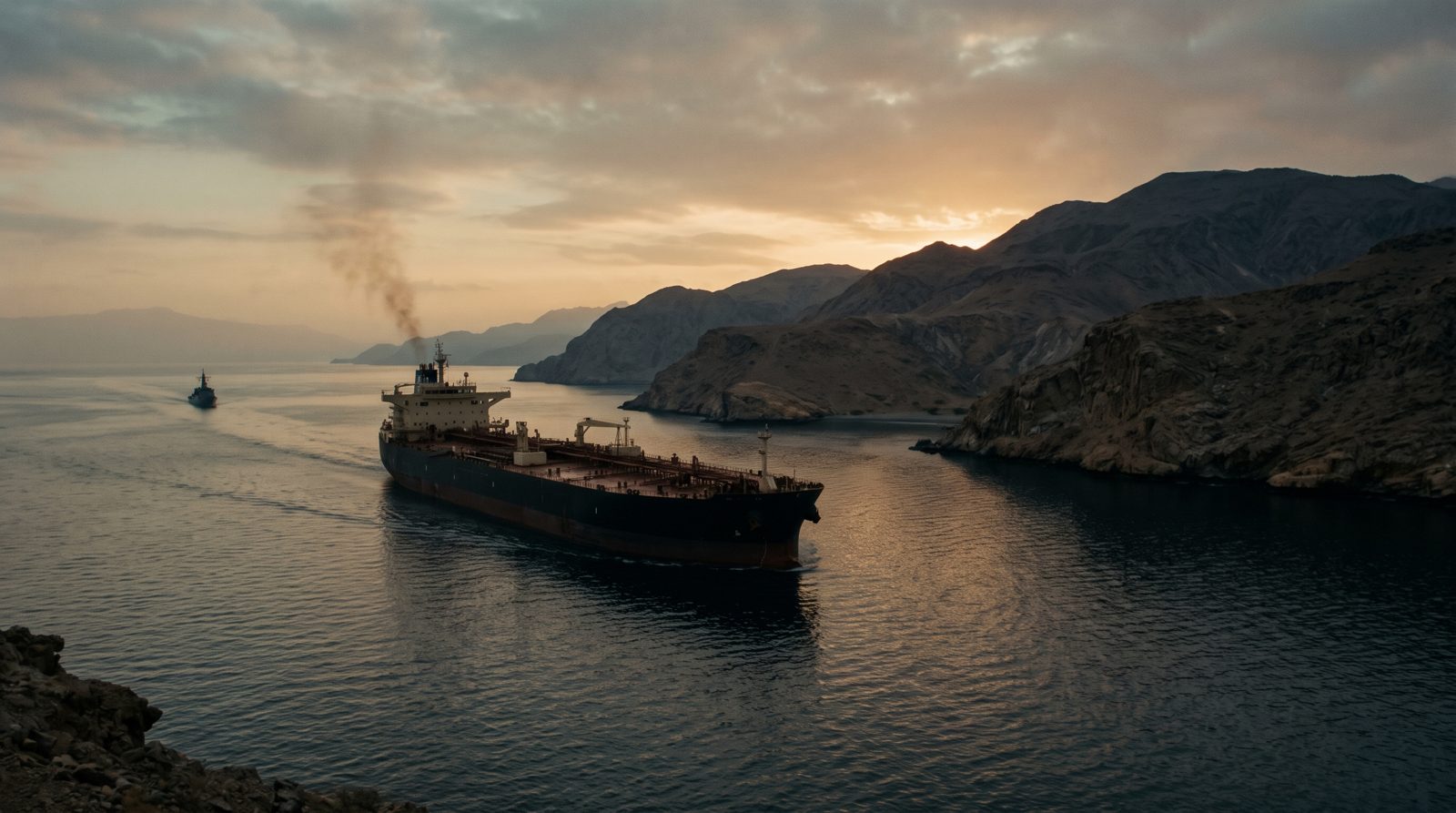
At about 05:00 UTC on Saturday, November 21, the Hong Kong-flagged crude tanker Torkel was heading out of the Gulf when something struck its stern roughly 11 nautical miles north of Khasab, the Omani town that sits on the tip of the Musandam peninsula. A fire broke out. The crew was evacuated, and the ship was later reported at anchor. Less than an hour later, a second outbound tanker, the Arina, was hit in its engine room about 17 nautical miles east of Khasab. Nobody was reported hurt on either ship, according to the trade publication Riviera and Gulf News, both drawing on the Joint Maritime Information Center, the US-led coalition's shipping advisory cell.
In its log, the center described both weapons the same way: unknown projectiles. It counted seven tankers struck in the strait between November 16 and 21, kept its threat rating at "severe," and warned that more attacks on tankers using the Omani side of the waterway were highly likely.
Two days later, Tehran told a different story about the same week. On Monday, November 23, the Islamic Revolutionary Guard Corps navy said, through the state news agency IRNA, that three "offending" oil tankers had suffered explosions and fires after striking naval mines. On Tuesday, Iran's navy said two more tankers had caught fire after hitting mines east of the strait. Iran did not name any of the ships, did not report casualties and did not say how much damage was done. Gulf News, The Jerusalem Post and the trade site Marine Insight all noted that the claims had not been independently verified.
Most coverage has framed this as a factual dispute: was it a mine or a missile? That question matters, and the evidence so far leans one way. But it is the less interesting one. The more revealing question is why Iran keeps reaching for the word "mine" at all, and what that word does that "we fired at a tanker" does not. Read closely, Iran's statements are not weapons reports. They are violation notices. They name an offence, cite the rule that was broken and point to the authority that wrote the rule. And on the same Monday that the first notice went out, Washington issued a list of its own. This piece follows both, and asks what it means for a strait to be policed by two rival rulebooks at once.
What Iran actually said, line by line
Start with the wording, because the wording is the story. According to The Jerusalem Post's account of the IRGC statement carried by IRNA, the Guard said the tankers had been under American escort and protection, and that this support "failed to prevent the incidents from occurring." It then addressed shipowners, masters and shipping companies directly. US military cover, it said, "will not serve as a substitute for complying with maritime regulations and the directives of the" IRGC navy's Traffic Control Center.
The statement went further. "The Strait of Hormuz is not a place for testing unauthorized routes and ignoring maritime warnings," it said, adding that passage through unauthorized routes, or disregard of warnings, "will be considered a violation" and treated as "collaboration with aggressor forces." CNBC, reporting the same statement, noted that Iran has repeatedly said only the northern shipping lane, the one closer to its own coast, is approved for safe passage, and that it has attacked or threatened ships taking alternative routes near Oman.
A day earlier, according to Marine Insight and Riviera, Iranian forces had said two supertankers "blew up and came to a stop" after hitting mines in a restricted zone east of the strait, and that both had switched off their identification and navigation systems and ignored instructions from Iranian naval units. On Tuesday the navy, as quoted by CBS News, added that the waterway "will never be reopened until Iran's objectives and demands are met." The same day, Maj. Gen. Amir Hatami, the army commander, said the strait "must become increasingly closed day by day" until Iran's conditions are met, a line reported by CBS and by the Tehran Times.
Lay those statements side by side and a pattern appears. Each one names a ship's behaviour (switched off its transponder, used an unauthorized route, ignored a warning), names the authority whose instruction was ignored, and then reports a consequence. The consequence is always phrased as something that happened to the ship, not something Iran did to it. The ship "struck" a mine. It "blew up and came to a stop." The cause, in this grammar, is the route the master chose.
Iran is not describing an attack. It is issuing a ticket, and in its account the ticket wrote itself.
Why call it a mine
The literal mechanism of a naval mine is simple. It is a charge left in the water that fires when a ship passes close enough or touches it. Unlike a missile or a drone, it has no launch, no flight path and no moment of decision that a radar can record. Once it is laid, whoever laid it is, in a narrow sense, no longer in the loop. The ship's own course completes the circuit.
That is why the word is so useful to a state that wants to run a strait rather than merely close it. Think of it as the difference between a police officer who pulls a driver over and a speed camera that mails a fine. The officer has to stop someone, on camera, and own the decision. The speed camera sits there, and the driver's own speed does the rest. A mine is a speed camera that explodes. Calling a strike a mine casts Iran as the operator of a hazard that only punishes people who break its rules, which is precisely the role its new strait authority claims to play.
The comparison has a limit worth stating plainly. A speed camera is posted, mapped and the same for everyone. A field of unmarked mines that Iran says exists in lanes it has not charted publicly is closer to an unpublished rule enforced by explosion. Mariners cannot comply with a hazard they cannot see, and that gap is exactly where the legal argument against Iran's position sits, as later sections explain.
Here is where the story turns. If the strikes near Khasab were projectiles, as the Joint Maritime Information Center logged them, then Iran's "mine" language is not a description at all. It is an argument. And it is an argument aimed at two audiences who are not on the ships.
The first audience is the US Navy's own record. In late August, President Donald Trump wrote on Truth Social that he had been informed "that all mines have been removed and/or detonated from within the International Waters of the Strait of Hormuz." Axios, citing US officials, reported that underwater drones had spent months scanning the waterway and found more than 100 objects suspected of being mines, which were then disposed of. Central Command later said the mines Iran had laid in the strait were cleared. An Iranian claim that tankers keep hitting mines, especially tankers under American escort, is a direct challenge to that record. It says, in effect, that the lane Washington certified as clean is not clean.
The second audience is the people who price the voyage. An escort can do a great deal against a drone, a missile or a fast boat. It can do very little against a mine already sitting in the water, because the threat has no launch for a warship to intercept. A tanker owner weighing whether to join an American-protected transit is buying, in effect, an insurance product with a warship attached. Every unverifiable mine claim is a small advertisement against that product. It does not need to be proven. It only needs to be impossible to disprove quickly.
There is a precedent for this pattern in the current war. In October, two crew members of the Panama-flagged supertanker Gem No. 2 told ABC News that drones hit their ship on October 9 and again on October 10, while it sat idle off the United Arab Emirates, and that the second attack started a fire that forced them to evacuate. The IRGC said the tanker had struck a mine while trying to pass through the strait on an unauthorized route. ABC reported that satellite images placed the ship well outside the strait, and that Fabian Hinz, a researcher who studies drone warfare, identified wreckage photographed by the crew as debris from an Iranian-made drone. On that ship, at least, the available evidence points to drones, and the mine looks like a label applied after the fact.
A missile is evidence of who fired it. A mine claim is evidence of who wants to be seen as the referee.
The blacklist behind the burning ships
The referee has a name. Iran set up the Persian Gulf Strait Authority this year to license and regulate transits through Hormuz, and it has steadily built a list of ships it says have broken its rules. In August it published a list of 45 tankers it accused of violating its crossing rules, warning that they could face fines, detention or confiscation, according to Reuters, as carried by Al-Monitor, and the maritime trade outlet Seatrade.
On October 27, the authority went further. It said on X that all vessels belonging to the South Korean shipping company Sinokor would face "legal action" from November 1, because Sinokor ships had recorded the most crossing violations over the previous three months, and that "appropriate actions" had already been taken against at least seven of them. The report, from Reuters via Al-Monitor, was also covered by Bloomberg, Seatrade and the Korea JoongAng Daily. The next day, the Korea Shipowners' Association pushed back: the vessels in question, it said, were not owned by Sinokor but sub-chartered to an overseas oil company, and carried no South Korean crew.
In early November the authority's non-compliance list roughly doubled. Seatrade reported that more than a hundred vessels were added on November 2 and that Sinokor's entire fleet would be treated like listed ships; Riviera put the list at about 240 vessels and reported that ships cooperating with listed vessels, including through ship-to-ship transfers, could be listed too. These counts come from trade publications reading an Iranian document, and the totals they report do not fully agree, so they are best read as an order of magnitude rather than a precise figure.
Now place the attacks against that list. Riviera, citing the maritime security firm Ambrey, reported that three Liberia-flagged supertankers commercially managed by Sinokor were hit at about 20:25 UTC on November 23, roughly 20 nautical miles northeast of Lima, on the Omani side, and continued their voyages with all crew accounted for. UK Maritime Trade Operations, as reported by The Times of Israel, said projectiles struck three vessels that Monday, with all crew accounted for. Riviera also reported that all three Sinokor ships, as well as the Torkel, appear on the Persian Gulf Strait Authority's list. That last link rests on one trade publication's reading of the list and has not been confirmed elsewhere, so it should be treated as a strong lead rather than an established fact.
Even with that caution, the shape is hard to miss. Iran announced a target list. It named a company. It set a date. The ships that were hit in the following weeks were, according to the best available reporting, the kind of ships the list described: outbound tankers on the Omani side, using routes Iran calls unauthorized, operated by firms it had singled out. Hamidreza Azizi of the International Crisis Group told ABC News that "Tehran now seems determined to make these arrangements more costly and less reliable." Sina Toossi of the Center for International Policy told the same outlet that Tehran "has escalated its attacks to make the STS system more dangerous, costly, and ultimately unviable," referring to the ship-to-ship transfers that let smaller tankers move cargo with their trackers switched off.
This is the part of the story that the mine-versus-missile argument keeps stepping around. The question is not only what hit the Torkel. It is whether a government has started enforcing an administrative blacklist with explosives, and dressing the enforcement in the language of navigation hazards. We wrote earlier this month that reopening Hormuz is really a fight over who runs it. The blacklist is what running it looks like in practice.
Reading a Hormuz incident report: a pocket glossary
UKMTO. UK Maritime Trade Operations, a Royal Navy-linked reporting centre. Masters report incidents to it; it publishes short warnings with a position and a description. It rarely names ships or attackers.
JMIC. The Joint Maritime Information Center, the US-led coalition's advisory cell. Its updates set the threat level (currently "severe") and log weapons by what can be verified, which is why "unknown projectile" appears so often.
Persian Gulf Strait Authority. The Iranian body that issues transit permits and keeps a non-compliance list. Its list is an Iranian designation, not an international sanctions list.
Traffic Separation Scheme. The internationally charted pair of inbound and outbound lanes through the strait. This is the corridor the US Navy says it cleared of mines in August.
AIS. The Automatic Identification System, the transponder that broadcasts a ship's identity and position. Ships switch it off to avoid being tracked, which also means they vanish from public traffic counts.
STS transfer. Ship-to-ship transfer of cargo at sea, used to move oil past a blockade or a blacklist in smaller hulls.
War risk premium. An extra insurance charge for sailing through a listed danger area, quoted as a percentage of the ship's hull value per voyage. It is where all of the above eventually turns into money.
Washington's list, the same Monday
On November 23, the same day as the IRGC's three-tanker mine statement, the US Treasury announced sanctions it described as part of "a sweeping effort to disrupt Iran's global shadow banking networks." The release designates 30 targets by our count, 22 companies and 8 individuals, across Iran, the United Arab Emirates, Türkiye and Hong Kong; CBS News, counting differently, described "two dozen names." The targets include two Iranian exchange houses, Mellat Exchange Company and Mina Fashki and Partners Exchange Company, a string of front companies registered mostly in the UAE, and the Iran Center for Exchange of Currency and Gold, which Treasury says matches exporters that earn foreign currency with importers that need it.
Treasury Secretary Scott Bessent framed the action in blunt terms. "Iran's economy is underwater, and its leaders are panicking," he said in the release, calling the shadow banking system "the last financial lifeline of a bankrupt regime." The action falls under what Treasury calls Operation Economic Outcast, which Bessent announced on August 24 and labelled "Economic D-Day."
The market's verdict on that claim was visible within a day. CBS News reported that the dollar traded at around 2.82 million rials on Tehran's unofficial market on Tuesday afternoon, up about 5 percent from roughly 2.68 million the day before. Iran's foreign minister, Abbas Araghchi, called a land blockade of Iran "impossible" and said the best response to the pressure was to make "those imposing sanctions lose hope of achieving their goals," according to CBS.
A third front opened the same week. The Wall Street Journal reported on Monday, as relayed by both CNBC and CBS News, that US authorities are investigating Iran as the primary suspect behind cyberattacks on dozens of tankers, with as many as 50 ships carrying oil, gas, chemicals and other hazardous cargo possibly targeted, some receiving bomb threats and occasional ransom demands. Russia is also being examined as a possible culprit, the Journal reported.
Put the two lists next to each other and the position of a shipowner becomes clearer. Treasury's list says that a company handling Iranian money or cargo risks being cut off from the dollar system. Iran's list says that a ship moving Gulf oil along routes Iran has not approved, or helping a listed ship through a transfer, risks fines, detention, confiscation or, in practice, a fire in the engine room. A company like Sinokor, which carries Gulf crude for Gulf producers, sits squarely in the second category. Others, moving Iranian barrels through Dubai fronts, sit in the first. A growing number of operators will find that some part of their business touches both.
The two lists are not morally or legally equivalent. One is a sanctions program run through banks and courts. The other, as far as the available evidence shows, is being enforced at sea with weapons against civilian ships. But they work on the same pressure point, which is the willingness of private companies to keep moving cargo through the region. That willingness is now what both sides are trying to price, and it explains why the IRGC addressed its mine statement not to Washington but to vessel owners, ship commanders and shipping companies.
The strait now has two blacklists, and the ships in the middle are being asked which one they fear more.
1987: the last time escorts met mines
None of this is new to the Gulf. On July 24, 1987, during the Iran-Iraq war, the reflagged Kuwaiti supertanker Bridgeton struck a mine on the very first convoy of Operation Earnest Will, the US Navy's escort mission for Kuwaiti tankers. The episode became famous for an awkward detail: the escorting warships, less able to survive a mine than the giant tanker, fell in behind it. The tanker, hull damaged but afloat, was effectively leading the convoy through the danger.
Less than a year later, on April 14, 1988, the frigate USS Samuel B. Roberts struck a mine in the central Gulf and nearly sank. The United States answered four days later with Operation Praying Mantis, a day of strikes on Iranian oil platforms and naval units that remains one of the largest surface actions the US Navy has fought since the Second World War. In between, US forces had caught an Iranian vessel, the Iran Ajr, laying mines at night in September 1987, which settled any argument over who was responsible.
The history carries two lessons for this week, and they point in different directions. The first is that escorts and mines have always been a bad match, and Iran knows it: the cheapest way to embarrass a convoy system is to make the water itself look dangerous. The second is that in 1987 and 1988 the mines were real, were found and were attributed, and that attribution changed the war. A mine claim with no mine, no ship name and no wreckage cannot do that. It can raise the cost of a transit. It cannot, on its own, give Washington the kind of evidence that would justify a response like Praying Mantis, which may be part of its appeal to Tehran at a moment when, as Iran International reported, President Trump is weighing whether to postpone renewed strikes, and the question of who decides on an Israeli strike is unsettled in Jerusalem.
Three scoreboards, three different games
If the strait is being fought over with words, the numbers deserve the same scrutiny, because each side has its own scoreboard and they do not measure the same thing.
Washington's scoreboard counts barrels. Central Command spokesman Tim Hawkins said more than 108 million barrels of crude moved through the strait with "U.S. protection" in the previous week, "the largest weekly volume to date," according to CBS News; a separate report by the Azerbaijani agency APA, citing Al Hadath, gave the same weekly figure from an unnamed US official. Divided by seven, that is roughly 15 million barrels a day. Before the war, about 20 million barrels of oil a day moved through Hormuz, a figure the US Energy Information Administration has used for years. On Tuesday, Trump went further than his own command and said, according to CBS, "We're taking more oil through the Hormuz Strait right now than we did before the war started." The protected volume alone does not show that. It may be that unescorted and untracked cargoes make up the difference, but no published figure yet demonstrates it.
Iran's scoreboard counts fires. Its statements over three days described at least five tankers, and perhaps seven, hitting mines, though the number shifts from statement to statement and some reporting cited a running tally of four. None of the ships was named, which means none of the claims can be matched cleanly against the incidents that independent monitors logged.
The independent scoreboards count attacks, and they disagree with each other in instructive ways. A CNN analysis of UKMTO data found more than 30 reported attacks in October, the first month above that level since the war began in late February, and at least 22 in November as of Sunday, November 22. ABC News, also using UKMTO data, counted 31 in October and about 19 in November as of November 18, and noted that the International Maritime Organization had confirmed 34 attacks in and around the strait across October and November. UKMTO itself has said its figures probably undercount incidents, because many ships sail with trackers off and some attacked vessels never report.
Traffic counts are even slipperier. Gulf News, summarizing the Joint Maritime Information Center's latest update, reported traffic through Hormuz about 65 percent below prewar levels, about 28 US-facilitated transits a day and 227 ships waiting at anchorages east of the strait. CBS also reported Central Command figures showing more than 8,000 commercial vessels crossing since the April ceasefire, about half under American protection, and quoted a US official saying over 95 percent passed without incident. Public trackers built on AIS data, meanwhile, can show almost no transits on a given day, because the ships that do cross are often the ones with their transponders off. All of these can be true at once. They are counting different ships.
The market, for now, is reading Washington's scoreboard. Brent crude fell to about $89 a barrel on Tuesday, near a three-month low, according to CNBC and Gulf News, and West Texas Intermediate traded around $80, down from an October high of nearly $105. Gregory Brew of Eurasia Group told CNBC that regional supply had recovered but warned that "intensifying Iranian attacks in the Strait of Hormuz could reverse that trend." Insurance is reading the other scoreboard. Trade press reporting of Lloyd's List data in early November put war risk cover for Gulf transits at several percent of a ship's hull value per voyage, against a small fraction of one percent before the war. Those figures are drawn from secondary summaries and vary between brokers, but the direction is not in dispute. Every attack, and every claim of a mine, feeds that number. Our earlier look at what the Hormuz markets knew found the same split between traders who price flows and those who price risk.
Washington measures the oil that gets through. Iran measures the fear that stops the rest. Each is winning on its own scoreboard.
The law the word is reaching for
There is one more reason the word "mine" matters, and it is legal. The main treaty on the subject, the 1907 Hague Convention VIII on automatic submarine contact mines, does not ban mines. It regulates them. Among other things, it requires that every possible precaution be taken for the security of peaceful shipping, and that the danger zones be notified to shipowners once military needs permit. A state that announces it has laid mines in specified areas, warns ships to avoid them and then reports that offenders struck them is, at least rhetorically, describing itself as a belligerent following those rules.
The weakness in that posture is obvious. Iran has not published charts of the mined areas, has not named the ships it says were hit and, in the cases that monitors could check, the evidence pointed to projectiles or drones. A notice that says "unauthorized routes are dangerous" without saying where the danger is does not look like the notification the convention describes.
The deeper dispute is over the strait itself. Under the UN Convention on the Law of the Sea, ships enjoy a right of transit passage through international straits, and states bordering a strait may not hamper or suspend it. Iran signed the convention in 1982 but has never ratified it, and on signing it declared that rights such as transit passage belong only to states that are party to the treaty. The United States has not ratified the convention either, though it treats transit passage as customary law. That long-standing gap is the legal space Iran's strait authority is built in. A permit system, a blacklist and a vocabulary of "authorized" and "unauthorized" routes all rest on the claim that Hormuz is Iranian water to regulate, rather than an international corridor to cross.
Seen that way, the mine statements are a small, consistent piece of a larger project. They are not designed to win the argument over the Torkel. They are designed to make shipowners act as though Iran's rules already apply. Every master who chooses the northern lane, applies for a permit or turns back is a data point in Iran's favour, whatever any monitoring centre later concludes about what hit the ship ahead.
The wider picture: one war, several chokepoints
Hormuz is not the only waterway where this is happening. In the Red Sea, the Houthis have spent the autumn threatening Saudi ports, and on November 20 the Saudi-led coalition struck the port of Hodeidah after a Houthi attack on Riyadh; we described that as a standoff over ports rather than open water. Saudi Arabia's main way around Hormuz, the East-West pipeline to Yanbu, has itself become a front line. And the southern Red Sea route has developed its own logic of permits and exclusions, which our Red Sea shipping intelligence report summed up as a strait that is open but checks your papers.
The common thread is that the actors who cannot defeat a navy are learning to regulate around it. A blockade or a convoy is a military instrument. A permit, a list and a claim about hazards in the water are administrative ones, and they are much harder for a carrier group to argue with. That is also why the verification problem keeps growing. The International Atomic Energy Agency cannot currently account for Iran's enriched uranium, as we reported in our analysis of the IAEA's blind spot, and in Hormuz no neutral party can yet confirm whether a single Iranian mine has hit a single ship this month. In both cases, Iran benefits from the uncertainty more than from any particular fact.
What we know, and what we don't
We know that tankers were hit near Khasab on November 21 and that the coalition's monitoring cell logged the weapons as unknown projectiles. We know that maritime security reporting, from the firm Ambrey as cited by Riviera and from UKMTO as cited by The Times of Israel, described projectile strikes on three vessels on November 23, with crews accounted for. We know Iran's forces said, on November 22, 23 and 24, that tankers hit mines, and that Iran named none of them. We know Iran's strait authority has published a growing non-compliance list and singled out Sinokor's fleet, and that the US Treasury sanctioned roughly 30 Iranian-linked targets on November 23.
We do not know whether any mine has struck any ship in the strait this month. Absence of confirmation is not proof of absence: mines can be laid in small numbers, and a ship that hits one may not report it. We do not know for certain who fired the projectiles that monitors logged, although analysts quoted by ABC, CNN and the trade press point to Iran and Iran's own statements claim the incidents as consequences of its rules. The link between the November 23 targets and Iran's blacklist rests on one trade publication's reporting. And the traffic figures from Central Command, the coalition and public trackers cannot be reconciled from the outside, because each counts a different set of ships.
How to read the next Hormuz headline
The next incident is likely to arrive within days, if the coalition's own warning is right. These six checks separate what happened from what is being claimed about it.
- Look for a ship's name. An incident with a named vessel, a flag and a position can be checked against tracking data, owners and insurers. A claim with none of those is a statement of intent, not a report.
- Check how the monitoring cells logged the weapon. UKMTO and the Joint Maritime Information Center describe weapons by what can be verified. "Unknown projectile" is a cautious phrase; it is not the same as "mine," and the two should not be merged in a headline.
- Ask which list the ship is on. Whether a vessel appears on the Persian Gulf Strait Authority's non-compliance list, or is linked to a company on Treasury's sanctions list, says more about why it was targeted than the weapon does.
- Separate protected volume from total volume. Central Command's barrel counts cover cargo moved with US protection. They are a measure of the convoy system's reach, not a measure of the whole strait.
- Watch insurance, not only crude prices. A falling Brent price can sit alongside rising war risk premiums. The second number is the one that decides whether a marginal shipowner sails.
- Treat both sides' superlatives with care. "Largest weekly volume to date" and "will never be reopened" are both claims made by parties to a war. Each may be accurate on its own terms and still describe only the half of the strait its author wants seen.
The ticket and the toll
The easy reading of this week is that Hormuz is getting more dangerous, and it is: by the independent counts, October was the worst month for attacks on shipping since the war began, and November is on course to rival it. But danger alone does not explain the way Iran is talking about it. A state that only wanted to close the strait would not need to explain which ships were punished or why. It would simply close it.
Iran is doing something more patient. It is writing tickets. Each mine statement names an offence, a rule and an authority, and each one asks shipowners, insurers and charterers to behave as though that authority is real. Washington, through Treasury, is writing tickets of its own, and through Central Command it is publishing the barrels that get through regardless. The strait is not simply open or closed. It is being administered, by two rival offices, and the ships in between are paying both.
That is why the most useful question about the next "mine" is not what exploded. It is whose rulebook the ship was following when it did, and how many other masters, reading the same statement, quietly changed course the next morning. In a contest of tickets, the decisive number is not the fires. It is the ships that never sail, and no scoreboard counts those. More of our coverage of Iran's strategy is collected on the Iran page.
FAQ
Did tankers really hit mines in the Strait of Hormuz this week?
Iranian naval forces said several tankers hit mines on November 22, 23 and 24, but named none of them. No maritime authority has confirmed a mine strike. The Joint Maritime Information Center logged the tankers hit near Khasab on November 21 as struck by unknown projectiles, and UKMTO described the November 23 incidents as projectile strikes.
What is the Persian Gulf Strait Authority?
It is an Iranian body that issues transit permits for the Strait of Hormuz and keeps a non-compliance list of ships it says broke its rules. It warned in October that all Sinokor vessels would face legal action from November 1, and its list roughly doubled in early November. The list is an Iranian designation, not an international sanctions list.
What did the US Treasury sanction on November 23?
Treasury designated about 30 companies and individuals in Iran, the UAE, Türkiye and Hong Kong that it says form part of Iran's shadow banking system, including two exchange houses and the Iran Center for Exchange of Currency and Gold. It is part of Operation Economic Outcast, announced on August 24.
Is oil still moving through Hormuz?
Yes, but far below prewar levels by most independent counts. Central Command says more than 108 million barrels of crude moved with US protection in one week, while the coalition's advisory cell, as summarized by Gulf News, put traffic about 65 percent below prewar levels. The figures count different ships and cannot be directly compared.